
India and Jordan Forge New Economic Partnership: A Strategic Alliance Rooted in History
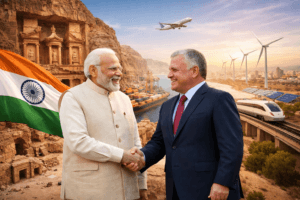
India and Jordan Forge New Economic Partnership: A Strategic Alliance Rooted in History
Introduction: A Meeting of Historic Trust and Future Opportunity
At the India-Jordan Business Forum in Amman, a significant blueprint for a strategic economic partnership was unveiled. Prime Minister Narendra Modi and His Majesty King Abdullah II jointly articulated a vision that transcends traditional trade. They framed the relationship not merely as one of shared markets, but as a unique convergence of deep-seated historic trust and vast future economic opportunities. This high-level engagement, marking the first full-fledged bilateral visit by an Indian Prime Minister in 37 years and coinciding with the 75th anniversary of diplomatic ties, signals a deliberate and ambitious shift in how both nations view their collaborative potential.
The Prime Minister captured the essence of the moment with a powerful call to action, urging the business communities of both countries to “invest together, innovate together, and grow together”. This article explores the multifaceted strategy laid out in Amman—a strategy that combines India’s scale and technological prowess with Jordan’s strategic geography to create a new engine for regional growth and a resilient link in the global supply chain.
Part 1: The Economic Vision: From Doubling Trade to a Global Supply Chain Hub
The centerpiece of the new economic agenda is a bold, quantifiable goal: doubling bilateral trade from the current figure to $5 billion within the next five years. This target is rooted in a solid existing foundation, as India is already Jordan’s third-largest trading partner, with bilateral trade valued at approximately $2.88 billion in 2023-24.
The partnership is envisioned as highly complementary. King Abdullah II emphasized that the combination of Jordan’s extensive network of Free Trade Agreements and India’s formidable economic power could forge a vital economic corridor connecting South Asia, West Asia, and beyond. Specifically, the King highlighted how Jordan’s strategic position can serve as a gateway for Indian companies to access markets in the United States, Canada, and other regions—an opportunity PM Modi explicitly urged Indian businesses to seize.
A key strategic element discussed was the integration of Jordan’s transport and logistics network with the India-Middle East-Europe Economic Corridor (IMEC). Both leaders identified this as a significant opportunity to enhance logistical cooperation, transforming Jordan into a pivotal logistics and manufacturing hub that connects continents.
Table: The Foundation for a $5 Billion Trade Partnership
| Current Pillars (2023-24) | Indian Exports to Jordan | Indian Imports from Jordan | Future Collaborative Sectors |
| Key Sectors | Electrical machinery, cereals, chemicals, automotive parts | Fertilizers, phosphates | Digital tech, pharma, green energy, infrastructure |
| Trade Value | ~$1.47 billion | ~$1.41 billion | Target: $5 billion total trade by 2030 |
| Strategic Goal | – | – | Develop Jordan as a reliable supply chain hub for West Asia and Africa |
Part 2: Sectoral Synergies: A Blueprint for Joint Growth
The forum moved beyond aspirations to identify specific, high-potential sectors for collaboration, each presenting a blend of “vision, viability, and velocity”.
- Digital Public Infrastructure and IT: PM Modi positioned India’s digital transformation as a model for inclusion and efficiency, offering its globally benchmarked frameworks—such as UPI for payments, Aadhaar for identity, and DigiLocker for document storage—for alignment with Jordan’s systems. The leaders discussed creating a shared digital ecosystem to directly connect startups in fintech, health-tech, and agri-tech, linking ideas with capital and innovation with scale.
- Pharmaceuticals and Healthcare: Recognizing healthcare as a strategic priority, the leaders outlined a powerful synergy. By establishing Indian manufacturing of medicines and medical devices in Jordan, the partnership would serve Jordan’s population and position the country as a “reliable hub” for the wider West Asia and Africa regions. India’s trusted supply of generics, vaccines, and Ayurvedic products combined with Jordan’s geographic reach creates a formidable alliance in a critical sector.
- Agriculture and Food Security: India’s extensive experience in dryland farming and water management was highlighted as directly applicable to Jordan’s needs. Collaboration was proposed in precision farming, micro-irrigation, and the development of integrated cold chains, food parks, and storage facilities. This cooperation builds on existing joint ventures in fertilizers and aims directly at advancing regional food security.
- Infrastructure and Green Growth: With King Abdullah sharing his vision for developing railways and next-generation infrastructure in Jordan, PM Modi assured that Indian companies are “both capable of, and eager to” partner in these projects. This extends to potential collaboration on reconstruction needs in neighboring Syria. In the realm of green growth, both nations committed to unlocking Jordan’s immense potential in solar, wind, and green hydrogen, with India offering its experience as a major investor in renewable energy.
Part 3: Reconnecting Civilizational Ties for a Modern Partnership
A distinctive feature of this dialogue was the consistent reference to shared history as a foundation for future prosperity. PM Modi evoked the ancient trade routes where goods from Gujarat reached European markets through the Nabatean city of Petra, stressing that “to ensure our future prosperity, we must revive those links once again”.
This historical consciousness was woven into contemporary cultural and people-to-people initiatives. Both leaders identified significant scope for heritage and cultural tourism, encouraging investors to explore this domain. Specific proposals included encouraging Indian film productions to shoot in Jordan, organizing joint film festivals, and fostering a large Jordanian delegation at the upcoming WAVES Summit in India.
Concrete steps were taken to institutionalize this cultural bridge, including the signing of a Cultural Exchange Programme for 2025-2029 and a twinning agreement between the City of Petra and India’s Ellora Caves site, focusing on archaeological development and social ties.
Conclusion: A Strategic Alliance for a New Global Economy
The India-Jordan Business Forum culminated in a clear and compelling narrative: “Geography is Jordan’s strength. India possesses both skill and scale. When these strengths come together, they will create new opportunities for the youth of both countries”.
This partnership, therefore, is more than a bilateral trade enhancement. It is a strategic alignment designed to address broader global needs. In a world seeking new engines of growth and trusted, resilient supply chains, the combined force of India’s innovation-driven, scalable economy and Jordan’s role as a stabilizing bridge and logistical nexus offers a compelling solution.
The vision of both governments has been clearly articulated. As PM Modi stated, the task now falls to the business communities of both nations to “translate this vision into reality through your imagination, innovation, and entrepreneurship”. By reviving ancient links and harnessing modern capabilities, India and Jordan are poised to build a partnership that promises mutual prosperity and contributes to regional stability and global economic resilience.
You must be logged in to post a comment.