
India and Ethiopia Forge Strategic Ties: Ancient Bonds Fuel a Modern Partnership
In his landmark address to Ethiopia’s Parliament on December 17, 2025, Indian Prime Minister Narendra Modi elevated the bilateral relationship to a Strategic Partnership, framing it as a union of two ancient civilizations with a shared modern destiny.
The speech masterfully wove deep historical ties—from Indian soldiers fighting for Ethiopia’s 1941 liberation to generations of Indian teachers and Ethiopian students—into a blueprint for future collaboration across digital infrastructure, defense, agriculture, and healthcare. Central to the vision is a joint leadership role in the Global South, advocating for a more equitable world order and aligning on climate justice and sustainable development.
By invoking shared philosophies like trusteeship for the planet and comparing the growing friendship to the connective rituals of Ethiopian coffee and Indian tea, Modi outlined a partnership based on mutual respect and civilizational kinship, positioning India and Ethiopia as collaborative architects of a new multipolar future.
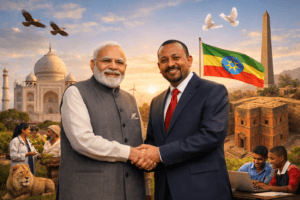
India and Ethiopia Forge Strategic Ties: Ancient Bonds Fuel a Modern Partnership
The decision by Indian Prime Minister Narendra Modi to make Ethiopia the destination of his first bilateral visit in his current term is a powerful statement of intent. His address to a joint session of the Ethiopian Parliament on December 17, 2025, was far more than a diplomatic courtesy; it was a strategic articulation of a partnership between two ancient civilizations poised to shape the future of the Global South. By elevating bilateral relations to a Strategic Partnership, India and Ethiopia have signaled a move from historical goodwill to a framework for concerted action on shared global ambitions.
More Than Diplomacy: A Speech Anchored in Shared Civilizational Roots
Prime Minister Modi’s speech masterfully wove a narrative of deep historical and cultural kinship, creating an emotional and philosophical foundation for the strategic agreements announced. He drew striking parallels: both nations refer to their lands as “mother” in their national anthems; both are homes to Asiatic and African lions; and both have histories of monumental rock-cut architecture. These were not superficial comparisons but deliberate reminders of a shared civilizational ethos.
This narrative extended to modern history, highlighting pivotal moments of solidarity. He recalled the Indian soldiers who fought for Ethiopia’s liberation in 1941 and paid respects at the Adwa Victory Monument, a symbol of anti-colonial resistance that resonates across the Global South. Furthermore, he fondly remembered the thousands of Indian teachers who shaped generations of Ethiopian students and the Ethiopian alumni of Indian universities who now lead their country, including the current Speaker of Parliament. These human connections have created a lasting “living bridge” between the two peoples.
Pillars of the New Strategic Partnership
The elevation to a Strategic Partnership translates this historical camaraderie into a concrete, multi-sectoral blueprint for cooperation. The joint vision, as detailed in Modi’s speech and the accompanying official briefings, is comprehensive and forward-looking.
Table 1: Key Pillars of the India-Ethiopia Strategic Partnership
| Cooperation Area | Key Initiatives & Goals |
| Digital & Technology | Collaboration on Ethiopia’s Digital 2025 Strategy; India to develop a Data Centre for the Ethiopian Foreign Ministry; AI training courses under the ITEC program. |
| Economic & Trade | Building on over $5 billion in Indian investments (textiles, pharma, manufacturing); enhancing trade; supporting Ethiopia’s WTO accession and New Development Bank membership. |
| Defence & Security | Implementing the Defence Cooperation Agreement (cybersecurity, joint research); solidarity against terrorism; capacity building for peacekeeping. |
| Agriculture & Food Security | Sharing expertise in climate-resilient farming, irrigation, soil health, and millet research to ensure food security for both nations. |
| Healthcare | Expanding cooperation from pharmaceuticals and vaccine supply (like the 4 million COVID-19 doses provided) to hospital management, telemedicine, and equipment provisioning. |
| Education & Capacity Building | Doubling ICCR scholarships for Ethiopian students; the “Africa Skills Multiplier Initiative” to train one million trainers; continued people-to-people exchanges. |
A prime example of this new-phase cooperation is India’s offer to partner in augmenting the capacity of the Mahatma Gandhi Hospital in Ethiopia, specifically in maternal health and trauma care—a blend of symbolic naming and tangible development aid.
A Unified Voice for the Global South
Beyond bilateral benefits, the partnership is framed as a joint project for South-South solidarity. Modi positioned India and Ethiopia as natural leaders in advocating for a more equitable global order. He pointedly stated, “The world cannot move forward if its systems remain locked in the past,” a clear call for reforms in institutions reflecting a 1945 worldview.
Ethiopia’s capital, Addis Ababa, is the headquarters of the African Union, which India championed as a permanent G20 member. Ethiopia’s recent inclusion in BRICS adds another strategic dimension. Modi’s visit reinforces India’s commitment to being a steadfast partner in Africa’s rise, a policy evidenced by over 100 high-level exchanges in the past 11 years. The partnership is envisioned not as an axis against any other power, but as a collective effort for inclusive development, accessible technology, and respected sovereignty.
A Distinctive Diplomatic Model: Trusteeship and Green Growth
The speech also highlighted a shared philosophy that distinguishes this partnership from purely transactional models. Modi invoked Mahatma Gandhi’s principle of “trusteeship”—the idea that we are caretakers of the planet for future generations. He directly linked this to India’s “A Tree for Mother” initiative and Ethiopia’s massive Green Legacy Initiative, framing environmental stewardship as a common moral duty.
This extends to offering support for Ethiopia’s leadership on climate justice at forums like COP32 in 2027. It signals an intent to collaborate on renewable energy, biofuels, and disaster-resilient infrastructure, aligning economic growth with ecological responsibility.
The Road Ahead: Brewing a Stronger Future
In a memorable metaphor, Modi compared the growing friendship to the slow, meaningful process of an Ethiopian coffee ceremony and the connective power of Indian tea. It perfectly captured the essence of this renewed partnership: patient, people-centric, and designed to foster deep bonds.
The path forward is now charted. With a Strategic Partnership framework, bolstered by specific agreements on digital infrastructure, defense, health, and skills development, the historical “spider webs” of connection have indeed united to tie a lion—symbolizing the collective strength of two resilient nations. As both countries confidently walk from ancient wisdom into a modern, multipolar world, their partnership offers a compelling model of cooperation based on mutual respect, shared civilizational values, and a common vision for their people and the Global South.
You must be logged in to post a comment.