
In the Shadow of Iran’s Missiles, Israel’s Southern Frontier Confronts a Crisis of Neglect
In the wake of heavy Iranian missile strikes on Israel’s southern Negev region, residents and critics accuse the government of a “complete failure” to protect civilians, pointing to years of neglect that have left over three million Israelis—disproportionately Palestinian citizens—without adequate shelters or safe rooms. A recent State Comptroller report revealed that only 0.5 percent of public shelters are located in Palestinian communities, underscoring deep structural inequities. Prime Minister Benjamin Netanyahu’s visit to the impact zone drew further backlash after he arrived with a portable safe room that was removed upon his departure, epitomizing what critics call a disconnect between political priorities and the safety of ordinary citizens. As the war with Iran escalates, observers warn that the state’s failure to secure the home front before entering a wider conflict has left southern towns dangerously exposed, relying more on luck than on policy.
In the Shadow of Iran’s Missiles, Israel’s Southern Frontier Confronts a Crisis of Neglect
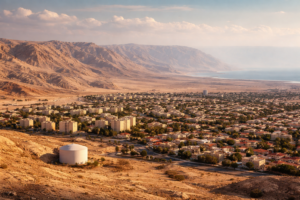
In the arid expanse of Israel’s Negev Desert, where the ochre mountains meet the haze of the Dead Sea basin, a different kind of storm has been falling from the sky. For the residents of towns like Dimona and Arad, the distant thunder of geopolitical escalation is no longer abstract. On a recent Saturday, it arrived in the form of Iranian missile fire—not as a one-off shock, but as the latest and most violent chapter in a confrontation that has exposed a brutal truth: for many Israelis living on the periphery, the state’s much-touted security apparatus stops at the outskirts of Tel Aviv.
In the aftermath of the strikes, which injured nearly 150 people across the two cities, a bitter refrain is echoing through the Negev. It is a criticism not of the military’s ability to strike back, but of the government’s failure to shield its own citizens. As the war with Iran intensifies, shifting from shadow warfare to direct exchanges of fire, the debate in Israel is no longer just about deterrence—it is about the moral and logistical failure to protect the people who live on the front lines.
A Scramble for Safety
When the sirens screamed across Dimona—a city indelibly linked to Israel’s nuclear program—residents did what they have done for months. They ran. But for many, the nearest reinforced shelter was either too far, locked, or non-existent.
Avi Dabush, the executive director of Rabbis for Human Rights, did not mince words in the days following the attack. Describing the government’s handling of the civilian front as “a complete failure,” Dabush pointed to a paradox that defines the current moment: a nation that spends hundreds of billions of shekels on advanced defense systems and preemptive military action has left its own citizens vulnerable to shrapnel and blast waves.
“The state spends hundreds of billions on various things, but not on protection,” Dabush said, articulating a frustration that is rapidly moving from local grievance to national reckoning. He emphasized that this was not a spontaneous lapse but the culmination of “years of policy neglect.”
The statistics support his claim. According to a recent State Comptroller report—a document that typically gathers dust in government archives until crisis brings it roaring back to relevance—more than a third of Israel’s population lacks access to standard-approved shelters or safe rooms. That translates to roughly 3.2 million civilians who have no proper protected space to run to when the ballistic missiles are in the air.
In the Negev, this isn’t just a number on a page. It is the reality of families huddling in stairwells, hoping the concrete is thick enough, or crowding into public bomb shelters built decades ago for a different kind of war. For the nearly half a million students attending schools without adequate protection, the start of the school day carries a weight that children in the country’s center do not have to bear.
The Inequality of Protection
Yet, perhaps the most damning figure to emerge from the comptroller’s report is one that speaks to a structural inequity that Israel has long struggled to confront. Of the public shelters scattered across the country, a minuscule 0.5 percent are located in Palestinian communities inside Israel. For a population of over two million Palestinian citizens, this amounts to roughly 30 shelters.
In the context of a war with Iran, where missiles do not distinguish between Jewish and Arab neighborhoods, this disparity reveals a chilling hierarchy of life. While wealthy municipalities in central Israel have retrofitted apartment buildings with “safe rooms” (known locally as mamadim), the Arab towns and unrecognized Bedouin villages in the Negev remain almost entirely bereft of state-funded protection.
This is not a new revelation. State Comptroller Matanyahu Englman noted that his office had raised alarms following the 12-day war with Iran in June 2025. Yet, nearly a year later, those warnings have translated into little actionable change. Englman’s words on Sunday carried the weight of an indictment: “The state cannot abandon the periphery to market forces. Without a structured, properly budgeted national plan, southern cities will remain exposed.”
For critics like Dabush, this neglect is not merely bureaucratic inefficiency; it is a philosophical failing. “There is a disregard for human life, and the sanctity of life is being crushed,” he said, framing the lack of shelters not as a logistical oversight but as a reflection of which citizens the state deems worthy of investment.
The Politics of the Portable Shelter
As the debris from the Iranian missiles was still being cleared, Prime Minister Benjamin Netanyahu traveled to Arad. Standing at an impact site, he framed the attack within the context of a global struggle, arguing that Iran’s missiles represent a threat to the entire world. “Fortunately, no one was killed, but that is due to luck, not their intent,” he said.
But the Prime Minister’s visit, intended to project leadership and solidarity, quickly became a symbol of the very disconnect residents were protesting. Israeli media revealed that Netanyahu arrived accompanied by a portable, movable safe room—a prefabricated reinforced structure that was set up for his brief stay and then removed shortly after he departed.
For the residents of Arad, who face the prospect of the next barrage without such amenities, the optics were devastating. One local resident told Ynet news: “Why couldn’t they just leave it?”
The episode crystallized the sentiment that the political echelon operates under a different set of safety protocols than the public it governs. Dabush described the incident as “yet another stark and embarrassing example of political interests being placed above everything else.” He added, “He dropped everything to come for a few hours to Arad and Dimona. As a resident of the Negev, this embarrasses me.”
War Without a Home Front
The deeper question emerging from the rubble is one of strategic responsibility. Israel has long prided itself on the concept of the “home front” as a critical component of its national resilience. The Home Front Command is designed to ensure that civilians can withstand prolonged attacks. But the current situation suggests that the nation went to war with an infrastructure that was already cracked.
Dabush put it bluntly: “Those who decided to go to war did not seriously consider civilian protection before making that decision.”
This is a damning accusation. In the calculus of war, governments typically weigh the readiness of the military against the resilience of the civilian population. In the Negev today, the evidence suggests that the latter was never truly ready. The decision to escalate against Iran—whether viewed as a strategic necessity or a reckless gamble—was made without ensuring that every citizen, regardless of whether they live in a high-profile city like Dimona or a marginalized Bedouin village, had a reinforced room to shelter in.
The result is a war that feels, to those in the south, like a betrayal. They are asked to bear the brunt of the retaliation while lacking the basic infrastructure to survive it. The missile strikes injured over a hundred people in Arad alone. By the government’s own admission, it was luck, not policy, that kept the death toll at zero.
A Crisis of Credibility
As Israel finds itself locked in an escalating cycle of strikes and counter-strikes with Iran, the crisis in the Negev represents a vulnerability that no Iron Dome or Arrow missile defense system can solve. Air defense can intercept projectiles, but it cannot protect a family if their apartment building lacks a safe room. Diplomacy can de-escalate tensions, but it cannot retroactively justify sending a population into harm’s way without adequate shelter.
The State Comptroller’s report—calling for a structured, budgeted national plan—now sits as a test of the government’s priorities. Will the billions allocated to wartime spending be matched with the billions needed to retrofit schools, build shelters in Arab communities, and fortify the southern periphery? Or will the periphery be left, once again, to depend on luck?
For the residents of Dimona and Arad, the answer cannot come fast enough. The war with Iran is no longer a distant threat; it is a weekly, if not daily, reality. The sound of the siren has become a test of the social contract. When it wails, the state is supposed to provide a safe place to go. In the Negev today, too many people are finding that such a place does not exist.
As Dabush concluded, the issue transcends politics. It touches on something more fundamental: “The sanctity of life is being crushed.” In a country that has long defined itself by its commitment to protecting Jewish lives, the current reality on the southern frontier suggests that for a significant portion of its citizens—both Jewish and Palestinian—that commitment has been hollowed out by neglect, inequity, and a wartime strategy that forgot to secure the home front before it set the region ablaze.
You must be logged in to post a comment.