
In Bethlehem, a Christmas Tree Lights Up: A Delicate Balance of Hope and Grief
In a subdued ceremony marked more by solemn prayer than festive cheer, Bethlehem lit its first public Christmas tree since 2022, creating a poignant symbol of resilience amid ongoing tragedy. The decision to hold the muted event, which notably excluded fireworks, came during a fragile ceasefire in Gaza and reflected the city’s deep anguish over the war, with Mayor Maher Canawati stating the celebration had “no meaning unless it first touches the hearts of the afflicted” in Gaza.
For the predominantly Muslim city, the lighting served as an act of Palestinian national unity and a desperate economic lifeline for its tourism-dependent community, which has been brought to its knees by a 90% drop in visitors and soaring unemployment. While the glowing tree offered a fragile glimmer of hope and a declaration that “we are here to stay,” it ultimately underscored the precarious reality of life under occupation and the profound uncertainty facing Palestinians, balancing a conscious reclaiming of joy against the overwhelming weight of shared grief and an unstable future.
In Bethlehem, a Christmas Tree Lights Up: A Delicate Balance of Hope and Grief
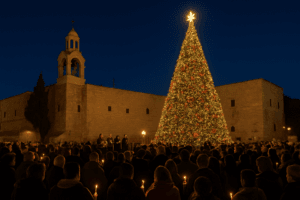
After two years of silence imposed by war, the glow of a Christmas tree has returned to Manger Square in Bethlehem. On December 6, 2025, thousands gathered not for a raucous festival, but for a subdued ceremony of hymns and prayers. For a city that lives and breathes its status as the birthplace of Jesus, this was more than a tradition revived; it was a fragile, conscious act of defiance—an attempt to reclaim joy while carrying the profound weight of grief for Gaza, just 60 kilometers away.
A Celebration Muted by War
The decision to light the tree was not made lightly. For the past two years, public Christmas celebrations in Bethlehem were unanimously canceled in solidarity with the devastating war in Gaza. The conflict, which began after the October 7, 2023, attacks, has resulted in a reported death toll of over 70,000 Palestinians in Gaza.
This year, with a precarious ceasefire in place, city leaders faced a difficult choice. “Some may say it’s not appropriate and others say it’s appropriate,” admitted Bethlehem Mayor Maher Canawati. He ultimately viewed the lighting as essential: “Christmas should never be stopped or cancelled. This is the light of hope for us”. The message was carefully woven into the ceremony itself, which began with a minute of silence for Palestinian martyrs.
The contrast with pre-war celebrations was stark. Typically filled with festive dances and songs, this year’s two-hour event was solemn, featuring only hymns and prayers for peace. Notably, the traditional fireworks display was omitted, a quiet acknowledgment of the ongoing suffering. As one attendee, Randa Bsoul, expressed: “It’s scary because no-one knows what will happen in the future. But we are hopeful”.
An Economy Brought to Its Knees
The lighting of the tree is a desperate lifeline for a city on the economic brink. Bethlehem’s identity and survival are inextricably linked to tourism and religious pilgrimage. Approximately 80% of the city’s residents depend on this sector.
The war shattered this lifeline. The statistics paint a dire picture of the economic collapse:
| Economic Indicator | Pre-War Level | Current Level | Impact |
| Tourism Revenue | Normal operations | 90% drop in visitors | Loss of ~$1.5 million per day |
| City Unemployment | ~14% | 65% (34% across West Bank) | Massive loss of livelihood |
| Hotel Occupancy | High during Christmas season | Near-zero for 2 years; now rebounding to ~70% for holidays | Many businesses permanently closed |
| Population Change | Stable | ~4,000 residents left seeking work | “Members of the family have moved to other countries just to keep living” |
Walking through Bethlehem reveals the human cost behind these numbers. Generational businesses are shuttered. Hotel owners like Fares Banak describe a struggle for survival, comparing their idled city to a car abandoned for years: “it will not work again”. At the decades-old Afteem restaurant, owner Alaa Salameh notes that recently, many local families could not even afford their traditional, low-cost falafel.
The crisis extends beyond Bethlehem. The Palestinian Authority, which governs parts of the West Bank, has been able to pay public servants only partial salaries. This is due to Israel withholding $1.76 billion in tax revenues, a measure Israel says is in response to Palestinian welfare payments to prisoners.
A Symbol for “One Nation”: Unity in a Muslim-Majority City
Perhaps one of the most powerful aspects of Bethlehem’s Christmas is that it is celebrated with pride by a predominantly Muslim community. Only about 20% of Palestinians are Christian, but as the whyChristmas guide notes, “many Muslim Palestinians are also proud that Jesus was born in a Palestinian Territory”.
This year’s celebration was explicitly framed as an act of national unity. In his speech, Ramzi Khoury, Chairman of Christian Affairs, stated that lighting the tree was “a declaration of the unity of our people,” where “the voices of churches blend with those of mosques”.
For residents like 29-year-old Issa Montas, a Muslim who traveled six hours from Ramallah to attend, the celebration transcended religion: “This is not just for us. It’s for everyone. Christian, Jewish, Muslims”. This sentiment highlights how Christmas in Bethlehem has evolved into a cornerstone of shared Palestinian cultural and national identity.
Between Checkpoints and Hope: Daily Life in the West Bank
The tentative joy in Manger Square exists within the harsh reality of life under occupation, which has intensified since the war began. For Palestinians in the West Bank, movement is severely restricted by Israeli military checkpoints, roadblocks, and a separation barrier.
Issa Montas’s six-hour journey to travel less than 20 miles is not unusual. These restrictions have decimated the economy, as tens of thousands of Palestinian laborers have been blocked from entering Israel for work. Furthermore, violence has surged. The United Nations reports that attacks by Israeli settlers on Palestinians have reached their highest level since record-keeping began in 2006.
This context makes the Christmas tree a potent symbol of steadfastness. As Mayor Canawati proclaimed, “We are here to stay, to preserve this land… Palestine is the land of messages and our deep roots in history”. The celebration is a declaration of presence and resilience against what many perceive as efforts to fragment and displace their communities.
A Cautious Path Forward
The future for Bethlehem remains uncertain. The ceasefire in Gaza is fragile, with both sides repeatedly accusing the other of violations. The city’s economic recovery hinges on this fragile peace holding and on tourists feeling safe to return.
There are faint, early signs of recovery. Mayor Canawati noted that November 2025 saw the highest number of tourist visits since the war began, and Christmas hotel bookings are strong. A handful of foreign pilgrims have returned, like Angelica from Russia, who appreciated the rare chance to visit holy sites without long lines.
Local businesses are cautiously reopening. John Juka, whose family restaurant was shuttered for two years, decided to reopen in August as ceasefire talks gained momentum. “Tourists finally feel safe to come back,” he said. “We’re hopeful that we might see peace in our future”.
Ultimately, the Christmas tree in Manger Square is a beacon with a dual purpose. For the outside world, it signals that Bethlehem is “open and ready to receive them”, a plea to revive its strangled economy. For Palestinians, it is an internal act of psychological endurance. It represents a conscious choice to nurture hope and seek normalcy amidst ongoing trauma—to, as the mayor said, “reignite the spirit of Christmas and to reignite hope”.
In a land where the story of Christmas originated as a narrative of hope born in humble circumstances, the people of Bethlehem are writing a modern chapter. They are striving to find light, not by ignoring the overwhelming darkness, but by defiantly kindling a small flame within it. The true message of this year’s celebration may be that even a subdued, somber hope is still hope—and in Bethlehem, that is a powerful act of faith.
You must be logged in to post a comment.