
IIT Delhi Clinches Top Spot in QS 2026: India’s Academic Ascent Reaches a Historic Inflection Point
In the QS World University Rankings 2026, India has achieved a historic milestone, emerging as the fourth most represented nation globally with a record 54 featured institutions, led by IIT Delhi at 123rd place and closely followed by IIT Bombay (129th) and IIT Madras (180th).
This collective ascent signals a critical inflection point for India’s higher education landscape, reflecting strategic investments in research, faculty, and global academic reputation that have propelled a cohort of universities into the top tiers. However, while this marks a significant shift from brain drain to a growing intellectual powerhouse and demonstrates the democratization of excellence beyond a few elite centers, challenges remain in internationalization, deepening research quality, and ensuring this top-tier success translates into broader educational reforms across the nation.
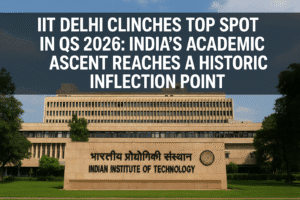
IIT Delhi Clinches Top Spot in QS 2026: India’s Academic Ascent Reaches a Historic Inflection Point
The recently released QS World University Rankings 2026 has delivered a powerful statement: India is no longer just a participant in the global higher education arena; it is a rapidly ascending powerhouse. With a record 54 institutions featured, India now stands as the fourth most represented country in the world, trailing only educational behemoths like the United States, United Kingdom, and China. Leading this charge is the Indian Institute of Technology Delhi (IIT-D), securing the 123rd rank globally and firmly planting the Indian flag in the upper echelons of world academia.
But to reduce this news to a simple list of rankings would be to miss the forest for the trees. This performance is not an isolated event; it is the culmination of a deliberate, multi-faceted transformation. It signals a critical inflection point for a nation long plagued by “brain drain,” now steadily building an ecosystem capable of cultivating and retaining world-class intellectual capital.
The Vanguard of an Academic Revolution: A Closer Look at the Top Performers
The leaderboard of Indian institutions in the QS 2026 tells a compelling story of concentrated excellence and fierce internal competition.
- IIT Delhi (123rd): Topping the list, IIT Delhi’s rise is built on a formidable reputation, particularly with global employers. Its graduates are consistently snapped up by leading multinational corporations and pioneering startups alike, a testament to its rigorous curriculum and focus on real-world problem-solving.
- IIT Bombay (129th): A perennial leader, IIT Bombay remains a titan of research and innovation. Its deep ties with industry and a prolific alumni network that includes leaders in global tech and entrepreneurship continue to bolster its international standing.
- IIT Madras (180th) & IIT Kharagpur (215th): These institutes exemplify the strength in depth of the IIT system. IIT Madras has become a hub for deep-tech research and incubation, while IIT Kharagpur, the oldest of the IITs, leverages its vast alumni network and multidisciplinary approach.
- The Pursuit of Pure Science: IISc Bangalore (219th): It’s crucial to note the presence of the Indian Institute of Science. While the IITs dominate the engineering and technology sphere, IISc’s high ranking underscores India’s parallel strength in fundamental scientific research. With one of the highest citations-per-faculty ratios in the world, IISc is a research powerhouse whose contributions to global science are immense, even if its more specialized focus places it differently in comprehensive rankings.
This clustering of institutions in the top 250 is unprecedented. A decade ago, seeing even one Indian institution break into the top 200 was cause for celebration. Today, we have a cohort, a “pack” that is pushing each other to greater heights.
Beyond the Elite: The Deeper Story of 54 Institutions
The headline “54 Indian Institutions Ranked” is perhaps the most significant part of this story. This represents a 30% increase from just a few years ago. Who are these other institutions, and why does their inclusion matter?
This expansion signifies a democratization of excellence. It’s no longer just the hallowed halls of the IITs and IISc. We are now seeing:
- National Institutes of Technology (NITs)
- State Universities
- Private Institutions like the University of Delhi (in the top 350)
This breadth indicates that quality education is spreading beyond a few centralized hubs. It suggests that regional universities are investing in faculty, infrastructure, and research, creating more access to high-quality education for students across the country. This is vital for a nation of India’s size and diversity, as it helps stem regional imbalances and fosters innovation ecosystems outside of the major metropolitan areas.
The “How” Behind the Ascent: Decoding India’s Ranking Strategy
The dramatic improvement in QS rankings is not accidental. It is the result of a strategic focus on the metrics that QS values most. The QS methodology heavily weights:
- Academic Reputation (40%): Indian institutions have become more proactive in international collaborations, hosting global conferences, and publishing in high-impact journals. This increases their visibility and prestige among academics worldwide who participate in QS surveys.
- Employer Reputation (10%): The “IIT brand” has long been gold-standard among employers. This is now being amplified by the success of graduates from other top institutions in the global job market, particularly in the tech sector.
- Faculty/Student Ratio (20%): While still a challenge, focused government initiatives like the Institutions of Eminence (IoE) scheme have provided top universities with greater autonomy and funding to hire more faculty, directly improving this metric.
- Citations per Faculty (20%): There has been a concerted push towards boosting research output. Institutes are incentivizing publications, investing in state-of-the-art labs, and forging international research partnerships, leading to a significant rise in the quantity and quality of cited research.
- International Faculty & Students (5% each): This remains an area for growth. However, institutions are actively creating more international student exchange programs and recruiting foreign faculty to create a more cosmopolitan campus culture.
The Road Ahead: Celebrations, Yes, But Also Sober Reflection
While the QS 2026 rankings are a cause for national pride, they are a milestone, not the final destination. The journey towards establishing India as a global education leader is far from over. Several challenges persist:
- The Internationalization Gap: Compared to top universities in the UK, Singapore, or Australia, Indian campuses still have a very low percentage of international students and faculty. Creating a truly global campus environment is the next frontier.
- Balancing Quantity with Quality: As new institutions aim for rankings, the focus must remain on deep, meaningful learning and groundbreaking research, not just on “gaming” the ranking metrics.
- Grassroots Education: The excellence of the top 54 must not overshadow the need for systemic reform in primary, secondary, and undergraduate education across the country. A strong pyramid needs a broad and solid base.
- From Employability to Entrepreneurship: Indian institutes are excellent at creating highly employable graduates. The next step is to amplify their role as incubators of world-changing ideas and pioneering startups that solve global challenges.
Conclusion: A New Chapter in India’s Knowledge Economy
The QS World University Rankings 2026 is more than a list; it is a resounding validation of India’s growing intellectual capital. IIT Delhi leading a pack of 54 institutions marks a historic shift from a narrative of potential to one of tangible, measurable achievement.
This success story is a powerful catalyst. For prospective students, it offers more world-class options at home. For global academia and industry, it positions India as an indispensable partner for collaboration and innovation. The “brain drain” is slowly but surely being complemented by a “brain gain” and, more importantly, a “brain circulation.”
The ascent is real, the momentum is building, and the message is clear: the Indian university system has arrived on the global stage, and it is here to stay. The foundation has been laid for India to not just be a supplier of talent to the world, but to become a primary source of the ideas that will shape its future.
You must be logged in to post a comment.