
Identity Under Siege: Why India’s Transgender Rights Amendment Has Sparked Nationwide Fury
Identity Under Siege: Why India’s Transgender Rights Amendment Has Sparked Nationwide Fury
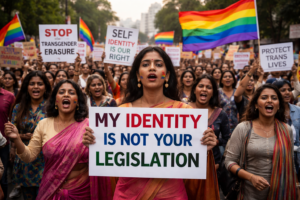
In the sweltering heat of Hyderabad on a March evening, Meera stands at the edge of a growing crowd, her painted fingernails gripping a placard that reads, “My Identity Is Not Your Legislation.” Around her, hundreds of voices rise in a chorus of chants, some singing traditional hijra folk songs turned protest anthems, others shouting slogans that echo off the government buildings lining the street. For Meera, a 34-year-old transgender woman who spent years navigating the bureaucratic maze to obtain legal recognition of her identity, the past week has felt like watching hard-won ground crumble beneath her feet.
“I didn’t choose to be who I am,” she says, her voice steady despite the exhaustion visible in her eyes. “But for the first time in my life, I felt like my country had chosen to see me. Now they’re taking that away.”
India’s parliament has done what critics are calling an unprecedented rollback of transgender rights, passing an amendment to the Transgender Persons (Protection of Rights) Act of 2019 that fundamentally alters how transgender individuals are legally recognized. The bill, which cleared both houses this week and now awaits the president’s signature, has ignited a firestorm of protest from LGBTQ activists, opposition politicians, and even a Supreme Court-appointed advisory panel that has urged the government to withdraw what it calls a deeply flawed piece of legislation.
At the heart of the controversy lies a seemingly technical question with profoundly human consequences: Who gets to decide who a transgender person is?
The Shifting Ground of Recognition
To understand the magnitude of what’s at stake, one must look back to 2014, when India’s Supreme Court delivered a landmark judgment that seemed to chart a progressive path forward. In National Legal Services Authority v. Union of India, the court recognized transgender people as a “third gender” and affirmed the principle of self-identification—the idea that an individual’s gender identity is a matter of personal conscience, not medical certification or bureaucratic approval.
That judgment was transformative for millions. For the first time, transgender Indians could seek legal recognition without submitting to invasive medical examinations or psychiatric evaluations. The 2019 act that followed, while imperfect, enshrined this principle in law, creating a framework that activists hoped would gradually dismantle decades of marginalization.
The new amendment dismantles that framework entirely. By removing the right to self-identify, it replaces individual autonomy with a definition rooted in biological and physical characteristics. Under the revised law, transgender recognition would be limited to people with intersex variations and those who fit within traditional community identities—a narrowing that critics say will exclude vast swaths of the transgender population, particularly non-binary and gender-fluid individuals, as well as trans men and women who do not conform to the state’s narrow criteria.
“This isn’t an amendment,” says activist Grace Banu, who has become one of the most prominent voices opposing the bill. “This is an erasure. They are telling us that our understanding of ourselves is not valid unless it matches their checklist.”
The Medical Board Mandate: Dignity Surrendered
Perhaps the most contentious provision in the new bill is the requirement that anyone undergoing gender-affirming surgery must obtain certification from medical boards and district authorities. For activists, this represents not just a bureaucratic hurdle but a fundamental violation of bodily autonomy.
Transgender rights lawyer N Kavitha Rameshwar articulated this forcefully in a recent op-ed, writing that the removal of “the factor of self-determination” in the bill amounts to “an attack on the privacy and dignity of the individual.” The mandatory medical certification, she argued, forces transgender people to subject their most intimate identities to the scrutiny of strangers—doctors and bureaucrats who may hold prejudices, lack understanding, or simply make arbitrary decisions that shape lives.
For many in the transgender community, the requirement evokes painful memories of the pre-2014 era, when legal recognition often meant enduring humiliating physical examinations and justifying one’s existence to hostile officials. Laxmi Narayan Tripathi, a veteran transgender rights activist, put it bluntly: “It has shattered our identity.”
The Government’s Case: Welfare or Control?
The government has defended the amendment with arguments that, on their surface, appear to prioritize the most vulnerable. Officials claim the current definition of transgender persons is too vague, making it difficult to identify and reach those facing “extreme and oppressive” discrimination. By narrowing the definition, they argue, welfare benefits—including job reservations and healthcare support—can be more effectively targeted to those who need them most.
The government also points to concerns about exploitation and trafficking, suggesting that clearer criteria for legal recognition could help prevent fraudulent claims and protect genuine beneficiaries. In parliamentary debates, proponents of the amendment emphasized that the changes are designed to strengthen existing protections against exploitation, not weaken them.
But activists and opposition lawmakers remain unconvinced. Congress leader Rahul Gandhi called the bill a “brazen attack” on transgender rights, while Supriya Sule of the Nationalist Congress Party questioned why the government introduced the legislation in what she described as a “hasty manner,” without adequate consultation with the communities it would affect.
The accusation of inadequate consultation carries particular weight given the Supreme Court-appointed advisory panel’s response. The panel, tasked with monitoring implementation of transgender rights, has called for the bill’s withdrawal, warning that the removal of self-identification directly contradicts the 2014 ruling. The panel also recommended wider consultation, suggesting that the government’s approach has been more about administrative convenience than genuine engagement with transgender communities.
Beyond the Headlines: What Gets Lost
For all the political drama surrounding the bill’s passage, there’s a danger of losing sight of what daily life looks like for India’s estimated two million transgender people—a number activists say likely underestimates the true population due to underreporting and stigma.
Despite the legal protections established in 2014 and 2019, transgender Indians continue to face systematic discrimination in education, healthcare, and employment. Many are effectively barred from formal economic participation, forced into traditional occupations like begging or sex work, or excluded from family structures that provide essential social and economic support.
Legal recognition was never just about paperwork. It was about access to bank accounts, ration cards, housing, and government services. It was about being able to walk into a hospital and receive treatment without being mocked or refused. It was about having an identity card that reflected who you actually are, not who the state decided you should be.
“The 2014 judgment gave us hope,” Meera says, adjusting her placard as the protest in Hyderabad begins to wind down. “It said we exist, we matter, we have rights. This amendment says our existence is conditional. It says our rights can be taken away when someone decides they know better than we do about our own lives.”
A Broader Backlash or a Moment of Reckoning?
The protests that have erupted across India over the past two weeks—in Hyderabad, Bengaluru, Delhi, and beyond—represent more than opposition to a single piece of legislation. They reflect a growing anxiety within the LGBTQ community that hard-won gains are increasingly vulnerable to political currents that prioritize majoritarian notions of identity over individual autonomy.
The timing of the amendment is striking. Just months after Scotland’s gender recognition reform faced its own political turbulence, and as debates over transgender rights intensify globally, India appears to be moving in a direction opposite to what many activists had hoped. The contrast between the progressive promise of the 2014 ruling and the restrictive approach of the 2026 amendment could not be starker.
For transgender rights activists who have spent decades fighting for recognition, the past week has been a stark reminder that legal protections, once granted, cannot be taken for granted. “We thought we had moved beyond this,” Tripathi told reporters at a press conference. “We thought the courts had settled the question of who we are. Now we have to fight all over again for the right to exist on our own terms.”
The Road Ahead
With the bill now awaiting presidential assent, the immediate focus is on whether President Droupadi Murmu will sign the legislation into law or return it to parliament for reconsideration. Activists are urging the president to heed the Supreme Court panel’s recommendation and reject what they call a regressive measure.
But regardless of the bill’s immediate fate, the political battle it has unleashed shows no signs of abating. Opposition parties have indicated they will continue to challenge the amendment, potentially in the courts, arguing that it violates the constitutional principles established in the 2014 judgment. Constitutional experts note that any legal challenge would likely center on whether the amendment effectively overrides a Supreme Court ruling without sufficient justification—a question that could ultimately return to the judiciary for resolution.
For now, though, the focus remains on the streets, where transgender Indians and their allies continue to make their voices heard. At the protest in Bengaluru, where demonstrators gathered at Freedom Park carrying placards and rainbow flags, the atmosphere was one of defiance mixed with exhaustion.
“We have been here before,” said one protester, a non-binary activist who requested anonymity due to fear of retaliation. “We have been told our identities are not real. We have been told we need to prove ourselves. We have been told that our lives are up for debate. We will keep fighting because the alternative is not acceptable. We exist. We have always existed. And no amendment can change that.”
As the sun set over Hyderabad, Meera and her fellow protesters began to disperse, their voices hoarse from chanting, their signs still raised high. The fight, they know, is far from over. But for one evening, in a city square filled with people who refuse to be erased, there was community. There was solidarity. And there was the quiet, stubborn insistence that some things cannot be legislated away.
“My identity is not a policy question,” Meera said, folding her placard under her arm as she prepared to head home. “It is who I am. I was who I am before this amendment. I will be who I am after it. They can change the law, but they cannot change that.”
Whether the courts, the president, or the broader public ultimately agree with her will determine not just the fate of a single piece of legislation, but the trajectory of transgender rights in the world’s largest democracy for years to come.
You must be logged in to post a comment.