
IAFS 2026: Can India and Africa Forge a New Model of Global South Cooperation?
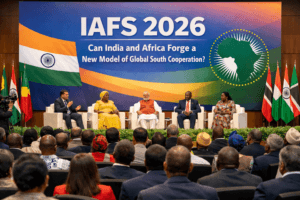
IAFS 2026: Can India and Africa Forge a New Model of Global South Cooperation?
The forthcoming India–Africa Forum Summit (IAFS) in 2026 is shaping up to be more than a diplomatic gathering; it is a pivotal test for a new vision of international partnership. As the global order fragments, India and Africa stand at a crossroads, seeking to move beyond a history of symbolic solidarity and sporadic projects. The challenge is to build a durable co-development architecture—a framework where shared strategic imagination drives the creation of joint industrial ecosystems, digital governance standards, and resilient supply chains. The success or failure of this ambition will determine whether one of the world’s most consequential South-South relationships can evolve from a partnership of necessity to one of genuine, reciprocal transformation.
This push is being fueled by a convergence of long-term ambitions. Africa’s Agenda 2063 envisions a continent transformed from commodity dependence into a diversified, industrialized powerhouse. Similarly, India’s Viksit Bharat 2047 vision aims to elevate the nation into a rule-shaping technological and economic leader. The alignment of these two transformative agendas creates a unique foundation. The core question for 2026 is whether both sides can architect cooperative systems that actively advance these parallel national and continental ambitions, creating shared prosperity rather than replicating outdated donor-recipient dynamics.
The Imperative for a Paradigm Shift
The traditional model of India-Africa engagement, built on capacity-building programs, concessional credit lines, and infrastructure projects, has delivered value and built considerable trust. However, this project-based approach is increasingly insufficient in a world where economic sovereignty is dictated by control over technology standards, integrated supply chains, and institutional platforms.
The next phase of engagement will be measured not by the number of projects initiated, but by the durability of the systems built. A failure to make this structural shift risks leaving both Indian and African economies permanently embedded in global value chains designed elsewhere, forever as rule-takers rather than rule-makers. The IAFS 2026, therefore, represents a critical “design moment” to transition from executing discrete projects to co-creating lasting architectures for growth.
The table below outlines the fundamental shift in thinking required for this new phase of partnership:
| Traditional Partnership Model | Emerging Co-Development Architecture |
| Focus on discrete projects and concessional finance | Focus on designing integrated systems and institutions |
| Engagement sector-by-sector | Building shared industrial ecosystems (e.g., pharma clusters, innovation corridors) |
| Capacity building through training programs | Ecosystem development through tech transfer, co-production, and R&D |
| Linear supply chain linkages (resource-for-goods) | Circular, value-addition partnerships within Africa |
| Ad-hoc multilateral coordination | Institutionalized strategic coordination in global forums |
Pillars of a Co-Development Future
Forging this new architecture will require focused collaboration on several interdependent fronts where complementary strengths are most evident.
- From Linear Trade to Shared Industrial EcosystemsIndustrialization remains the bedrock of economic sovereignty. Africa’s drive to add value to its vast resources, particularlycritical minerals for the green transition, meets India’s need for secure supply chains for its manufacturing ambitions. The opportunity lies in moving beyond extracting and exporting raw materials. The future lies in establishing joint processing ventures and downstream manufacturing within Africa, creating jobs, capturing more value, and building sustainable industrial clusters. Zimbabwe’s Vice President explicitly highlighted this, pointing to opportunities in mining and value addition, particularly in lithium for electric vehicles, as a prime area for Indian partnership.
- Digital Public Infrastructure as a Foundational LayerIndia’s globally recognized success in building population-scale **Digital Public Infrastructure (DPI)**—interoperable digital systems for identity, payments, and data sharing—offers a powerful template for Africa’s digital transformation. Cooperation here extends beyond selling software; it involves co-designingopen-architecture digital governance frameworks, developing local data-hosting capacity, and deep skills transfer. This partnership can empower everything from telemedicine and e-education to streamlined cross-border trade under the African Continental Free Trade Area (AfCFTA). As an Indian minister noted, India is already aiding Africa’s digital transformation through IT centers and tech parks, a foundation that can be dramatically scaled.
- Strategic Coordination in a Multipolar WorldBoth India and African nations have long been vocal advocates for a more representative and equitablemultilateral system. IAFS 2026 provides a platform to transform this shared grievance into a coordinated strategy. This means moving beyond issuing joint statements to establishing structured consultation mechanisms and joint negotiating platforms in forums like the UN, WTO, and global climate talks. By presenting unified positions on issues like sovereign debt, technology access, and UN Security Council reform, they can amplify the Global South’s voice and reshape global governance from the margins to the center.
Navigating the Implementation Challenge
A visionary blueprint is only the first step. The formidable test will be in execution, which requires confronting several complex challenges.
Financing and Delivery Mechanisms The scale of ambition demands a move beyond government-backed lines of credit. Success will hinge on developing innovative blended finance structures that de-risk projects and attract large-scale private capital from both regions. As noted in analyses, the central challenge is “the ability to convert political commitments into bankable, implementable project pipelines”. This requires dedicated project preparation facilities to develop feasibility studies and ensure projects are ready for investment, bridging the gap between political agreement and ground-breaking.
Managing Geopolitical and Internal Complexity This partnership does not exist in a vacuum. Other major powers, notably the European Union with its massive Global Gateway initiative, are deepening their own strategic economic engagements with Africa. The EU-Africa partnership, involving €150 billion and focusing on green energy, digital corridors, and health manufacturing, sets a clear benchmark for scale. India’s approach must clearly articulate its distinct value proposition: a partnership of equals rooted in shared Global South experiences, a focus on affordable, scalable solutions, and a commitment to local value addition.
Furthermore, Africa’s own internal complexity—the need to align continental agendas like Agenda 2063 with national priorities and to harmonize regulations across 54 countries—presents a persistent coordination challenge. Sustainable partnership models must be flexible enough to work at both the continental and bilateral levels.
The Road to 2026 and Beyond
As the countdown to IAFS 2026 continues, the work of think tanks like the Centre for Social and Economic Progress (CSEP) and the AUDA-NEPAD Africa Policy Bridge Tank is critical in fleshing out actionable pathways. Their ongoing dialogue series aims to distill scholarly and policy expertise into concrete recommendations, ensuring the summit is a launchpad for detailed frameworks, not just a platform for declarations.
The ultimate measure of success for IAFS 2026 will be whether it catalyzes a shift in mindset and establishes the first operational pillars of co-development. Can it yield the blueprint for a flagship industrial corridor that integrates Indian technology with African processing? Can it produce a ratified framework for mutual recognition of digital IDs to facilitate commerce and mobility? Can it establish a standing India-AU committee for multilateral strategy?
If India and Africa can answer these questions affirmatively, they will achieve much more than deepening bilateral ties. They will have authored a powerful new template for South-South cooperation in the 21st century—one built on mutual agency, strategic alignment, and a shared commitment to writing their own economic destinies. In a fragmented world, the strength and sincerity of this partnership will resonate far beyond their own shores, offering a vision of international cooperation that is inclusive, equitable, and self-determined.
You must be logged in to post a comment.