
‘I Thought I Was the Only One Left’: The 12-Year-Old Survivor of a Bullet-Ridden Car in the West Bank
A 12-year-old Palestinian boy, Khaled Bani Odeh, has described how Israeli forces shot and killed his parents and two youngest brothers—including a blind and disabled seven-year-old—as the family drove home from a shopping trip in the occupied West Bank, leaving Khaled and his eight-year-old brother Mustafa as the sole survivors of the attack. Witnesses and first responders contradict the Israeli military’s account that the vehicle accelerated toward soldiers, stating instead that the family car was stationary when troops opened fire without warning, unleashing more than 50 rounds that tore through the windscreen and killed the occupants instantly. As the two surviving boys recover—Mustafa from shrapnel wounds and Khaled from the psychological trauma of watching his family die—the incident has intensified scrutiny of Israel’s use of lethal force against Palestinian civilians, with opposition leader Yair Lapid criticizing the government over the death of a special needs child and the family’s grandmother describing the killings as part of a broader pattern of escalating violence in the West Bank since October 2023.
‘I Thought I Was the Only One Left’: The 12-Year-Old Survivor of a Bullet-Ridden Car in the West Bank
In the aftermath of a midnight shooting that killed four members of his family, a young boy recounts the moments that shattered his world forever
The phone rang just after midnight in the Bani Odeh household, but it wasn’t news anyone was prepared to hear. On the other end of the line, a stranger’s voice delivered fragments of a nightmare: a car, soldiers, gunfire. Come quickly.
By the time relatives reached the scene in Tammun, a small village nestled in the northern West Bank’s rugged hills, they found a family sedan transformed into a steel coffin. The windscreen was obliterated. Spent bullet casings glittered under the headlights like deadly confetti. And inside, four members of one family sat motionless, their blood still seeping into the upholstery.
But in the chaos of that night, something remarkable—something heartbreaking—emerged from the wreckage. Two small boys, 12-year-old Khaled and 8-year-old Mustafa, were pulled from the vehicle, alive. One would carry physical scars across his face for the rest of his life. The other would carry something far heavier: the memory of exactly how his family died.
The Last Ride
Earlier that evening, the Bani Odeh home had buzzed with the kind of electric excitement that precedes a holiday. Eid al-Fitr, the festival marking the end of Ramadan, was just days away. For weeks, the children had watched their mother Waad prepare sweets and their father Ali count the days until he could return home from work.
Ali, 37, had spent six weeks on a construction site inside Israel—grueling work that kept him away from his family but provided the income they desperately needed. His return that week had transformed the household. The children, particularly the youngest, clamored for his attention, for outings, for the simple pleasure of being together.
“They begged him to take them shopping in Nablus,” their grandmother Najah would later recall, her voice catching. “They wanted new clothes for Eid. They wanted to feel special.”
Nablus, with its bustling markets and sweet shops, sits about 30 minutes from Tammun by car—close enough for a family outing, far enough to feel like an adventure. Ali loaded his wife Waad, 35, and their four sons into the family car. Seven-year-old Othman, blind and disabled since birth, settled onto his mother’s lap as he always did during car rides. Five-year-old Mohammed squeezed between his parents up front. Khaled and Mustafa claimed the back seat.
They ate dinner together in Nablus. They shopped for Eid clothes. They laughed, argued over silly things, and eventually pointed the car toward home as the night deepened around them.
None of them knew they were driving toward a military operation.
‘The Children Were Singing’
The road into Tammun winds through hills dotted with olive trees and stone houses. On a typical night, the village sleeps early, its narrow streets quiet except for the occasional barking dog or distant call to prayer.
But this night was not typical.
According to the Israeli military, soldiers and Border Police units were operating in Tammun to arrest individuals suspected of terrorist activity against Israeli security forces. Such night raids have become increasingly common across the West Bank, part of what the military describes as counterterrorism operations aimed at preventing attacks.
What happened next depends entirely on whom you ask.
The military’s initial statement painted a straightforward picture: a vehicle “accelerated towards the forces, who sensed danger and responded by shooting.” In this version, the Bani Odeh family’s car became a threat, and soldiers neutralized it according to protocol.
But a witness who lives above the road where the shooting occurred tells a different story—one that challenges the official account in nearly every particular.
From his window, the resident—who asked not to be named for his safety—watched the family car turn onto his street. He had been awake, he said, because of sporadic shooting he’d heard in the distance earlier. When the sedan appeared, it was moving slowly, normally. It turned left, faced uphill, and then stopped completely.
“The firing directly targeted the car,” he told us, his voice steady but his eyes betraying the weight of what he’d seen. “I just heard the woman in the car screaming. The little kids were crying before they were killed.”
He insists there were no warnings, no warning shots, no opportunity for the family to understand what was about to happen.
The New York Times, citing family accounts, added another layer of tragic detail: Waad had asked her husband to pull over momentarily so she could search for something in her bag. It was in that stationary moment, with a mother rummaging through her belongings and children chattering in the back, that the shooting began.
What Khaled Saw
Twelve-year-old Khaled Bani Odeh sits in his grandmother’s house now, surrounded by women who stroke his hair and murmur prayers. His face is drawn, older than his years. When he speaks about that night, his voice carries the flat, detached quality of someone describing events that happened to someone else—a common psychological response to trauma too immense to process.
“My mother cried out one last time before going quiet,” he says. “My father recited the Shahada as he died.”
The Shahada—the Islamic declaration of faith—is often the final words of a dying Muslim, a testament whispered when death approaches. Ali Bani Odeh had seconds to recognize what was happening, seconds to form the words that would be his last.
In the front seat, five-year-old Mohammed had been sitting between his parents. When the bullets tore through the windscreen, he fell forward into Mustafa’s lap in the back, his small body covering his older brother in blood.
Othman, the blind seven-year-old who couldn’t see the danger coming, never had a chance. He died on his mother’s lap, still wrapped in her arms.
For a terrible moment after the shooting stopped, Khaled believed he was alone—the last living member of his family in a car filled with the dead. Then he heard Mustafa breathing.
When Israeli forces approached the vehicle and tried to pull Mustafa out, Khaled instinctively moved to protect his younger brother. It was the act of an older sibling, automatic and brave, but it cost him.
“They pulled me out instead and began jumping on my back,” he recalls. “Then they took me to a corner and questioned me about who had been in the car. I told them it was my mother and father. They accused me of lying and started beating me.”
The Scene That Greeted First Responders
Hassan Fuqoha has been a Red Crescent ambulance crew member for years. He’s responded to countless emergencies, seen things that would haunt most people for a lifetime. But when he reached the Bani Odeh family’s car that night, even he was unprepared.
“The scene was completely different from other incidents I had attended,” Fuqoha says slowly, choosing his words with care. “Both parents and one of the children had part of their heads blown off.”
He walked around the vehicle, counting. Bullet casings littered the ground—dozens of them, from assault rifles of the type used by Israeli forces. Residents would later collect more than 50 casings and hand them over to authorities. Another remained visible days later, trapped under rubble by the roadside, near where bloodstains still streaked the asphalt.
“It was very heavy fire, directly at the car,” Fuqoha emphasizes. “It’s not normal.”
The distinction matters. In military operations, rules of engagement typically govern when and how soldiers may use lethal force. Warning shots, verbal warnings, escalating responses—these are standard protocols designed to minimize civilian casualties. What Fuqoha describes, and what witnesses corroborate, suggests something else entirely: a fusillade unleashed on a stationary vehicle containing four children.
‘A Seven-Year-Old with Special Needs’
The deaths of Othman Bani Odeh have resonated far beyond the West Bank, in part because of their cruel specificity. A blind, disabled seven-year-old—a child who posed no conceivable threat to anyone—killed while sitting on his mother’s lap. The image defies easy categorization.
In Israel, opposition leader Yair Lapid seized on this detail to criticize his government’s handling of West Bank operations.
“A seven-year-old boy with special needs should not die in the wars of adults,” Lapid said, calling for an official apology to the family.
But apologies, even if they come, cannot undo what happened on that dark road. Nor can they address the broader pattern that many Palestinians see in this tragedy.
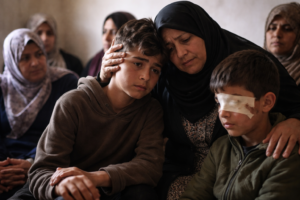
Najah Bani Odeh, Khaled and Mustafa’s grandmother, sits surrounded by mourners in her home—women in tightly wrapped woolen shawls and headscarves in black, white, and brown. Eight-year-old Mustafa stands beside her, a bandage across his face covering the wounds from glass shrapnel. He needs surgery, she explains, to remove fragments embedded in his skin.
But her words aren’t focused only on her family’s pain. They reach outward, toward a larger reality she believes this incident represents.
“A settler over there goes on rampage hurting men, women, and children, and we only defend ourselves by hurling stones,” she says. “They want to strip us out of our lands. They are now building walls around the lands they have seized and firing at will at anyone approaching.”
Her words touch on a truth documented by international observers: violence in the West Bank has escalated dramatically since October 7, 2023. According to the UN’s humanitarian affairs office (OCHA), between that date and March 15, 2026, 1,071 Palestinians were killed in the West Bank, including at least 233 children. During the same period (through mid-October 2025), 19 Israeli civilians and 23 Israeli security forces were killed there.
The numbers tell a story of asymmetrical violence, of occupation’s daily toll, of lives measured in statistics until a family sedan becomes a tomb and a 12-year-old boy must describe watching his parents die.
The Investigation and Its Gaps
The Israeli military has stated that the incident is being investigated by “the relevant authorities.” When pressed about witness accounts describing a stationary vehicle fired upon without warning, the military directed inquiries to the police. As of this writing, no response has been received.
For the Bani Odeh family, an investigation changes nothing. On Sunday, they buried Ali, Waad, Mohammed, and Othman—four members of one family, lowered into the same earth in Tammun’s cemetery. Mourners gathered in the hundreds, their grief a public testament to a private loss.
Khaled attended the funeral of his parents and youngest brothers. So did Mustafa, his bandaged face a visible reminder of the night that stole their childhood.
They returned afterward to their grandmother’s house, where the walls still echo with the sounds of happier times. The Eid clothes bought in Nablus that day remain unworn, purchased for a celebration that will now pass in mourning. The sweets Waad prepared sit uneaten.
And two boys must somehow navigate a world in which their parents are gone, their brothers are gone, and the only thing left is the memory of gunfire in the dark and a mother’s final cry.
The Human Cost of Statistics
It’s easy, in conflicts as protracted and bitter as the Israeli-Palestinian one, to lose sight of individual lives amid the torrent of numbers. Every week brings new casualties, new statements from both sides, new condemnations and justifications. The human brain, confronted with endless tragedy, builds walls of numbness to protect itself.
But sometimes a story breaks through—not because the deaths are more tragic than others, but because the details refuse to be ignored. A blind child on his mother’s lap. A 12-year-old watching through the windshield. A grandmother describing how her grandson’s kindergarten clothes were soaked in his brother’s blood.
These are not political arguments. They are human realities.
Khaled Bani Odeh will turn 13 this year. He will mark the occasion without his parents, without his youngest brothers, without the family he knew three days ago. He will carry with him the sound of his mother’s last cry, the image of his father whispering his faith as death approached, the weight of soldiers jumping on his back when he tried to protect his surviving brother.
He will also carry questions—questions about why his family died, about what threat they posed, about whether anyone will be held accountable. These questions may never receive satisfactory answers. In the West Bank, as in so many conflict zones, accountability often proves elusive, buried under layers of military procedure, political calculation, and competing narratives.
But questions, once planted, have a way of growing. And 12-year-old boys, even traumatized ones, eventually become men.
The Road Ahead
In Tammun, life continues in the strange, suspended way it does after tragedy. Women prepare food for mourners. Men make phone calls, arrange logistics, handle the endless practical details that death demands. Children play in the streets, their laughter a jarring counterpoint to the grief that hangs over one particular household.
Mustafa’s bandage will come off eventually. The shrapnel will be removed, the wounds will heal, and his face will bear the scars of that night forever—not just the physical marks, but the invisible ones etched into memory.
Khaled will return to school, to friends, to the ordinary rhythms of boyhood. But ordinary has been redefined. Ordinary now means living with the knowledge that safety is an illusion, that a family car can become a killing zone, that soldiers’ bullets do not distinguish between threats and children.
The Bani Odeh family’s tragedy has already been absorbed into the larger narrative of the conflict, cited by politicians, activists, and advocates on all sides. It will be used to argue for this policy or against that one, to condemn this government or exonerate that military. Such is the fate of individual suffering in collective struggles.
But for those who knew Ali and Waad, who watched Mohammed and Othman grow, who held Khaled and Mustafa as they cried—this is not a political story. It is the story of a family shattered in an instant, of a grandmother burying her son, of two brothers navigating a world that just became infinitely more dangerous and lonely.
And it is a reminder, if one were needed, that behind every statistic, every headline, every political statement, there are human beings—flawed, beloved, irreplaceable—whose lives end not with arguments but with silence.
“My mother cried out one last time before going quiet,” Khaled said.
In that silence, a family disappeared. In that silence, a boy grew up.
You must be logged in to post a comment.