
How Technology Could Transform Tribal Rights in India: The FRA Digital Revolution
The Ministry of Tribal Affairs is pioneering a novel, ground-up approach to digitize the implementation of the Forest Rights Act (FRA) by leveraging student innovation from the Smart India Hackathon 2025 and validating it through direct field engagement. Following the hackathon, student teams and officials visited Nashik, Maharashtra, to observe the state’s FRA portal and interact with Gram Sabhas and patta holders, ensuring the proposed national AI-powered FRA Atlas and WebGIS Decision Support System are rooted in real-world workflows and challenges. This initiative aims to transform the historically paper-based and fragmented process by creating an integrated digital platform for Individual, Community, and Community Forest Resource rights, which will streamline claim processing, enhance transparency, and empower tribal communities through technology, ultimately seeking to translate legal rights into tangible security and sustainable development.
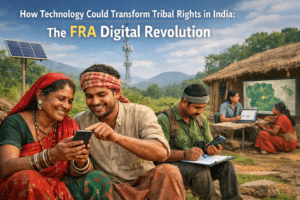
How Technology Could Transform Tribal Rights in India: The FRA Digital Revolution
Technology is bridging the gap between policy and people, turning legal rights into lived realities for India’s forest-dwelling communities through an innovative mix of youth innovation and grassroots validation.
The Forest Rights Act of 2006 was landmark legislation designed to correct historical injustices against India’s forest-dwelling communities. Yet, eighteen years later, its implementation remains fragmented, uneven, and often mired in bureaucratic complexities. This month, a quiet revolution began in Nashik, Maharashtra, that could fundamentally transform how tribal rights are recognized and protected. The Ministry of Tribal Affairs (MoTA) has initiated an unprecedented collaboration between government, academia, and tribal communities to develop an AI-powered digital platform that promises to streamline and strengthen FRA implementation across India.
Why Technology is the Missing Link in FRA Implementation
The Forest Rights Act was created with transformative potential—aiming not only to recognize land rights but also to empower Gram Sabhas (village councils) as central decision-making bodies in forest governance. The Act recognizes three distinct categories of rights:
| Right Type | Description | Key Features |
| Individual Forest Rights (IFR) | Rights to self-cultivation and habitation on forest land | Residential and agricultural land rights for families |
| Community Rights (CR) | Rights to grazing, fishing, water access, and traditional resource use | Shared access to forest resources and biodiversity |
| Community Forest Resource Rights (CFR) | Rights to protect, regenerate, and manage community forest resources | Management authority and conservation responsibility |
Despite this comprehensive framework, implementation has faced significant challenges. Documentation is often paper-based and scattered across multiple departments, creating delays and inconsistencies. Verification of claims requires cross-referencing with land records, forest maps, and satellite imagery—a process that can take years. The Gram Sabha, though legally empowered, frequently lacks the technical capacity to map resources, document claims, or monitor implementation.
Before this digital initiative, tribal communities navigating the FRA process faced bureaucratic hurdles, with paper documentation causing significant delays in claim processing. States like Maharashtra have developed their own digital portals, but a unified national platform has been absent until now.
The Innovative Approach: Hackathons Meet Ground Realities
What makes the MoTA’s initiative particularly innovative is its methodology. Rather than contracting a private tech firm to develop the platform, the Ministry turned to the Smart India Hackathon 2025, a flagship initiative of the Ministry of Education’s Innovation Cell. By presenting the FRA digital platform as a “problem statement” to student teams, MoTA tapped into fresh perspectives and cutting-edge technological approaches from India’s youth.
The post-hackathon phase represents an even more significant innovation. Following initial concept development, student teams from Pune, Kurnool, and Indore traveled to Nashik for field validation. This two-day immersion in FRA-implemented villages enabled direct interaction with Gram Sabha members, patta (land title) holders, and district-level functionaries.
During this field engagement, the Maharashtra government demonstrated its state-level FRA portal, highlighting successes and challenges from one of India’s more digitally advanced states in tribal rights implementation. This “learning from the field” approach ensures the national platform will be grounded in practical realities rather than theoretical ideals.
Components of the Digital Transformation
The envisioned digital platform comprises several interconnected components designed to address specific implementation gaps:
- AI-Powered FRA Atlas
This component will serve as a centralized repository of all FRA-related data across India. Using artificial intelligence, the system will be able to analyze patterns in claim submissions, approvals, and rejections, identifying bottlenecks and disparities across regions. The Atlas will integrate with existing government databases to automate verification processes that currently require manual cross-referencing.
- WebGIS-Based Decision Support System
Geospatial technology forms the backbone of this system. By layering forest boundaries, land records, satellite imagery, and recognized claims on interactive maps, the platform will provide visual clarity that paper records cannot match. This geotagging capability will be particularly crucial for Community Forest Resource Rights, where boundaries are often based on traditional knowledge rather than surveyed coordinates.
- Integrated Workflow Management
From claim submission to title issuance, the platform will streamline bureaucratic processes that currently involve multiple departments and jurisdictions. Gram Sabhas will be able to digitally submit claims, track their status, and receive notifications, reducing the need for repeated visits to government offices.
Real-World Impact on Tribal Communities
The true test of this digital initiative will be its impact on the ground. For tribal communities, the platform promises several tangible benefits:
Reduced processing times: Digital submission and automated verification could cut claim processing from years to months, providing faster security of tenure for vulnerable communities.
Enhanced transparency: Real-time tracking of claim status will reduce opportunities for corruption and arbitrary decision-making, addressing long-standing grievances about opaque bureaucratic processes.
Empowered Gram Sabhas: By providing village councils with digital tools for resource mapping and claim documentation, the platform strengthens their legal authority as decision-making bodies under the FRA.
Data-driven policy: The aggregated data from the platform will enable evidence-based policy adjustments, identifying regions with disproportionate rejection rates or implementation gaps that require targeted interventions.
The field visits in Nashik allowed student developers to witness firsthand how the platform might be used. They heard success stories from patta holders whose lives had been transformed by secure land rights, but also documented the practical challenges that slower, less tech-savvy users might face in adopting digital systems.
The Broader Context: Digital Democracy in Rural India
The FRA digital platform initiative aligns with a broader movement toward digital empowerment of rural governance structures in India. As noted in analyses of digital Gram Sabha initiatives, technologies like facial recognition for attendance, AI-generated meeting minutes, and video conferencing are already transforming how village councils operate.
Tatarpur village in Haryana’s Palwal district, for instance, conducted India’s first fully digital Gram Sabha meeting in April 2025, demonstrating how technology can enhance participation and transparency in grassroots democracy. Similar principles apply to the FRA platform—by making processes more accessible and transparent, technology can strengthen rather than undermine traditional governance structures.
The Ministry’s approach recognizes that technology must be adapted to rural realities rather than forcing rural communities to adapt to urban-centric designs. The inclusion of local language interfaces, voice note submissions, and simplified user experiences reflects this understanding.
Challenges and Future Directions
Despite its promising potential, the digital FRA platform faces significant implementation challenges:
Digital literacy gaps: Many tribal communities, particularly elders and women, may lack experience with digital interfaces, requiring comprehensive training programs alongside platform deployment.
Connectivity issues: Remote forest areas often have limited internet connectivity, necessitating offline functionality and synchronized data updates when connections are available.
Interdepartmental coordination: The platform’s effectiveness depends on integration with land records, forest departments, and revenue systems across states, requiring unprecedented bureaucratic cooperation.
Data privacy concerns: Sensitive information about tribal landholdings and resources must be protected against misuse, requiring robust security protocols.
Following the field validation in Nashik, student teams will proceed to New Delhi for a two-day hackathon at the National Tribal Research Institute, where they will work under the guidance of the Secretary of Tribal Affairs to finalize the platform design. This structured post-hackathon engagement represents a new model for translating policy into practical solutions—one that could be replicated across other governance challenges.
Conclusion: A New Paradigm for Inclusive Governance
The Ministry of Tribal Affairs’ initiative represents more than just another government digitization project. It signifies a fundamental shift in how rights-based legislation can be implemented through collaborative innovation. By bringing together student technologists, government officials, and tribal communities in a shared problem-solving process, the approach itself models the inclusive governance the FRA was designed to promote.
As India advances toward its vision of “Viksit Bharat” (developed India), initiatives like the FRA digital platform demonstrate how technology can be harnessed for inclusive growth that leaves no community behind. The true measure of success will not be in the sophistication of the algorithms or the elegance of the user interface, but in how effectively the platform translates legal rights into secure livelihoods and empowered communities.
The students returning from Nashik’s tribal villages carry with them not just technical requirements, but human stories—of elderly patta holders finally securing land their families have cultivated for generations, of Gram Sabha members struggling to map community forests without proper tools, of the gap between policy promise and lived reality. Their challenge now is to build bridges across that gap, creating digital pathways where rights recognition flows as naturally as the forest streams their new platform will help protect.
You must be logged in to post a comment.