
How One Airline Grounded a Nation: The Real Cost of India’s Aviation Monopoly
India’s recent aviation chaos, with thousands of IndiGo flights canceled, exposes the profound vulnerability created by the airline’s near-monopoly over the domestic market. Controlling over 65% of passenger traffic, IndiGo’s dominance—formed as competitors like Jet Airways and GoAir collapsed—bred operational hubris, leading it to ignore new pilot rest rules designed to ensure safety. The resulting cancellations highlight a systemic failure: a regulator that bent rules instead of enforcing them, and a market so concentrated that consumers have no viable alternative, leaving the nation’s travel infrastructure hostage to the decisions of a single, over-mighty corporation.
How One Airline Grounded a Nation: The Real Cost of India’s Aviation Monopoly
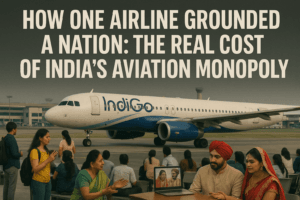
The scene at India’s airports over recent weeks has been one of collective national frustration. Not the usual hustle of travel, but a peculiar modern chaos: passengers doing garba in departure lounges to pass the time, couples attending their own wedding receptions via shaky Zoom connections from an airport cafe, and a pervasive sense of helpless anger directed at overwhelmed staff. The trigger? The cancellation of thousands of flights by a single carrier: IndiGo.
This isn’t just a story of operational hiccups or bad weather. It is a stark unveiling of a deeper, systemic vulnerability: India’s domestic aviation market, despite the appearance of choice, is held hostage by a de facto monopoly. The chaos is a symptom; the disease is the alarming concentration of market power in one company’s hands.
From Shaadi Halls to Shopping Malls: The Illusion of Choice
To understand the present, we must glance back. In the 1980s, flying was a rare event. Airports were functional, often resembling modest community halls. The choice was binary: fly with the state-owned Indian Airlines (or its subsidiary Vayudoot) or not fly at all. Cancellations, like the one experienced by a young Vivek Kaul in 1988, were crises solved by personal intervention and sheer luck.
Today, Indian airports are glittering temples of commerce and efficiency. Screens flash with dozens of daily options. Low-cost carriers promise affordability. The narrative is one of liberalization, progress, and consumer choice. Yet, this is a carefully constructed illusion.
The numbers are unequivocal. IndiGo now carries two out of every three domestic passengers. In many smaller cities, this dominance is even more pronounced. Combine its share with the Tata-owned Air India group, and nearly 90% of the market is controlled by just two entities. This is not a competitive landscape; it is a duopoly that functions like a monopoly, with IndiGo as the undisputed hegemon.
The Inevitable Arc of “Free” Markets: Competition That Destroys Competition
How did we get here? The early 2010s presented a more vibrant market. IndiGo held a strong but not overwhelming share, competing vigorously with Jet Airways, a robust SpiceJet, Air India, and GoAir. Then, the brutal economics of aviation played out.
Airlines are capital-destroying machines, infamous for turning billionaires into millionaires. Success hinges on operational rigor, financial discipline, and often, sheer endurance. One by one, competitors faltered:
- Jet Airways collapsed under financial weight.
- Kingfisher Airlines succumbed to owner vanity and debt.
- GoAir (Go First) grounded itself amid bankruptcy.
- SpiceJet has shrunk to a marginal player.
- Air India survived only because the Tata Group’s emotional acquisition rescued it from a cycle of government-funded losses.
In this carnage, IndiGo didn’t just survive; it perfected a model of punctuality and cost-efficient operations that resonated with the Indian traveler. It vacuumed up the market share left by the fallen. This is the dark side of competition economists seldom highlight: in winner-takes-most markets, competition often leads to consolidation, not perpetual diversity. The efficient eliminate the less efficient until choice becomes a theoretical concept.
The Hubris of Dominance: When Rules Become Suggestions
IndiGo’s success bred a dangerous corporate hubris. With no credible alternative for most passengers, the incentive to relentlessly prioritize customer experience diminished. Social media became a repository of daily grievances about indifferent service, opaque policies, and last-minute changes. Yet, market share remained untouchable. Why? As one disgruntled flyer put it, “Switch to whom?”
This hubris manifested catastrophically in the recent crisis. In May 2024, the Directorate General of Civil Aviation (DGCA) introduced new Fatigue Risk Management System (FRMS) rules, aligning India with global standards. The principle was simple and non-negotiable: tired pilots are a deadly risk. The rules mandated longer, scientifically-backed rest periods for crew.
Every other airline adjusted schedules and hired pilots to comply by the November 2025 deadline. IndiGo, evidently, did not. The reason points to a toxic cocktail of arrogance and short-term profit calculus. Analysis of their financials reveals a telling trend: employee costs as a percentage of revenue have been strategically suppressed post-pandemic. While some recovery is visible, the pressure to maintain ultra-lean operations seemingly overrode operational prudence.
The finance department, it appears, won the argument over the risk and operations teams. The plan, perhaps, was to squeeze more flying hours from existing crew, treating the new safety rules as flexible guidelines. The result was an entirely predictable arithmetic reality: without enough rested pilots, planes cannot fly. Flights were cancelled en masse.
The Regulatory Failure: A Captive Watchdog?
The DGCA’s role in this fiasco is deeply troubling. As the regulator, it had over a year to monitor compliance. That it was seemingly unaware of India’s largest airline being structurally unable to meet a major safety mandate is an indictment of its oversight. Worse was the reaction to the crisis.
Instead of holding IndiGo accountable and forcing it to acquire capacity (even if it meant curtailing its schedule), the DGCA’s solution was to suspend the new rest rules. This is akin to solving drunk driving by raising the legal blood-alcohol limit. It punishes the compliant airlines that invested in hiring and rewards the one that gambled on non-compliance. For conspiracy theorists, it validates the suspicion that a giant monopoly can create a crisis so large that the rules themselves are bent to bail it out.
Beyond the Chaos: The Real-World Consequences
The impact transcends missed holidays. This concentration of power has tangible costs:
- Economic Vulnerability: A shock to one airline sends ripple effects through the entire national economy—from tourism and hospitality to business travel and logistics.
- Stifled Innovation: With no competitive pressure, there is little impetus to improve service, invest in customer comfort, or pioneer new efficiencies. The bare minimum becomes the standard.
- Consumer Exploitation: Dominant pricing power in peak seasons or during crises (as seen with skyrocketing fares during the cancellations) is a direct tax on the public.
- Systemic Risk: The entire aviation infrastructure—from airport slots to ground handling—becomes overly reliant on one player, creating a single point of potential failure.
The Way Forward: Rekindling the Spirit of Enterprise
Solving this requires more than finger-wagging. It requires a conscious effort to foster real competition.
- Proactive Regulatory Antitrust Action: The Competition Commission of India (CCI) must view aviation not through a narrow lens of collusion but of harmful dominance. Remedies could include mandating slot allocation at congested airports to favor new entrants and scrutinizing predatory pricing.
- Incentivizing New Capital: The government must make the sector attractive for serious, long-term capital. This isn’t about venture-funded app glamour but about patient infrastructure investment. Policies should ensure a level playing field in airport access, jet fuel pricing (a major cost), and taxation.
- Reclaiming Regulatory Spine: The DGCA must be empowered and mandated to act as a guardian of safety and fairness, not as a crisis mediator for the dominant player. Its credibility rests on enforcing rules uniformly, regardless of the size of the airline.
The current mayhem is IndiGo’s crisis, but it is India’s lesson. A monopoly isn’t just bad for prices; it’s bad for safety, resilience, and national dignity. It leads to the kind of arrogance where an airline believes it can defy the laws of arithmetic and physics. The solution lies not in hoping for altruism from a dominant corporation, but in rebuilding a marketplace where true competition can once again take flight—where passengers have a real choice, and where no single company can ground the plans of a nation.
You must be logged in to post a comment.