
How Mohit Malhotra’s Three-Decade Journey is Reshaping Dabur’s Global Blueprint
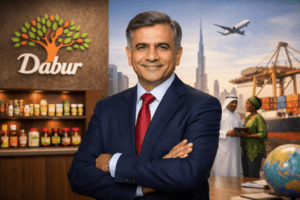
How Mohit Malhotra’s Three-Decade Journey is Reshaping Dabur’s Global Blueprint
In the fast-moving world of consumer goods, leadership changes are often announced with little more than a press release and a flurry of LinkedIn congratulations. But every once in a while, a corporate elevation tells a deeper story—one of strategic intent, cultural continuity, and the meticulous crafting of a global powerhouse.
On February 17, 2026, Dabur India’s board made a significant move, redesignating Mohit Malhotra from CEO to Global Chief Executive Officer. While the title change might seem subtle to the outside world, for industry insiders and the 13,000+ employees of the 140-year-old Ayurvedic giant, it signals a definitive shift in how the company views its place in the world.
This isn’t just a story about a promotion. It’s a case study in how modern Indian multinationals are structuring themselves for the future, and a testament to the power of homegrown leadership.
The Architect of International Growth Takes the Helm
To understand the weight of this new role, one must first look at the man stepping into it. Mohit Malhotra is not an external rockstar hire brought in to shake things up. He is the embodiment of Dabur’s internal strength. Joining as a Management Trainee in 1994, Malhotra has spent over 31 years absorbing the company’s ethos—a unique blend of modern FMCG practices and ancient Ayurvedic wisdom.
His trajectory is a masterclass in succession planning. Before this latest elevation, Malhotra had already held the position of Group CEO since April 2019. But the prefix “Global” is more than a honorific; it formalizes a reality that Malhotra has been architecting for years.
Having served as the CEO of Dabur International in Dubai and as Business Head for the MENA (Middle East and North Africa) region, including Egypt, Malhotra has a visceral understanding of what it takes to sell herbal toothpaste in Cairo or hair oil in Dubai. He has been responsible for the gritty details of international expansion—overseeing brand investment planning, managing profitability across borders, and conducting quarterly sales reviews with distributors who operate in vastly different cultural and economic landscapes.
This on-ground experience is critical. It’s the difference between a leader who views international business as a spreadsheet of export figures and one who understands the nuance of local retail dynamics. By elevating him to Global CEO, Dabur is effectively saying that its future growth will be written in multiple languages, not just Hindi and English.
Decoding the “Global CEO” Mandate
Why create a Global CEO role now? The answer lies in the changing nature of the Indian FMCG sector.
For decades, Indian companies treated international operations as a secondary revenue stream—a nice-to-have addition to the domestic cash cow. That era is over. Markets in the Middle East, Africa, and South Asia are no longer just “adjacencies”; they are core growth drivers. However, managing a transnational portfolio with presence in over 100 countries requires a different leadership muscle.
By splitting the leadership structure, Dabur has created a dedicated cockpit for global strategy. Malhotra’s mandate from the board will likely focus on three high-stakes areas:
- Portfolio Rationalization: Not every product that sells in rural India will sell in Nairobi or London. Malhotra’s global view allows him to curate a “power brand” portfolio that can travel across borders—think Dabur Honey, Chyawanprash, or premium hair care—while allowing regional R&D to cater to local tastes.
- M&A and Partnerships: With a dedicated global leader, Dabur can more aggressively scout for strategic acquisitions or joint ventures in high-potential markets, moving beyond organic growth.
- Supply Chain Resilience: A global FMCG company today faces volatility from geopolitics to commodity pricing. A Global CEO can centralize risk management and optimize the supply chain across continents.
The New Guard: Herjit Bhalla and the Sharpening of Domestic Focus
A move of this magnitude always creates a ripple effect. In a brilliantly strategic restructuring, Dabur has simultaneously announced the appointment of Herjit S. Bhalla as CEO of the India business, effective April 15, 2026.
This is the other half of the puzzle. By handing the reins of the domestic market to a dedicated leader, Malhotra is freed from the day-to-day firefighting of the Indian market—which, despite its strength, is fiercely competitive with deep-pocketed rivals like HUL, Patanjali, and Colgate.
Bhalla, described as an “industry veteran,” steps into a role with a razor-sharp focus: execution. While Malhotra flies the flag globally, Bhalla will be tasked with fortifying the fort. His priorities will be intense: deepening distribution in tier-3 and tier-4 cities, defending market share in legacy categories like digestives and hair oils, and capturing the premiumization trend in urban India.
The reporting structure is telling. Bhalla will report to Malhotra, creating a clear line of sight from the trenches of the Indian mandi (market) to the global boardroom. It’s a structure that ensures global strategy is always grounded in the reality of the company’s most important market, and that local innovations can be rapidly scaled for international audiences.
A Deeper Human Insight: The Quiet Power of the Long Game
Beyond the corporate jargon, Malhotra’s elevation offers a powerful human narrative in an era obsessed with job-hopping and quick career hacks.
In a market where top talent is often lured by flashy offers from MNCs or startups, Malhotra’s 31-year journey with a single organization is almost an anomaly. It speaks volumes about Dabur’s culture of “growing your own timber.”
His career arc—from Management Trainee to Global CEO—is a testament to the value of institutional memory. He has likely negotiated with distributors who have known him since he was a young sales manager. He has seen product launches succeed and fail. He understands the unwritten codes of the organization.
This deep-seated trust is invaluable. When Malhotra makes a strategic bet on entering a new African market or pivoting a brand’s positioning, the board knows it’s not based on a PowerPoint presentation from a consultant, but on three decades of accumulated wisdom.
What This Means for the Future of Dabur
For the average consumer, this leadership change will be invisible. But over the next 24 months, its effects will be felt on the shelves.
We can expect to see a more aggressive Dabur in international markets. Under Malhotra’s direct guidance, the company may look to replicate the success of its “Heritage” positioning in new geographies, potentially adapting products for the large South Asian diaspora while also courting mainstream consumers curious about Ayurveda and natural wellness.
Simultaneously, with Bhalla sharpening the domestic axe, expect faster response times to competitive threats in India. The Indian FMCG sector is currently navigating a tricky patch of rural recovery and urban inflation. Having a CEO singularly focused on navigating these local currents could give Dabur a crucial edge.
Conclusion
The elevation of Mohit Malhotra to Global CEO is more than a routine corporate announcement. It is a strategic realignment for a company preparing for its next century of growth. It’s a recognition that to win globally, you need a leader who has lived the brand locally, and to win locally, you need a leader whose sole focus is the Indian consumer.
As Malhotra takes on this expanded role, he carries with him not just a new title, but the weight of a 140-year-old legacy and the opportunity to write its most global chapter yet. For the students of business and leadership watching, this move at Dabur offers a timeless lesson: sometimes, the best person for the top job isn’t the one from outside with the flashiest resume, but the one who has been quietly building the company’s future, brick by brick, for thirty years.
You must be logged in to post a comment.