
How India’s BRICS Agenda Builds a New Global Order Amid Geopolitical Tensions
Russia’s endorsement of India’s 2026 BRICS chairmanship agenda signifies a strategic alignment within the bloc to reshape global norms, actively supporting India’s focus on counter-terrorism to address regional instability, on energy and food security as buffers against external market pressures, and on establishing sovereign-first governance for emerging technologies like AI, which collectively aim to reform existing international institutions and assert the developmental priorities of the Global South within a more multipolar world order.
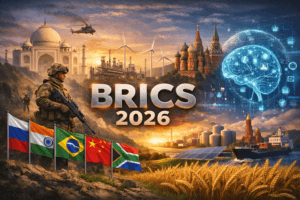
How India’s BRICS Agenda Builds a New Global Order Amid Geopolitical Tensions
Russia’s vocal endorsement of India’s BRICS chairmanship agenda in February 2026 is not merely diplomatic courtesy but a calculated alignment that signals a deepening strategic realignment within the Global South. As the 11-nation bloc charts a course distinct from traditional Western-led forums, India’s 2026 leadership prioritizes counter-terrorism, energy security, and technology governance. This agenda directly addresses the most pressing fissures in the contemporary world order, from regional instability to technological dependency. Russia’s pledge of “active support” underscores the bloc’s shift from an economic dialogue forum to a potent platform for political coordination, aiming to reshape global norms from climate policy to digital sovereignty.
Counter-Terrorism: A Regional Imperative with Global Ambitions
Foreign Minister Sergey Lavrov’s immediate endorsement of India’s focus on counter-terrorism highlights security as the bedrock of the 2026 agenda. He explicitly linked this priority to active hotspots in Afghanistan and the India-Pakistan-Afghanistan corridor, framing terrorism as a direct, transnational threat to member states’ stability.
Beyond rhetoric, this cooperation is operational. Russia and India are jointly working within the United Nations to advance a drafted global counter-terrorism convention, seeking the consensus that has so far eluded the international community. This effort exemplifies the BRICS modus operandi: using coordinated positions in established multilateral bodies like the UN to amplify its influence and challenge stalled Western-led initiatives.
The emphasis on security cooperation reflects the bloc’s understanding that sustainable economic development, a core BRICS pillar, is impossible without regional stability. It moves the group beyond abstract declarations toward concrete, collective action on a shared security challenge.
Energy and Food Security: The Twin Pillars of Sovereign Stability
Lavrov intricately linked energy security to “actions taken by the Trump administration,” framing it as a defensive priority against external market pressures. This view positions BRICS cooperation as a buffer against unilateral policies from traditional economic powers. The agenda seeks to ensure affordable energy access and diversified supply sources, including a significant push for renewables and low-carbon transitions.
Food security is its inseparable counterpart. BRICS nations are agricultural powerhouses, responsible for 42% of global food production and holding 33% of agricultural land. The agenda champions food sovereignty—the right to define one’s agricultural policies—and promotes sharing transformative national programs.
- India’s National Food Security Act (NFSA): A cornerstone policy that transformed the nation from a food-deficit country to a self-sufficient one, now leveraging strategic grain reserves to shield its population from global price inflation.
- Ethiopia’s National Wheat Harvest Program: An irrigation-driven initiative that turned the nation into Africa’s largest wheat exporter.
- Brazil’s National Food Security System: A comprehensive framework that has dramatically reduced hunger, pulling the equivalent of a stadium-sized population out of food insecurity daily.
This exchange of proven strategies is vital as climate change threatens global agriculture. BRICS focuses on developing climate-resilient agriculture and sustainable practices to protect a food system that nourishes a significant portion of humanity.
Table: Key BRICS Initiatives in Food and Energy Security
| Policy Area | Example Initiative (Country) | Core Objective |
| Food Security | National Food Security Act (India) | Achieve self-sufficiency and build strategic food reserves |
| Agricultural Tech | Digital Agriculture Program (Russia) | Automate production and ensure traceability |
| Energy Transition | Wind/Solar Forecasting System (Brazil) | Optimize clean energy generation and integration |
| Market Access | Smart Agriculture Action Plan (China) | Connect small farmers to markets via AI platforms |
Technology and AI Governance: Forging a Sovereign Digital Future
Perhaps the most forward-looking and complex element of India’s chairmanship is its focus on emerging technologies and artificial intelligence governance. India will host a dedicated AI summit, with Russia actively contributing to the agenda. This builds directly on the foundational BRICS Leaders’ Statement on the Global Governance of Artificial Intelligence, adopted in 2025.
The BRICS framework on AI is a direct challenge to the concentration of technological power in a few Western corporations and states. Its core principles are:
- Digital Sovereignty: Asserting each nation’s right to establish its own regulatory frameworks and develop indigenous AI capabilities.
- UN-Centric Multilateralism: Advocating for the United Nations to be the central, inclusive forum for global AI governance, preventing a fragmented “splinternet” of rules.
- Equitable Development: Ensuring AI reduces inequalities rather than exacerbating them. This includes mandating bias mitigation in algorithms, promoting environmental sustainability in AI systems, and protecting workers’ rights in the face of automation.
The bloc is translating principles into action. Brazil champions AI for social inclusion, China implements AI in healthcare through its “Healthy China 2030” platform, and South Africa uses AI to personalize education. The proposed BRICS AI observatory would institutionalize this sharing of best practices.
A New Vision for AI: “Global governance of AI should mitigate potential risks and address the needs of all countries, especially those of the Global South,” states the 2025 BRICS AI Declaration. It must be “representative, development-oriented, accessible, inclusive… and conducive to overcoming the growing digital and data divides.”
The Geopolitical Context: Continuity, Not Revolution
Lavrov took care to clarify that BRICS is not seeking to dismantle the IMF, World Bank, or WTO. Instead, the goal is comprehensive reform of these institutions to grant emerging economies voting rights and influence “commensurate with their actual weight in the global economy”. This positions BRICS as a reformist, rather than a revolutionary, force within global governance.
The support from Russia, a founding member, for India’s agenda underscores the strategic continuity within the bloc. Priorities evolve thematically—from Brazil’s 2025 focus on AI for social inclusion to India’s 2026 emphasis on security and energy—but the underlying mission remains consistent. It is to build a more multipolar world order where the interests and development models of the Global South are recognized and respected.
The Path Forward
India’s 2026 BRICS chairmanship arrives at a moment of profound global transition. By weaving together hard security concerns like counter-terrorism with foundational economic issues like food and energy, and capping it with a visionary framework for the digital age, the agenda offers a holistic blueprint for South-South cooperation.
The strong backing from Russia and other members suggests a shared resolve to move from dialogue to tangible outcomes. Success will be measured not just in summit declarations, but in the advancement of the UN counter-terrorism convention, the resilience of joint energy and food supply chains, and the establishment of inclusive, sovereign-first AI norms. In pursuing this integrated agenda, BRICS is steadily constructing the architecture for an alternative center of gravity in international affairs, one defined by the priorities of its diverse and populous member states.
You must be logged in to post a comment.