
How Georgia’s Ports Are Positioning Savannah as America’s Gateway to India’s Economic Boom
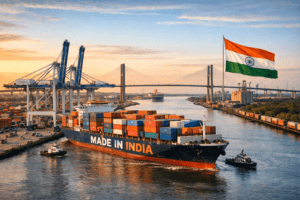
How Georgia’s Ports Are Positioning Savannah as America’s Gateway to India’s Economic Boom
Savannah’s strategic location and infrastructure investments have created what one port executive calls a “1-2-3 strategy” that delivers Indian cargo to U.S. inland markets up to eight days faster than traditional West Coast routes.
The recent U.S.-India trade agreement signals more than just diplomatic progress—it marks a fundamental shift in global trade corridors. While national headlines focus on macroeconomic implications, the real transformation is happening at a specific geographic point: the Port of Savannah, Georgia. This East Coast gateway has quietly positioned itself as the primary American portal for Indian commerce, handling 22% of India’s containerized trade on the U.S. Eastern Seaboard in fiscal year 2025 alone. What appears as a routine port development story actually reveals a sophisticated, multi-year strategy to capitalize on India’s economic ascent and reshape transoceanic supply chains.
The Economic Backdrop: India’s Ascent and American Supply Chain Realignment
India’s economic trajectory provides the essential context for this port development story. The country is poised to become the world’s fourth-largest economy in 2026, surpassing Japan and trailing only the U.S., China, and Germany. With projected GDP growth of 6.5% this year according to World Bank forecasts, India represents one of the few major economies expanding at such a robust pace.
Beyond macroeconomic figures, India’s demographic profile offers compelling long-term trade potential. A population of nearly 1.5 billion people, with 65% under age 35, creates both a massive consumer market and a productive workforce. For American companies, this represents a dual opportunity: access to cost-competitive manufacturing and sourcing, plus entry to one of the world’s fastest-growing consumer markets.
For U.S. businesses still recovering from pandemic-era supply chain disruptions, India offers something equally valuable: diversification. The concentration of manufacturing in East Asia has revealed strategic vulnerabilities, prompting companies to seek alternative sourcing locations. India presents not just an alternative, but one with democratic governance, English-language business environment, and a growing middle class.
The Georgia Ports Authority (GPA) has tracked this potential for years. Griff Lynch, GPA President and CEO, notes that his organization has “long thought India will be the key to our future success with the market proximity our U.S. East Coast gateway port offers”. This foresight has translated into tangible growth—Savannah’s loaded container trade with India surged by nearly 48% between fiscal years 2021 and 2025, reaching 304,450 twenty-foot equivalent container units (TEUs).
Savannah’s Competitive Edge: The 1-2-3 Advantage
The Port of Savannah’s growing prominence in U.S.-India trade isn’t accidental. It’s the result of strategic advantages that create what the port calls its “1-2-3 strategy”: cargo discharged from vessels on day one, placed on rail by day two, and available at inland destinations by day three.
Comparison of Savannah vs. West Coast Gateways for India-U.S. Trade
| Factor | Port of Savannah | Typical West Coast Gateway | Savannah Advantage |
| Ocean Transit Time | As short as 29 days | Typically longer via Pacific routes | Up to 8 days faster to inland markets |
| Rail Connection Time | Cargo reaches rail within 22 hours | Can exceed one week at some gateways | Significantly faster connection |
| Inland Reach | Day 3 availability in many markets | Additional time required for cross-country rail | Closer proximity to Eastern U.S. markets |
| Direct India Services | 6 weekly direct services, 10 total Indian subcontinent services | Varies by port, but primarily transshipment routes | More direct connections reducing handling |
Savannah’s geographic position provides a fundamental shipping advantage. Ocean routes from India to the U.S. East Coast are shorter than those to West Coast ports, which require either lengthier voyages around continents or passage through the Panama Canal. This geographic reality translates into tangible time savings for cargo destined for major Eastern distribution hubs like Atlanta, Memphis, and Nashville.
The port’s infrastructure amplifies this natural advantage. Eleven ocean carriers operate on Savannah-India routes, with transit times as short as 29 days. Direct vessel services connect to major Indian ports including Nhava Sheva/Mumbai, Pipavav, and Hazira, with additional connections through regional hubs like Colombo, Sri Lanka.
Perhaps Savannah’s most significant advantage lies in its rail connectivity. The Mason Mega Rail Terminal, described as the largest on-terminal rail facility in the Western Hemisphere, handles 42 trains per week with double-stack service from both CSX and Norfolk Southern. This infrastructure enables what the port industry calls “speed to rail”—the time between a container being discharged from a vessel and being placed on a departing train. Savannah’s average rail dwell time is just over one day, compared to more than a week at some other U.S. gateways.
The Leadership Behind the Strategy: Griff Lynch’s Calculated Vision
Understanding Savannah’s positioning requires examining the leadership guiding its development. Griff Lynch brings 34 years of maritime industry experience to his role as GPA President and CEO. His career trajectory reveals a leader uniquely prepared for this moment in global trade.
Lynch’s professional journey began with a maritime education but took an unexpected turn when he discovered he got seasick, forcing him to pursue “landside” opportunities. This early adaptation foreshadowed a career marked by flexibility in responding to challenges. His experience spans terminal operations, sales, and executive leadership, including designing and developing the APM Terminals Virginia facility—one of the nation’s first semi-automated terminals.
This diverse background has proven invaluable in recent years. Lynch guided Georgia’s ports through what he describes as “the peak of peaks and the low of lows in a very short period” during the pandemic-era supply chain disruptions. His response combined operational pragmatism with long-term vision—implementing “isolate and operate” protocols to maintain operations during COVID outbreaks while accelerating infrastructure projects to handle unexpected volume surges.
Lynch’s leadership philosophy emphasizes team building and consensus. Joel Wooten, GPA board chair, notes that Lynch is “very much a team builder and a consensus builder” who connects with employees at all levels. This approach has fostered strong relationships with critical partners like the International Longshoremen’s Association (ILA), which Lynch describes as “true partners in making this engine work”.
Perhaps most importantly, Lynch understands both the operational and commercial sides of port management. His sales experience calling on major retailers taught him that “containers were not just steel boxes but they actually had customers and people that were relying on them”. This customer-centric perspective informs Savannah’s value proposition—not just moving containers efficiently, but delivering competitive advantages to the businesses whose goods fill those containers.
Strategic Infrastructure: Preparing for the Next Wave of Trade Growth
Savannah’s current success represents just one phase in a long-term development strategy. The Georgia Ports Authority maintains a $4.5 billion, self-funded 10-year investment plan that includes adding five new big-ship berths in Savannah and a fourth berth in Brunswick. This follows a decade in which GPA has already invested $3.2 billion in infrastructure improvements.
These investments reflect a philosophy of staying ahead of demand—a lesson learned during the pandemic when the ports faced “volumes that Lynch and the Georgia Ports Authority board of directors were not anticipating until at least 2025”. The Mason Mega Rail Terminal, completed in November 2021, exemplifies this forward-looking approach. The project increased Savannah’s rail tracks from eight to 18, doubling rail capacity to 2 million containers per year.
Inland connectivity receives equal attention. The Appalachian Regional Port in Murray County, Georgia, opened in 2018 and has “greatly exceeded volume projections”. This inland port, along with plans for additional facilities in Hall County, extends Savannah’s reach deep into the American interior while reducing truck traffic near coastal communities.
The Savannah Harbor Expansion Project represents perhaps the most significant long-term investment. This 20-year endeavor to deepen the harbor to accommodate ever-larger ships is now nearing completion. Combined with investments in state-of-the-art cranes and equipment, these improvements ensure Savannah can handle the next generation of container vessels serving the India trade route.
Beyond Savannah: Implications for American Supply Chains
The strategic alignment between Georgia’s ports and India’s economic rise carries implications beyond a single port or state. It represents a rebalancing of American trade gateways, with East Coast ports gaining prominence relative to their West Coast counterparts for Indian commerce.
This shift offers American businesses tangible advantages. For companies distributing goods primarily in Eastern U.S. markets, Savannah provides a faster, more predictable supply chain than West Coast alternatives. The certainty of delivery timing has become particularly valuable following pandemic-era disruptions and ongoing uncertainties in global shipping routes.
The diversification benefit extends beyond mere geographic spread. India represents a different type of trading partner compared to East Asian counterparts, with distinct economic cycles, risk profiles, and market characteristics. For American importers and exporters, this diversification strengthens overall supply chain resilience.
Georgia’s broader business environment amplifies these advantages. The state has been ranked the top state to do business for 12 consecutive years, with CNBC specifically ranking Georgia #1 in the U.S. for infrastructure in 2024. This business-friendly climate, combined with port efficiency, creates a compelling value proposition for companies engaged in U.S.-India trade.
Navigating Future Currents: Challenges and Opportunities Ahead
Despite its strategic positioning, Savannah faces challenges in maintaining its competitive edge. The port must continue balancing growth with community impacts, addressing concerns ranging from traffic congestion to environmental considerations. GPA’s commitment to donate $6 million to communities near the Port of Savannah for workforce housing initiatives represents one approach to managing this balance.
Global shipping dynamics present another variable. Carrier alliances, route decisions, and global economic conditions all influence Savannah’s connectivity to Indian markets. The port’s relationships with eleven ocean carriers on India routes provide some stability, but maintaining these connections requires ongoing competitiveness.
Technological evolution represents both challenge and opportunity. Savannah has embraced automation where it enhances efficiency and safety, as evidenced by Lynch’s experience with semi-automated terminals earlier in his career. The next phase may involve digital integration, real-time tracking, and data analytics to further streamline the movement of Indian cargo through the port.
Perhaps the greatest opportunity lies in the complementary nature of U.S.-India trade. Top exports from Savannah to India include forest products, resins and rubber, and iron and steel, while imports feature textiles, minerals and machinery. This two-way trade flow creates efficiency in container utilization and supports economic activity in both countries.
The Human Element in Global Trade
Behind the statistics and strategic analyses, the U.S.-India trade relationship facilitated through Savannah represents human connections: American manufacturers accessing new markets, Indian producers reaching global consumers, and logistics professionals ensuring the smooth flow of goods between democracies.
Griff Lynch’s personal journey reflects these human dimensions. A New York native who discovered his maritime calling despite seasickness, he now leads one of America’s critical trade gateways from his adopted home of Savannah—a place he describes as “by far the most favorite place—not just for me, but for my entire family”.
This human element extends to the 1,800 GPA employees and countless logistics professionals who facilitate the India trade. Their expertise turns strategic advantages into reliable operations, ensuring that the potential of the U.S.-India trade agreement translates into tangible economic benefits.
As India continues its economic ascent and the new trade agreement takes effect, Savannah’s preparation positions it not just as a beneficiary of this growth, but as an active facilitator. The port’s infrastructure investments, operational efficiencies, and strategic focus have created a gateway that reduces the effective distance between the world’s largest democracy and its oldest continuous one.
In an era of supply chain uncertainty, Savannah offers something increasingly valuable: predictable, efficient connectivity between two economic giants whose partnership may well define global commerce in the coming decades. The port’s success will be measured not just in container volumes, but in its contribution to a more resilient, diversified, and prosperous trade relationship between the United States and India.
You must be logged in to post a comment.