
How a Single US-Bangladesh Deal Shattered India’s Textile Trade Edge
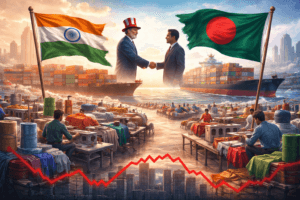
India’s recently secured tariff advantage over Bangladesh in the US market vanished overnight following a swift counter-deal between Washington and Dhaka, which grants Bangladesh quota-based zero-duty access for key textile exports—a move that reversed India’s perceived 1% edge into an 18% disadvantage. This aggressive play by Bangladesh, which committed to purchasing billions in US agricultural and energy products in return, is both a defensive economic strategy as it graduates from least-developed status and a reflection of deepening geopolitical tensions with India, marked by terminated transit agreements and diplomatic friction. The development underscores how trade pacts are now central to strategic maneuvering in South Asia, leaving Indian exporters facing intensified competition and highlighting the fragile interplay between regional diplomacy and economic interest.
How a Single US-Bangladesh Deal Shattered India’s Textile Trade Edge
In the high-stakes arena of global textiles, where profit margins are measured in single percentages and competitive edges are hard-won, India recently experienced a reversal so swift it seemed to defy the usual slow grind of trade diplomacy. Within days of finalizing its own hard-negotiated trade deal with the United States, India watched as Bangladesh secured an agreement with Washington that effectively vaporized New Delhi’s newfound tariff advantage. The immediate fallout was visible on stock tickers: shares of major Indian textile exporters like Gokaldas Exports and KPR Mill tumbled up to 5%. But beyond the market reaction lies a deeper narrative of shifting alliances, regional geopolitics, and a quiet trade war reshaping South Asia’s economic future.
The Anatomy of a Vanishing Advantage
For years, the global textile and apparel export market has been a fiercely contested ladder. China sits at the top, with Bangladesh, Vietnam, and India jostling for position beneath. Tariffs imposed by large importers like the US and EU are critical determinants of competitiveness. In India’s recent deal with the US, reciprocal tariffs on certain goods were lowered to 18%. This was seen as a win, especially as competitors like Bangladesh were expected to face a 19% rate—a slim but significant 1% margin in an industry where that difference can decide which country wins a billion-dollar order.
Bangladesh’s countermove, announced just days later, turned this calculus on its head. The US-Bangladesh joint statement outlined a mechanism for “zero reciprocal tariff rates” on a specified volume of Bangladesh’s textile and apparel exports to the US. While subject to a quota linked to Dhaka’s purchases of US cotton and synthetic fibers, the symbolic and practical impact was immediate. Overnight, India’s perceived 1% advantage transformed into an 18% disadvantage for any shipments falling under that quota.
“The perceived tariff advantage, which we imagined we would have over Bangladesh, gets reversed into a tariff disadvantage,” noted Abhijit Das, a former trade negotiator, capturing the whiplash felt across Indian industry.
Beyond Textiles: The Strategic Gambits
To view this solely as a textile tussle is to miss the broader strategic chessboard. The Bangladesh-US deal is a classic exercise in reciprocal concession. In exchange for preferential access for its garments—the lifeblood of its economy, accounting for over 80% of its exports—Dhaka made steep commitments. It agreed to purchase $3.5 billion in US agricultural products (wheat, soy, cotton) and a staggering $15 billion in US energy products over 15 years. As an Indian Commerce Ministry official pointed out, Bangladesh “significantly opened its economy to the US,” while India’s deal was more protective of its domestic sectors.
For Bangladesh, this was a necessary, defensive play. The nation is transitioning out of Least Developed Country (LDC) status, which will see it lose automatic trade concessions in key markets like the EU. Simultaneously, it watched India advance trade talks with the UK, EU, and US, potentially sidelining Bangladeshi goods. This deal with Washington is a pillar of a broader strategy to secure its economic future post-LDC graduation and to counterbalance India’s own diplomatic outreach.
The Geopolitical Fault Lines Exposed
The trade dynamics cannot be separated from the palpable cooling of India-Bangladesh relations, a stark contrast to the warmth of the previous Sheikh Hasina era. The current interim government in Dhaka, led by Chief Adviser Muhammad Yunus, has struck a notably different tone.
Two pivotal incidents underscore the rift:
- Termination of Transshipment: In April 2025, India terminated a facility allowing Bangladeshi export cargo to be transshipped via Indian land stations and ports to third countries. This was a practical blow to Bangladesh’s trade logistics.
- The “Guardian of the Ocean” Remarks: Professor Yunus’s statement that Bangladesh is the “only guardian of the ocean” for the landlocked Seven Sisters of Northeast India was interpreted in New Delhi as a strategic assertion of leverage. His further suggestion that the region could become an “extension of the Chinese economy” rang alarm bells, highlighting Dhaka’s potential pivot toward Beijing as a counterweight to Indian influence.
This geopolitical souring provides essential context. Bangladesh’s swift trade move is not merely an economic calculation; it is an act of diplomatic signaling, demonstrating its capacity to forge independent partnerships that directly impact Indian interests.
The Two-Fold Challenge for Indian Industry
The Confederation of Indian Textile Industry (CITI) identifies a dual threat:
- Direct Competition in the US Market: The quota-based zero-tariff access gives Bangladeshi exporters a powerful tool to undercut Indian prices and secure larger orders from American brands increasingly seeking to diversify from China. In a market where Bangladesh already holds a larger share than India, this advantage could accelerate the shift.
- Secondary Impact on Upstream Exports: India is a major exporter of cotton yarn to Bangladesh, which then weaves and stitches it into finished garments. If the US-Bangladesh deal incentivizes Dhaka to buy more US cotton (as part of its commitment), demand for Indian cotton yarn could decline, hurting a vital segment of India’s domestic textile ecosystem.
The Bigger Picture: Trade as the New Diplomacy
This episode illustrates a fundamental shift in how trade is being weaponized and woven into the fabric of regional diplomacy. Agreements are no longer just about tariffs and quotas; they are tools of strategic alignment and deterrence.
- For the US: The deal deepens engagement in South Asia, creates a stable market for its agricultural and energy surplus, and subtly checks China’s inroads by strengthening ties with Bangladesh.
- For Bangladesh: It secures an economic lifeline, diversifies partnerships away from over-reliance on any single neighbor, and bolsters its negotiating position vis-à-vis India and the EU.
- For India: It serves as a stark lesson that in a fragmented global order, advantages are fleeting. It underscores the need for agile diplomacy and deeper introspection on managing relationships with neighbors, where economic ties and geopolitical interests are inextricably linked.
Looking Ahead: Pathways for India
The vanishing tariff advantage is a setback, but not an endpoint. India’s response will likely involve:
- Accelerating Other Trade Pacts: Fast-tracking negotiations with the EU and the UK to open alternative, preferential markets for Indian textiles.
- Domestic Competitiveness: Moving beyond tariff debates to address internal challenges like logistics costs, labor reforms, and scaling up productivity to compete on efficiency, not just duty differentials.
- Diplomatic Outreach: Re-engaging with Dhaka to manage disputes and find areas of pragmatic cooperation, recognizing that a perpetually tense neighbor can continually source external partners to offset Indian influence.
Conclusion
The overnight evaporation of India’s tariff edge over Bangladesh is more than a market story. It is a case study in modern economic statecraft, where trade deals are rapid-response instruments in broader strategic rivalries. It reveals the vulnerabilities of interim advantages in a multipolar world and highlights how regional relationships, when mismanaged, can have direct and costly commercial consequences. For India, the challenge now is to look beyond the immediate stock market dip and craft a coherent, long-term strategy that harmonizes its economic ambitions with the delicate geopolitics of its own neighborhood. The textile trade, it seems, is woven with threads of power, diplomacy, and national interest.
You must be logged in to post a comment.