
How a Satellite Discovery Revealed India’s Changing Stubble Burning Crisis
Farmers in northern India have shifted the timing of stubble burning from early afternoon to late afternoon (4-6 PM), a strategic move primarily to evade detection and penalties from authorities who rely on satellite passes that occur earlier in the day.
This behavioral change, driven by a compressed farming schedule due to water preservation laws, has created a double crisis: it undermines official pollution data by causing monitoring systems to miss many fires, and it exacerbates public health dangers because evening meteorological conditions trap smoke closer to the ground, leading to a more severe overnight buildup of hazardous particulate matter. Consequently, while official fire counts may show declines, the actual pollution impact persists or worsens, revealing a critical gap between policy enforcement and on-the-ground reality that demands more accurate monitoring and economically viable alternatives for farmers.
How a Satellite Discovery Revealed India’s Changing Stubble Burning Crisis
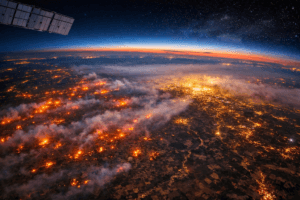
In November 2025, the skies over Delhi once again turned a suffocating grey. For residents, it was the familiar, hazardous onset of winter. For scientists watching from space, however, this year’s toxic haze revealed something new: the nightly rhythm of pollution had fundamentally changed. Farmers across northern India’s agricultural heartlands had begun lighting their crop fires hours later than ever before—a behavioral shift with profound consequences for public health, environmental policy, and the accuracy of the data used to combat this annual crisis.
NASA scientists, analyzing high-frequency data from a South Korean geostationary satellite, documented a clear and recent trend. Where stubble fires once peaked predictably in the early afternoon (between 1 p.m. and 2 p.m.), the bulk of burning now ignites in the late afternoon and early evening, between 4 p.m. and 6 p.m. local time. This seemingly simple change in timing is a strategic adaptation with complex roots, undermining current monitoring efforts and potentially making dangerous air pollution even more severe for millions of people.
The View from Space: Pinpointing the Shift in Smoke
For decades, monitoring seasonal stubble burning has relied on instruments like NASA’s MODIS and VIIRS sensors, which pass over India once or twice a day. This system had a blind spot: it could easily miss fires that burned outside its narrow observational windows.
The discovery of the timing shift came from a different kind of eye in the sky: GEO-KOMPSAT-2A, a South Korean geostationary satellite. Unlike polar-orbiting satellites, this craft maintains a fixed position relative to Earth, allowing it to scan the Indian subcontinent every 10 minutes. This continuous surveillance provided the irrefutable evidence.
As Hiren Jethva, a NASA atmospheric scientist, stated, the data shows farmers have definitively “changed their behaviour”. This finding was corroborated by Indian researchers using Europe’s Meteosat satellite, who reported peak fire activity shifted from 1:30 p.m. in 2020 to about 5:00 p.m. in 2024.
Why Farmers Burn Later: Evasion, Economics, and Tight Schedules
Farmers’ decision to burn later is not arbitrary; it is a rational, if problematic, response to a web of pressures.
- Avoiding Detection and Penalties: A primary driver is the desire to avoid satellite detection and subsequent fines. With authorities using daily satellite passes to identify and penalize burning, shifting the practice to the evening effectively cloaks the activity from the most common monitoring tools.
- The Tyranny of a Tighter Calendar: A deeper, structural cause traces back to a 2009 groundwater preservation law. This policy delayed rice transplanting until the mid-June monsoon, pushing the harvest—and the subsequent need to clear fields—later into October and November. This compression leaves farmers with a critically short window, often just 2-3 weeks, to clear rice stubble and plant the next wheat crop. Burning remains the fastest, cheapest method to meet this relentless deadline.
- A Gap in Risk Perception: Compounding the issue is a disconnect between awareness of the problem and personal responsibility. A 2025 study in Punjab found that while 65% of farming households considered stubble burning a “big problem,” nearly 60% believed the smoke did not affect their own or their family’s health. Furthermore, most respondents believed Delhi’s pollution was caused by urban sources within the city itself, not by their agricultural practices.
Why Timing Matters: From Missed Fires to Trapped Pollution
The shift to evening burning has two major and troubling consequences.
- The “Vanishing Fire” Anomaly and Faulty DataReliance on traditional satellites has created a dangerous illusion of progress. The Indian government reported a90% reduction in fire incidents in Punjab and Haryana in 2025 compared to 2022. However, independent analysis of “burnt area” data—which measures the actual scarred land rather than just counting active flames—tells a different story, showing only a 30% reduction over the same period. This discrepancy suggests official tallies are missing a significant portion of the burning activity, leading to potentially misplaced optimism and inadequate policy responses.
Table: The Evolution of Satellite Monitoring for Stubble Fires
| Satellite/Sensor Type | Observation Frequency | Key Strength | Key Weakness in Current Context |
| MODIS / VIIRS (Polar-orbiting) | 1-2 times per day | High resolution, detects small fires, long-term data record | Misses fires that burn outside its afternoon pass; creates data gaps. |
| GEO-KOMPSAT-2A / Meteosat (Geostationary) | Every 10 minutes | Continuous monitoring, can track daily timing of fires | Lower spatial resolution may miss some smaller fires. |
| Burnt Area Analysis | Post-event analysis | Measures actual impact, not just active flame | Not real-time; requires specialized processing. |
- Worsening the Nighttime Pollution TrapThe new timing is meteorologically disastrous. The evening is when theplanetary boundary layer—the lowest part of the atmosphere where we live—begins to shallow and winds weaken. Pollution released at this time has nowhere to go. Instead of dispersing, smoke and particulates accumulate overnight, leading to a stronger and more hazardous buildup by morning. As a UN Environment Programme official described, winter in Delhi creates a bowl-like effect where pollutants become trapped, turning simple respiration into a health hazard.
Estimates of stubble burning’s contribution to Delhi’s peak pollution vary widely, from 10% to 50% on an episodic basis, highlighting the complexity of attribution. NASA scientist Pawan Gupta notes that while burning can contribute 40-70% on a single severe day, this averages to 20-30% over a month and falls below 10% annually, emphasizing that it is a intense, seasonal shock layered on top of perennial urban pollution from vehicles, industry, and dust.
Beyond Carrots and Sticks: The Search for Effective Solutions
The government’s approach has been a mix of penalties (“the stick”) and subsidies for alternative machinery (“the carrot”), such as the Happy Seeder, which plants wheat through the stubble. While the adoption of such technology is growing, barriers remain high due to cost, accessibility, and ingrained practice.
Experts argue for a more integrated, full-year strategy that moves beyond crisis management. Key recommendations from recent analyses include:
- Transparent and Accurate Data: The government must prioritize and publish burnt area estimates alongside fire counts to gain a true picture of the problem.
- Financial Innovation: Solutions like direct payments for ecosystem services could compensate farmers for the added cost and labor of sustainable stubble management, making it an economically viable choice.
- Diversifying End-Uses: Promoting a robust market for paddy straw—in bioenergy, packaging, or composting—can transform waste into income, creating a self-sustaining solution.
The late-afternoon smoke over Punjab is more than just a change in the clock; it is a symptom of a deep-seated agricultural dilemma. It reveals the gaps in our monitoring, the unintended consequences of well-meaning policies, and the urgent need for solutions that align with the economic realities of farmers. As satellites continue their silent watch, the challenge remains to translate their clear-eyed view into effective action on the ground, ensuring that the quest for food security does not come at the cost of the air we breathe.
You must be logged in to post a comment.