
How a Farmer’s 30-Year-Old Lesson from His Father Became a Game-Changer for 150 Farms
How a Farmer’s 30-Year-Old Lesson from His Father Became a Game-Changer for 150 Farms
For Subrata Karmakar, a farmer in West Bengal’s Hooghly district, the seeds of success were planted not in a laboratory, but in his childhood memories. A simple, oft-repeated piece of paternal wisdom has blossomed into a ₹30 lakh enterprise, quietly reshaping the agricultural fortunes of over 150 farming families.
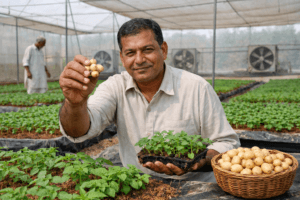
The sun climbs over the fields of Beleswar Basna village, casting long shadows across the neatly arranged rows of a polyhouse. Inside, Subrata Karmakar, 50, moves with a quiet, deliberate focus, inspecting tender green plantlets nestled in beds of cocopeat. The air is cool, a controlled 22 degrees Celsius, a stark contrast to the February warmth building outside. This is not just a farm; it’s a factory of possibility. And at its heart is an idea Subrata has carried with him since he was 11 years old, trailing behind his father through their nine bighas of land.
“A good farmer always produces his own seeds,” his father would say.
For decades, that was a dream deferred by circumstance. Like most farmers in West Bengal, a state that devours potatoes, Subrata was dependent on seeds trucked in from the cold plains of Punjab. It was a system that worked, but at a cost—literally and figuratively. The seeds were expensive, their performance sometimes unpredictable in Bengal’s climate, and the farmer was perpetually at the mercy of an external supply chain.
“My father’s words were always in the back of my mind,” Subrata admits, his hands gently touching a micro-plant. “But knowing something and being able to do it are two different things. For years, I didn’t have the means or the knowledge to change the way we farmed.”
The Graduate Who Chose the Soil
In 1998, after completing a Bachelor of Arts degree, Subrata faced a choice that defines the trajectory of many rural youths. The village often pushes its educated young toward the city, toward government jobs, toward anything that isn’t the back-breaking, uncertain toil of agriculture. Subrata chose to stay.
Farming wasn’t a fallback; it was a calling he understood intimately. The early years were a canvas of experimentation. He grew rice, pumpkins, cucumbers, and gourds, learning the subtle language of his soil—its texture, its thirst, its response to different seasons. Some crops flourished, others failed, but each harvest added a brushstroke to his understanding. He learned to read the land in a way no textbook could teach.
This quiet period of learning was crucial. It built in him a resilience and a problem-solving mindset that would later prove invaluable. When he first heard, around 2012, about the West Bengal government’s push for self-sufficiency in potato seeds, his father’s old words echoed louder than ever. The concept of Apical Rooted Cutting (ARC) technology was introduced to him. It sounded complex, almost scientific, but its core promise was simple: to free farmers like him from dependency.
The School of Hard Knocks (and Low Germination)
Driven by this vision, Subrata took his first leap into the world of high-tech agriculture in November 2023. He procured micro-plants—tiny, lab-grown plantlets that are the foundation of the ARC process—and followed the protocol to the letter. Or so he thought.
The result was a humbling failure. Only about 40% of his first batch of ARC from those micro-plants survived. For a farmer investing time, money, and a lifetime of reputation, it was a crushing blow.
“Many people would have given up,” says a neighbour who watched the experiment unfold. “They would have said, ‘This modern technology is not for us.’ But Subrata is different. He just sat in his field, staring at the plants that didn’t make it, trying to understand why.”
Subrata didn’t get frustrated; he got analytical. He revisited every step, questioned every assumption, and consulted with agricultural officers. He realised that success in ARC wasn’t just about following a manual; it was about precision, hygiene, and creating a micro-environment of perfect care. He adjusted the temperature, refined his sterilisation process, and learned the exact moment to make a cut. The setbacks became the most valuable training he could have asked for.
A Greenhouse of Ideas
The breakthrough came with support. Through the Rashtriya Krishi Vikas Yojana – RAFTAAR scheme, Subrata applied for and received a subsidy in 2024. It was the catalyst he needed. With an investment of ₹7.5 lakh from his Farmers Producer Company (FPC) and a ₹2 lakh government subsidy, he constructed a state-of-the-art 1,000-square-metre greenhouse on a 15-katha plot next to his field.
Walking into that greenhouse is like stepping into a different world. A fan and pad cooling system hums constantly, maintaining a climate between 18 and 24 degrees Celsius. The process is meticulous. Before anything is planted, cocopeat bricks are soaked and their salinity checked with an EC meter, ensuring it reads zero. The beds are laid out on clean polythene sheets. Every detail is controlled.
Here, the magic of multiplication happens. The micro-plants, sourced from a lab in Krishnanagar, arrive in containers of 50 to 75. They are planted with five centimetres of space between them. In three to four weeks, they grow six to eight centimetres tall. That’s when Subrata performs the critical act: taking an apical cutting—the top of the shoot with five leaves.
These tiny cuttings are washed in mineral water, treated with antibiotics and antifungals to prevent disease, dipped in a rooting hormone called Rootex, and then carefully inserted into the cocopeat beds.
Within three days, new roots emerge. When these new plants mature, they are pruned again. Through this repetitive process, a single micro-plant can yield a staggering 256 plantlets. It’s a biological chain reaction, turning a handful of lab specimens into a field-ready army of seed producers.
The Ripple Effect: From One Farm to 150
From 6,500 micro-plants purchased in 2025, Subrata raised over 1,08,000 mother plantlets. From 13,500 of these plantlets, he harvested 67,000 G0 (Generation Zero) mini-tubers—the first, purest generation of seeds. In 2024 alone, his turnover from potato seeds reached ₹30 lakh.
But the most profound impact is felt beyond his own balance sheet. Subrata is a Director of the Hooghly Vegetable Growers Producer Company Limited (HVGPCL), and through this network, the benefits are multiplying like the plants in his greenhouse.
Take Hareram Singha, a 74-year-old farmer from the nearby Baksagarh village. For decades, he planted table potatoes bought from the market, accepting the costs and the yields as they came. Last year, he used ARC seeds produced by Subrata’s network on his one bigha of clay soil. He planted Himalini potatoes and harvested 3,000 kilos. This year, he’s sown Chandramukhi and is expecting 4,000 kilos.
“The difference is clear,” says Hareram, his weathered face breaking into a smile. “The plants are healthier, more vigorous. Even the smaller potatoes I now save as seed for the next small planting. It’s a cycle that has begun.”
The economics are undeniable. A 50-kilogram sack of conventional potato seed from Punjab can cost a farmer between ₹2,500 and ₹3,000. Subrata’s ARC seeds are sold through the FPC for ₹1,200 to ₹1,800 for the same weight. This isn’t just a discount; it’s a lifeline for small and marginal farmers. Lower input costs mean they can breathe easier, invest in other areas, or simply have a financial cushion.
Furthermore, the yield per plant is transformative. An ARC seed can generate up to 26 tubers, with an average of 18 to 20. A conventional seed? Just four to six. This isn’t just incremental improvement; it’s an exponential leap in productivity.
“The plants from ARC seeds are also remarkably disease-free,” adds Shyamal Mukherjee, another Director of the FPC, who farms on 30 to 40 bigha of harder soil. “We are not seeing the ring rot or late blight that we often had to contend with before. It reduces our need for sprays and increases our confidence in the crop.”
Today, out of the 1,000 farmers associated with HVGPCL, around 150 are now cultivating potatoes using ARC seeds. The greenhouse and the 15 net houses operating across Balagarh block have created a decentralised, resilient network of seed production. Farmers are no longer just consumers of a distant industry; they are becoming producers of their own most critical resource.
The Future is in Their Own Hands
Sitting in the shade of his greenhouse, with the quiet hum of the cooling system in the background, Subrata’s thoughts are already on the next harvest and the one after that. By 2026, the group aims to produce around 300,000 G0 tubers, which could generate an estimated 1.8 million G1, G2, and G3 seeds. These will replenish their own farms and supply an ever-growing circle of neighbours.
His ambitions, however, stretch beyond just multiplying seeds. He talks about developing potato varieties tailored for specific purposes—high-starch potatoes for processing companies, and others ideal for making crispy chips. He dreams of a dedicated, large-scale seed farm in Bengal that could make the state a powerhouse of potato planting material, not just table produce.
Challenges remain. As Subhojit Saha, Vice President of the West Bengal Cold Storage Association, points out, dedicated storage for these high-quality ARC seeds is still limited. For now, they rely on shared space in existing cold storages, but a more robust, specialised infrastructure is the next frontier.
Yet, on a warm afternoon, as Subrata walks back through his fields, the journey feels less like a list of challenges and more like a story coming full circle. The boy who once walked behind his father, absorbing a simple lesson, now walks ahead, leading a movement.
He stops and gestures toward the polyhouse. “This technology is incredible. The cooling systems, the cocopeat, the plantlets—it’s all very modern. But the core of it is very old.”
He picks up a small, firm G0 mini-tuber, holding it up to the light. “My father told me a good farmer produces his own seeds. He meant it as a lesson in self-reliance. He never imagined it would be possible on this scale. But the principle is the same. It’s about not being dependent. It’s about having control over your own future.”
In the red soil of Hooghly, that principle has not only taken root—it has multiplied a thousand times over, one tiny cutting at a time.
You must be logged in to post a comment.