
How a 73-Day Hunger Strike Reshaped UK Activism and Defense Policy
The Palestine Action hunger strikers achieved a significant but partial victory: their 73-day protest, which brought international attention and saw participants risk death, successfully pressured the UK government to deny a £2 billion defense contract to Elbit Systems UK, a key demand, and secured some improvements in prison conditions like mail delivery and a transfer. However, they failed to achieve their other core objectives, including immediate bail for the imprisoned activists (who remain in long-term pre-trial detention) and the de-proscription of the Palestine Action group. Ultimately, the hunger strike served as a powerful rallying cry that mobilized hundreds of new supporters and elevated public awareness of UK arms ties with Israel, marking a strategic impact on the movement despite the steep personal health costs and unmet demands.
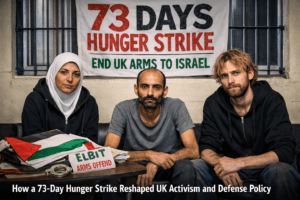
How a 73-Day Hunger Strike Reshaped UK Activism and Defense Policy
Their bodies had reached the breaking point, but their protest had reached the world.
The longest hunger strike in Britain since the 1981 Irish prison protests ended not with a death, but with a significant political concession. After 73 days without food—reaching the same grim milestone as 1981 hunger striker Kieran Doherty—Heba Muraisi ended her protest alongside fellow activists Kamran Ahmed and Lewie Chiaramello. While the activists secured neither their freedom nor the de-proscription of their organization, they achieved something remarkable: disrupting a £2 billion defense contract with a company they accused of complicity in the war in Gaza.
What Was Won and Lost: A Mixed Outcome
| Demands Met (Partial or Full Victories) | Demands Not Met (Continued Struggles) |
| Elbit Systems UK denied £2bn MoD contract | Immediate bail denied (all remain in pre-trial detention) |
| Heba Muraisi’s prison transfer approved (back to HMP Bronzefield) | Palestine Action remains proscribed as a “terrorist organisation” |
| Some withheld mail and books delivered | All 16 Elbit UK sites remain operational |
| Export license data on Elbit disclosed to a researcher | Government refused to meet with strikers or their representatives |
| Increased public awareness of Elbit and UK arms trade | Lengthy pre-trial detention continues (over 18 months for some) |
The Body as the Final Protest: Sacrifice and Human Cost
By the time the hunger strike ended, the participants had entered medically uncharted and dangerous territory. Dr. James Smith, an emergency physician advising the strikers, stated they were “well into the critical phase” where “things can decline very quickly and irreversibly”.
Heba Muraisi, who spoke to Al Jazeera via an intermediary on her 72nd day, described a deteriorating reality: “I no longer feel hunger, I feel pain… I think about how or when I could die”. Her physical symptoms included severe muscle spasms, breathing difficulties, memory decline, and an inability to read as she once could. Kamran Ahmed’s condition was equally grave. Having started at a healthy 74kg, his weight plummeted to 56kg. He suffered cardiac atrophy (heart shrinkage), chest pain, intermittent hearing loss, and slurred speech, and had been hospitalized multiple times during the protest.
These were not abstract political actors but individuals whose bodies were literally breaking down. Ahmed reflected on this dichotomy while imprisoned: “I don’t think any of the hunger strikers wish to die, but it’s funny, if I potentially pass away, does it only matter because I have a [UK] passport? Are the Palestinians disposable numbers?”
The Elbit Contract: A Complex Victory
The most concrete outcome claimed by the strikers was the UK government’s decision not to award a £2 billion Ministry of Defence contract to Elbit Systems UK, a subsidiary of Israel’s largest arms manufacturer. The 10-year contract would have involved training 60,000 British troops annually.
While Prisoners for Palestine called this “a resounding victory for the hunger strikers,” the reality appears more nuanced. According to reports, the decision followed revelations about improper conduct during the bidding process. The Times reported that a former British Army brigadier who had overseen the contract process later attended meetings with Elbit to help them secure it, potentially breaching business appointment rules. Additionally, a senior civil servant assessing the bid was reportedly “dined by Elbit seven times,” while rival bidder Raytheon UK hosted no such events.
The Ministry of Defence maintained that Raytheon was simply a “better candidate,” but the coincidence of timing is striking. The contract decision emerged publicly just as the hunger strikers reached their most critical health phase. As Francesca Nadin of Prisoners for Palestine acknowledged: “We’ll never know for sure but it’s quite clear to me that all of the campaigning… had an impact on that”.
Prison Conditions and Systemic Tensions
Beyond the Elbit contract, the hunger strike highlighted systemic tensions within the UK’s justice and prison systems. The activists’ prolonged pre-trial detention—expected to exceed 18 months before their trials begin—far exceeds the standard six-month limit, raising questions about the use of remand in politically sensitive cases.
During the protest, the strikers reported censorship of communications, with prison staff allegedly withholding mail, particularly materials related to Palestine. However, the campaign did secure some concessions: Muraisi’s approved transfer to a prison nearer her family, the bulk delivery of previously withheld mail (including an apology for a six-month delay), and the provision of books on Gaza and feminism that had been blocked.
The government maintained a firm institutional line throughout. Ministers refused to meet with the strikers or their representatives, arguing this would create “perverse incentives” for others to endanger themselves. They emphasized that bail decisions rest with the independent judiciary, not the government.
Historical Echoes: Hunger Strikes as Political Strategy
This protest inevitably drew comparisons to the 1981 Irish republican hunger strikes, particularly Bobby Sands’ 66-day fast that ended in death. Muraisi’s 73-day strike surpassed Sands’ duration, placing her in a historically significant but medically precarious position.
The historical parallel is not exact but instructive. Like the 1981 strikers, these activists used self-sacrifice as leverage against a government unwilling to negotiate directly. And like their predecessors, they achieved some objectives while leaving core demands unmet. The 1981 hunger strikers are now “retrospectively recognised as changing the course of the Northern Irish conflict,” suggesting that the full impact of such protests may only become clear with time.
One significant difference lies in medical management. Advances in understanding refeeding protocols and supplementation may have prevented the catastrophic organ failure that claimed earlier hunger strikers’ lives. Yet this medical progress doesn’t eliminate risk—refeeding itself can be fatal if mismanaged, and long-term health consequences from such prolonged starvation often take years to manifest.
A Movement Energized, Not Satisfied
The hunger strike’s conclusion represents a strategic pause rather than a resolution. While the activists ended their life-threatening protest, the broader campaign continues. The judicial review challenging Palestine Action’s proscription as a terrorist organization is still pending. The “Filton 24” defendants still face trial. And Elbit Systems, despite losing one major contract, maintains multiple UK sites and government contracts.
Perhaps the most significant outcome is the mobilization effect. Prisoners for Palestine reported that in the protest’s final weeks, 500 people signed up to take direct action—more than had joined Palestine Action’s entire five-year campaign before its proscription. This suggests the hunger strike served as what activist Francesca Nadin called “a rallying cry to the people”.
The protest also achieved significant international amplification, with U.S. Congresswoman Rashida Tlaib posting about the strikers’ plight on social media, UN experts intervening, and media outlets worldwide covering the story. This global attention elevated what might have remained a contained UK prison protest into an international symbol of resistance against arms sales to Israel.
As the hunger strikers begin the delicate process of refeeding and physical recovery, their legacy is complex. They forced a rare corporate consequence for Elbit Systems, drew unprecedented attention to UK complicity in the Gaza conflict, and exposed tensions in the British justice system. They did not secure their freedom or their organization’s legal status, but as Kamran Ahmed’s sister Shahmina Alam observed: “They took back control”.
In the balance between sacrifice and achievement, between bodily risk and political gain, these activists have written a new chapter in the long, painful history of hunger strikes as political protest—one that demonstrates both the enduring power and profound limitations of using one’s body as the final argument.
You must be logged in to post a comment.