
How a ₹460 Crore Deal Merges Space Tech with India’s Railway Ambitions
Avantel’s ₹459.9 crore contract with Zetwerk to supply and maintain 12,000 RTIS devices for Indian Railways marks a pivotal integration of space technology—developed with ISRO—into the national rail network, moving train tracking from manual, cellular-based systems to automated satellite communication. By leveraging Avantel’s defence‑grade expertise in SATCOM and software‑defined radios alongside Zetwerk’s manufacturing scale, the deal not only enhances real‑time operational efficiency and safety but also exemplifies India’s push for self‑reliance in critical infrastructure, creating a unified, future‑proof data backbone for the country’s vast locomotive fleet.
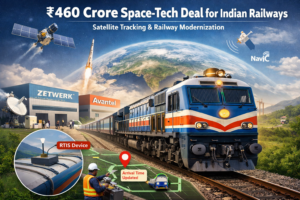
How a ₹460 Crore Deal Merges Space Tech with India’s Railway Ambitions
In a move that underscores the deepening integration of space technology into India’s terrestrial infrastructure, Avantel Ltd has secured a monumental contract worth ₹459.9 crore from Zetwerk. At first glance, this might appear to be just another transaction in the bustling aerospace and defence sector. However, a closer look reveals a pivotal moment in the Indian Railways’ journey toward complete digital autonomy—a journey where satellite constellations, homegrown defence electronics, and the “Make in India” ethos converge on a single railway track.
The contract, awarded by Bengaluru-based manufacturing unicorn Zetwerk, tasks Avantel with the supply and comprehensive Annual Maintenance Contract (AMC) of 12,000 Real-Time Train Information System (RTIS) devices. These devices are destined for the Centre for Railway Information Systems (CRIS), the technological backbone of Indian Railways. While the headline focuses on the hefty price tag, the real story lies in the technological symphony being orchestrated: a partnership between a defence electronics specialist (Avantel), a contract manufacturing giant (Zetwerk), and the Indian Space Research Organisation (ISRO) to solve one of the railway’s oldest operational challenges—knowing exactly where a train is, at any given second.
Beyond the Press Release: The RTIS Technology
To understand the significance of this order, one must first understand what RTIS represents. Developed in conjunction with ISRO, the RTIS project moves beyond the limitations of traditional cellular-based tracking (which often fails in remote areas or tunnels) and legacy GPS systems. Instead, it leverages satellite communication (SATCOM) to automatically update train locations, speeds, and estimated arrival times without requiring human intervention from loco pilots or guards.
Currently, train tracking often relies on manual inputs at stations or the older Train Control and Monitoring Systems. RTIS automates this. By using satellite-based tracking units installed on locomotives, the system pings the train’s location to a central server every few seconds. For the average passenger, this means the difference between a vague “delayed due to operational reasons” and a precise, real-time update showing the train’s exact position on a map.
For Indian Railways, however, the utility is far more profound. This system enables:
- Optimized Asset Utilization: Knowing the real-time location of every locomotive and rake allows for tighter turnaround times at terminals. A train that sits idle for an extra hour because the control office didn’t know it had arrived translates into lost capacity. RTIS aims to eliminate that lag.
- Enhanced Safety: In a network where thousands of trains run on a shared grid, precise location data is the cornerstone of collision avoidance systems and better management of unmanned level crossings.
- Predictive Maintenance: Data regarding speed patterns, braking events, and vibration (often captured by ancillary sensors linked to these devices) can feed into predictive algorithms to identify rolling stock that is about to fail, shifting maintenance from reactive to proactive.
The Zetwerk-Avantel Synergy
The fact that this contract flows through Zetwerk is equally telling. Zetwerk, known for disrupting the manufacturing supply chain in India, acts as the prime contractor or aggregator in this scenario. For Avantel, a company with deep roots in defence electronics (specifically software-defined radios and radar subsystems), this partnership validates a strategic pivot or expansion.
By partnering with Zetwerk, Avantel gains access to a streamlined supply chain and manufacturing scalability that is crucial for an order of 12,000 units. Siddhartha Abburi, Director of Avantel Ltd, highlighted that the contract spans three years, covering both supply and maintenance. This AMC component is critical; it signifies a long-term commitment to the operability of the system, moving Avantel from a pure-play hardware supplier to a lifecycle service provider for national infrastructure.
Avantel’s Defence Pedigree Meets Civilian Infrastructure
Avantel’s core expertise lies in domains typically reserved for high-security defence applications: satellite communications (SATCOM), radar subsystems, and software-defined radios (SDRs). SDRs, in particular, are interesting in the context of railway tech. Unlike traditional hardware-based radios, SDRs can be reprogrammed and updated over the air to adapt to new communication protocols.
The deployment of 12,000 devices equipped with such hardened communication technology suggests that Indian Railways is not just looking for tracking, but is future-proofing its network for upcoming communication-based train control systems. In many ways, the technology that ensures a fighter jet remains in contact with its command center is now being repurposed to ensure that a freight train or a passenger express remains visible to the network operations center.
This cross-pollination of defence technology into civilian infrastructure is a testament to India’s growing indigenous capability. It reflects a strategic effort to reduce dependency on foreign vendors for critical communication networks. Given the strategic nature of railway infrastructure—moving troops, supplies, and millions of citizens daily—the ability to control the hardware and software stack domestically (under the “Atmanirbhar Bharat” initiative) is a national security imperative as much as an operational one.
The Digital Transformation of Indian Railways
This contract fits into a much larger mosaic of digital transformation currently underway within Indian Railways. Over the last five years, the national transporter has aggressively moved toward integrating IT systems. From the installation of the Kavli automatic train protection system to the revamp of unreserved ticketing, the goal has been to transform a colonial-era behemoth into a modern, tech-driven logistics giant.
CRIS, the end-user in this contract, is the nodal agency driving this change. The organization is tasked with designing and maintaining the mission-critical information systems that run the railway. By standardizing the RTIS devices through a massive tender like this, CRIS is ensuring uniformity. Historically, Indian Railways had a fragmented landscape of tracking systems. The move to saturate the locomotive fleet with 12,000 new, standardized RTIS devices is a push toward a single source of truth for train movement data.
Implications for the Supply Chain and Manufacturing
For the broader Indian manufacturing ecosystem, the contract signals a maturation of the domestic supply chain. Zetwerk, which started as a B2B marketplace for manufacturing, has evolved into a critical player in infrastructure projects. By entrusting a contract of this magnitude to a company like Zetwerk, Indian Railways and CRIS are demonstrating confidence in the ability of Indian private enterprises to manage large-scale, complex supply chain logistics that were traditionally the domain of public sector undertakings (PSUs).
Moreover, Avantel’s commitment to the “Make in India” initiative suggests that the localization of these RTIS devices will be high. This not only creates jobs but also ensures that the maintenance and replacement parts for these devices over their lifecycle remain available domestically, shielding the project from global supply chain shocks.
Challenges Ahead
Despite the optimism, the execution of such a contract is fraught with challenges. The railway environment is notoriously harsh. Locomotives operate in extreme temperatures, high dust conditions, and constant vibration. Ensuring that 12,000 sophisticated electronic devices maintain uptime in such conditions requires a level of ruggedization that goes beyond standard commercial electronics.
Additionally, the “AMC” component for 12,000 devices spread across the length and breadth of India—from the deserts of Rajasthan to the hills of the Northeast—poses a logistical nightmare. Avantel will have to establish a service network that can respond to hardware failures in remote locations to ensure the data stream remains uninterrupted. The success of this contract will likely be measured not just by how many units are supplied, but by the system availability percentage three years from now.
The Bigger Picture: A Connected National Network
What is perhaps most exciting about this development is the shift in perspective regarding what Indian Railways can be. The introduction of SATCOM-enabled tracking brings it closer to the standards of modern global railways. When combined with the upcoming high-speed rail corridors and the expansion of dedicated freight corridors, the RTIS system will form the data backbone that allows for high-density, high-speed operations.
Furthermore, the partnership with ISRO adds a layer of sovereignty. In an era where geopolitical tensions can jeopardize access to foreign satellite services, relying on India’s own navigation and communication satellites (like the ones planned under the NavIC and future SATCOM programs) ensures that the railway network remains operational regardless of external pressures.
Conclusion
Avantel’s ₹459.9 crore contract is more than just a financial win for the Hyderabad-based company; it is a validation of India’s ability to build complex, indigenous tech stacks for its critical infrastructure. It brings together the agility of private enterprise (Zetwerk), the specialized R&D of the defence sector (Avantel), and the visionary space capabilities of ISRO to solve a problem that impacts the daily lives of millions of passengers.
As Siddhartha Abburi noted, this is about building “smarter and more connected infrastructure.” For the Indian Railways, the journey toward a fully digital, AI-driven future is long. But with the deployment of these 12,000 RTIS devices, the tracks are being laid—not just of steel, but of data. This contract ensures that for the next three years, and likely beyond, India’s trains will be guided not just by the hands of their pilots, but by the silent, consistent gaze of satellites orbiting hundreds of kilometers above the earth.
You must be logged in to post a comment.