
Heritage and Hegemony: Israel’s Seizure of Sebastia Threatens to Erase Palestine’s Layered History
The February 18, 2026 Israeli order to seize 2,000 dunams of land near Sebastia in the northern West Bank represents a strategic maneuver to expand settlement control by appropriating not only a major archaeological site of immense historical significance—containing layers from Canaanite to Islamic civilizations—but also the surrounding agricultural lands and olive groves that have sustained Palestinian families for generations. By framing the seizure as heritage “development” and leveraging administrative tools alongside legislative efforts to extend Israeli antiquities law over the occupied territories, the move effectively dispossesses local communities from their livelihoods while attempting to rewrite the region’s multi-layered history. This action is part of a broader escalation of settlement expansion and military operations in the West Bank since the Gaza war began, which Palestinians and international bodies like the ICJ view as a systematic step toward de jure annexation, transforming a living cultural landscape into an exclusive nationalist narrative enforced through military orders and archaeological authority.
Heritage and Hegemony: Israel’s Seizure of Sebastia Threatens to Erase Palestine’s Layered History
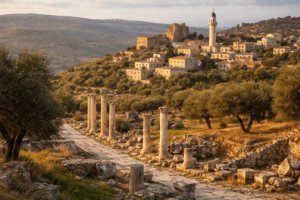
The sun rises over the hills of the northern West Bank, casting long shadows across a landscape that has borne witness to millennia of civilization. In the quiet of the morning, the ancient stones of Sebastia tell a story of empires—Canaanite, Roman, Byzantine, and Islamic—each leaving its indelible mark on the terraced slopes. But today, a new and aggressive chapter is being written, not with the chisel and hammer of builders, but with the cold, administrative stroke of a military order.
On Tuesday, the Israeli government issued a directive to seize approximately 2,000 dunams (494 acres) of land in this sensitive area of the Nablus governorate. The order, confirmed by Moayad Shaaban, head of the Palestinian Wall and Settlement Resistance Commission, targets land belonging to the towns of Sebastia and Burqa. While the official rationale, as reported by Haaretz late last year, points to the “development” of the Sebastia archaeological site, Palestinians and international observers see a far more calculated maneuver: the strategic consolidation of Israeli settlement control in the central West Bank, cloaked in the language of heritage preservation.
This is not merely a land grab; it is a battle over narrative, memory, and the very physical evidence of a people’s connection to their homeland. By seizing a site of such profound historical significance, Israel is attempting to rewrite the history of the land, selectively excavating one past while actively burying another.
Sebastia: A City Built on Layers of Time
To understand the gravity of this move, one must first appreciate what Sebastia represents. Unlike many disputed sites that hold religious significance primarily for one faith, Sebastia is a palimpsest of human history. According to the Palestinian Tourism Ministry, its origins stretch back to the Bronze Age. It is traditionally identified as the capital of the northern kingdom of Israel under King Omri and later became the Greco-Roman city of Sebaste, named by Herod the Great in honor of Emperor Augustus.
Walking through the site today, one can see the remnants of a Roman colonnaded street, a forum, and a temple dedicated to Augustus. The remains of a Byzantine church stand nearby, and a mosque, Nabi Yahya Mosque, is said to house the tombs of Elisha and Obadiah, prophets revered in both Islamic and Judeo-Christian traditions. This layered history has made it a symbol of coexistence and the rich, intertwined heritage of the region. For Palestinians, it is not just an archaeological treasure; it is a living testament to their deep-rooted presence in the land, a history that predates the modern conflict and challenges the narrative that this is an empty land promised to one people alone.
For years, Sebastia has been a point of pride and a site of quiet Palestinian cultural preservation. Local families from the adjacent town of Sebastia, which has a population of just under 3,000, have tended the land and the olive groves that blanket the surrounding hills for generations. The olive trees, some hundreds of years old, are as much a part of the heritage as the Roman columns, their gnarled trunks a symbol of sumud, or steadfastness, in the face of adversity.
The Mechanics of Annexation
The February 18th seizure order is the culmination of a process set in motion over a year ago. Shaaban pointed to an initial notice of intent issued on January 18, 2025, highlighting a systematic approach. The Israeli Civil Administration, the military body that governs the occupied West Bank, has increasingly used “land regularization” and “state land” declarations to effectively annex territory for settlement expansion. By declaring archaeologically significant land as a “national park” or antiquities site, it can be removed from Palestinian use and placed under the control of Israeli bodies, such as the Israel Antiquities Authority or pro-settlement organizations.
This move dovetails with legislative efforts in the Knesset (Israel’s parliament). In July 2024, a bill passed a preliminary reading seeking to apply Israeli law to West Bank antiquities, effectively extending Israeli sovereignty over them. A new version of the bill was tabled in December 2024, with the explicit goal of bringing Areas A and B of the West Bank—where the Palestinian Authority has civil control under the Oslo Accords—under the purview of Israeli law. By seizing Sebastia, Israel is not just taking land; it is preemptively enforcing a law that doesn’t officially exist yet, creating a fait accompli on the ground.
The order is not limited to the ancient ruins. It extends, as Shaaban warned, into the surrounding agricultural lands, the “olive groves owned by Palestinian residents.” This is a critical detail. It reveals that the goal is not just to fence off a few historical pillars for tourists, but to create a territorial buffer, a continuous stretch of land under Israeli control that connects existing settlements and restricts the growth of Palestinian communities like Burqa and Sebastia. The fertile valleys and hillsides, carefully cultivated for centuries, are being transformed from a source of livelihood for Palestinian families into a strategic asset for the settlement movement.
The Human Cost: A Harvest Interrupted
For the farmers of Burqa and Sebastia, this is an existential crisis. For 52-year-old Mahmoud Abdallah, whose family has owned a plot of land on the slopes below the archaeological park for generations, the news is a devastating blow. “My grandfather planted these trees,” he says, his voice heavy with grief. “He taught my father, and my father taught me. Every olive harvest is a connection to them, to the land. Now they tell me this is for ‘development’? What kind of development takes a man’s livelihood and calls it heritage?”
Mahmoud’s story is not unique. Thousands of Palestinians in the area face the imminent loss of their primary source of income. The olive harvest, which usually takes place in October and November, is not just an economic activity; it is a cultural cornerstone, a time when families reunite and communities come together. With the seizure order, this year’s harvest may be their last. The military order effectively makes it illegal for them to access their own land, paving the way for settlers, under military protection, to eventually cultivate it or for it to be declared a closed military zone.
This tactic is a well-established feature of Israel’s occupation. By controlling the land, you control the people. When farmers are cut off from their fields, they are forced to seek work in Israeli industrial zones or settlements, creating an economic dependency that further erodes the viability of a future Palestinian state. The seizure of Sebastia is a textbook example of this strategy: use the pretext of history to dispossess the living inhabitants of that history.
A Broader Escalation
The Sebastia seizure cannot be viewed in isolation. It is part of a dramatic intensification of Israeli operations and settlement expansion in the West Bank since the onset of the war in Gaza on October 7, 2023. Palestinian officials view this escalation—characterized by near-daily military raids, mass arrests, home demolitions, and the ramping up of settlement construction—as a systematic push towards de jure or de facto annexation.
Earlier this month, the Israeli government adopted additional measures expanding its enforcement powers in parts of the West Bank, specifically citing violations related to construction, water, and, significantly, “heritage.” This provides the legal cover for actions like the one in Sebastia. The focus on “heritage-related violations” is a particularly insidious tool, as it allows Israel to police Palestinian building and land use under the guise of protecting antiquities, even when those antiquities lie directly beneath Palestinian-owned land.
The international community has repeatedly condemned such actions. In a landmark advisory opinion in July 2024, the International Court of Justice (ICJ) declared Israel’s occupation of Palestinian territory illegal and called for the evacuation of all settlements in the West Bank and East Jerusalem. More than 80 UN member states recently condemned Israeli acts to expand its “unlawful presence” in the occupied territory. Yet, these condemnations have done little to alter the reality on the ground. For the residents of Sebastia, international law feels like an abstract concept, powerless against the bulldozers and military orders that are reshaping their world.
The War of Narratives
Ultimately, the battle for Sebastia is a war of narratives. For the Israeli right and the settler movement, controlling these sites is a way to assert a monolithic, exclusive Jewish claim to the land. By unearthing and prioritizing Jewish and Roman layers of the site, they can attempt to minimize or erase the subsequent Islamic and Arab history. This is a form of archaeological warfare, where the spade is used as a weapon to delegitimize the Palestinian national project.
For Palestinians, protecting Sebastia is an act of cultural survival. It is a fight to preserve the multi-layered truth of their homeland—a land where Canaanites, Israelites, Romans, Muslims, and Christians have all left their footprint. To lose Sebastia is not just to lose territory; it is to have a part of their collective memory confiscated. It is to see their ancestors’ graves and their grandfathers’ olive trees rebranded as part of another people’s heritage park.
As the Israeli order moves from paper to implementation, the people of Sebastia and Burqa are left to contemplate a future where they are visitors in their own homeland. The ancient stones will remain, but the living culture that surrounded them—the sound of Arabic echoing from the hills, the sight of farmers tending their ancestral groves, the deep, personal connection to a place that has been home for centuries—will be systematically dismantled. The seizure of this land is more than a political maneuver; it is an act of historical erasure, one stone, and one olive tree, at a time.
You must be logged in to post a comment.