
Haze Returns to Delhi: Decoding the 169 AQI and the Ominous Start to Pollution Season
The recent deterioration of Delhi’s air quality to an AQI of 169 marks the ominous start of its annual pollution season, primarily driven by a cyclonic circulation that pulled dust from neighboring arid regions into the city’s natural topographic bowl. While this initial “moderate” haze is distinct from the severe winter smog—being composed largely of coarse PM10 dust rather than the more dangerous PM2.5 particles from stubble burning and vehicles—it serves as a critical warning sign that the atmospheric conditions are now conducive to pollutant accumulation.
This early spike underscores the complex interplay of meteorological and geographical factors that trap pollutants, signaling the beginning of a prolonged period of toxic air that demands immediate public vigilance, such as the use of masks and air purifiers, rather than waiting for conditions to worsen to “severe” levels.
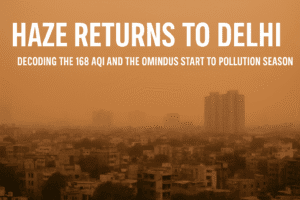
Haze Returns to Delhi: Decoding the 169 AQI and the Ominous Start to Pollution Season
The first grey veil has descended. For the residents of Delhi, the sight of a hazy, sepia-toned sky in late September is a familiar, yet deeply unsettling, annual ritual. After a brief summer respite of relatively clearer skies, the national capital woke up this past Saturday to a palpable shift. The Air Quality Index (AQI), a crucial metric for public health, deteriorated to 169, categorizing the air as ‘moderate’ but signaling the unmistakable start of Delhi’s long and arduous battle with pollution. This wasn’t just another day; it was a portent, a quiet alarm bell for the toxic months to come.
But what does this number truly mean? Why now? And most importantly, how does this early spike differ from the suffocating smog that will likely blanket the city in the weeks ahead? To understand this, we need to look beyond the headline and delve into the complex interplay of meteorology, geography, and human activity that defines Delhi’s air.
The Immediate Culprit: A Cyclonic Circulation’s Unwelcome Gift
Unlike the peak winter pollution, which is often a toxic cocktail of vehicle emissions, industrial pollutants, and agricultural stubble burning, Saturday’s haze had a more specific, meteorological cause. The System of Air Quality and Weather Forecasting and Research (SAFAR) and the India Meteorological Department (IMD) pointed to a cyclonic circulation over Rajasthan and adjoining areas.
Think of this circulation as a giant, invisible vacuum cleaner in the atmosphere. As it spun, it began pulling vast quantities of dust from the arid regions of Rajasthan and Haryana, transporting them hundreds of kilometers and depositing them over the Delhi-NCR basin. This phenomenon is a stark reminder that Delhi’s air quality is not solely a product of its own sins. It is a recipient of pollutants from far beyond its borders, trapped by its unfortunate geography.
Situated in a natural topographic bowl, with the Himalayas to the north and the Aravalli range not substantial enough to the south, Delhi acts as a perfect sink. When wind speeds are low, as they often are during this transitional period, this bowl becomes a lidless container where pollutants accumulate, mix, and fester.
Deconstructing the AQI: What Does 169 Really Mean for You?
An AQI of 169 falls squarely in the ‘moderate’ category, as defined by the Central Pollution Control Board (CPCB). The official description for this range is: “Air quality is acceptable; however, for some pollutants there may be a moderate health concern for a very small number of people who are unusually sensitive to air pollution.”
This clinical definition, however, can be dangerously misleading. It fosters a sense of complacency. Let’s translate this into tangible, human terms:
- For the General Population: While most may not feel immediate, acute effects, prolonged exposure at this level can initiate minor symptoms. You might experience increased eye irritation, a slight scratchiness in the throat, or a feeling of general lethargy. For athletes or those engaging in heavy exertion outdoors, lung capacity can be marginally reduced.
- For Vulnerable Groups: This is where the “moderate” tag becomes critically insufficient. For children with developing lungs, the elderly, pregnant women, and individuals with pre-existing respiratory (asthma, bronchitis) or cardiovascular conditions, an AQI of 169 is a clear warning sign. It can trigger asthma attacks, worsen COPD symptoms, and increase the risk of cardiac arrhythmias. The fine particulate matter (PM2.5) at this level is already embedding itself deep into lung tissue and entering the bloodstream.
The jump from 120 (on Friday) to 169 (on Saturday) is significant. It represents a 40% deterioration in air quality in just 24 hours. This rapid decline is a classic characteristic of Delhi’s pollution season, where conditions can turn from manageable to hazardous in a matter of hours, not days.
The Calm Before the Storm: How This Haze Differs from Peak Winter Smog
It is crucial to distinguish this dust-driven haze from the notorious winter smog for which Delhi is infamous. This distinction is the key to formulating an effective personal and policy response.
The Current Episode (Late September):
- Primary Pollutant: Coarse particulate matter (PM10). This is the dust, sand, and other large particles pulled in by weather patterns.
- Source: Primarily natural/geographical (dust storms), amplified by meteorological events.
- Visibility & Sensation: The haze is more “gritty” and the sky takes on a pale, dusty grey hue.
- Health Impact: Primarily affects the upper respiratory system—nose, throat, and sinuses.
The Forthcoming Winter Smog (Late October – January):
- Primary Pollutant: Fine particulate matter (PM2.5). These are microscopic particles, 30 times smaller than the width of a human hair.
- Source: Overwhelmingly anthropogenic. A deadly synergy of parali (stubble burning) from neighbouring states, vehicular emissions, industrial pollution, and construction dust. Diwali firecrackers often act as a trigger for a sharp, severe spike.
- Visibility & Sensation: The smog is a thick, pungent, brownish-yellow blanket that often carries a burning smell. It reduces visibility drastically.
- Health Impact: PM2.5 particles penetrate deep into the alveoli of the lungs and enter the bloodstream, causing systemic inflammation. This is linked to not just respiratory and cardiac issues, but also strokes, cognitive decline, and diabetes.
Understanding this evolution is vital. The current dust haze is the opening act. It signals that the atmospheric stage is being set—the wind patterns are changing, temperatures are dipping, and the inversion layer that traps pollutants is beginning to form. The main actors—stubble burning and intensified local emissions—are waiting in the wings.
Beyond the Needle: A Forecast and a Call to Action
The IMD’s forecast of a partly cloudy sky with temperatures hovering around seasonal averages suggests that the immediate dust storm influence may subside. The critical metric to watch will be the AQI needle over the next few days. If it retreats, it was a temporary meteorological event. If it holds steady or climbs, even without a clear dust source, it indicates that local pollutants are starting to accumulate, refusing to disperse.
So, what can a Delhi resident do now, at this pivotal moment?
- Do Not Wait for ‘Severe’ Days: An AQI of 169 is the cue to act. Reintroduce N95/ N99 masks for your outdoor commute, especially if you are on a two-wheeler or spend significant time in traffic.
- Invest in Indoor Air Quality: This is the perfect time to service your air purifiers, check HEPA filters, and ensure they are ready for the grueling months ahead. Consider adding air-purifying plants like Snake Plants and Peace Lilies as a supplementary measure.
- Monitor and Plan: Use reliable AQI apps to track the air quality in your specific locality in real-time. Plan strenuous outdoor activities for times when the AQI is relatively lower.
- Build Resilience: Focus on a diet rich in antioxidants (Vitamin C, E). While no “superfood” can counter pollution, a healthy body is better equipped to handle inflammatory stressors. Stay hydrated to help your respiratory system flush out irritants.
The grey haze over Delhi is more than just a weather report; it is a narrative. It’s the story of a city grappling with a multi-headed environmental monster. The AQI of 169 is not just a number—it is the first chapter of this year’s story. How that story unfolds depends on a complex web of factors, from wind directions over Punjab to policy implementations in the capital. For now, the warning is clear: the season of toxic air has officially begun. It’s time to pay attention.
You must be logged in to post a comment.