
Hamas Relinquishes Control: A Historic Shift in Gaza’s Governance and the Uncertain Road to a “Technocratic” Future
Hamas has announced a definitive decision to dissolve its governing authority in the Gaza Strip and transfer control to a Palestinian technocratic committee, a move framed within the October ceasefire deal and the controversial UN-backed “Board of Peace” framework.
This strategic withdrawal, intended to offload the burden of administering a devastated territory, is set against a backdrop of ongoing violence and a dire humanitarian crisis, raising profound questions about sovereignty given the model’s significant international oversight. While the transition could theoretically pave a path toward stable governance and reconstruction, its success hinges on a genuine cessation of hostilities, the lifting of the blockade, and whether the committee can evolve beyond a managed stalemate into a genuine bridge toward Palestinian self-determination or merely becomes a new administrator of the status quo under a different name.
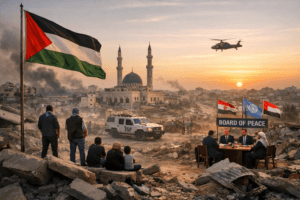
Hamas Relinquishes Control: A Historic Shift in Gaza’s Governance and the Uncertain Road to a “Technocratic” Future
In a move that could redefine the political landscape of the Middle East, Hamas announced its readiness to dissolve its governing authority in the Gaza Strip and transfer control to a Palestinian technocratic committee. This decision, framed as “clear and final” by spokesperson Hazem Qassem, marks a potential watershed moment, not merely in the immediate aftermath of war, but in the 17-year history of Hamas’s rule over the enclave. However, beneath the surface of this headline lies a complex web of geopolitical maneuvering, profound skepticism, and a desperate humanitarian reality that will ultimately determine whether this transition represents genuine progress or a new form of managed conflict.
The Anatomy of a Strategic Withdrawal
Hamas’s declaration is not an act of sudden capitulation, but the culmination of a calculated shift. Since at least February 2025, the group has signaled openness to a technocratic administration. This evolution is driven by a confluence of crushing pressures. The devastating human and infrastructural toll of the recent conflict has made the task of governing Gaza—already crippled by a 17-year blockade—an almost impossible burden. By stepping back from the day-to-day administration of a shattered territory, Hamas potentially seeks to preserve its core identity as a “resistance” movement while offloading the blame for Gaza’s immense reconstruction challenges onto a new, internationally recognized body.
Furthermore, the transition is framed within the architecture of the October ceasefire deal, which envisioned a “Board of Peace.” The involvement of figures like Amjad Al-Shawa, a respected NGO head, suggests an attempt to form a committee with civilian credibility. However, Hamas leader Mohammad Nazzal’s claim to have submitted a list of 40 names to Egyptian mediators reveals the group’s intent to retain significant influence over the committee’s composition, blurring the line between genuine independence and political theater.
The “Board of Peace”: A Controversial Blueprint
The governance model itself, anchored in UNSC Resolution 2803, is arguably the most contentious element. Endorsing a plan originally put forward by former U.S. President Donald Trump, the resolution establishes an international framework that has drawn sharp criticism. UN Special Rapporteur Francesca Albanese’s condemnation of it as a “security-first, capital-driven model of foreign control” strikes at the heart of Palestinian anxieties. The appointment of former UN envoy Nickolay Mladenov as director-general, while more palatable to Hamas than the initially proposed Tony Blair, underscores the profound international oversight embedded in the plan.
This model raises critical questions about sovereignty and self-determination. The authorized “International Stabilization Force” may promise order, but to many Palestinians, it evokes memories of historic trusteeships and the potential for a permanent, internationalized limbo that neutralizes Palestinian political aspirations. The technocratic committee, in this context, risks being perceived not as a sovereign government-in-waiting, but as the local administrative arm of a foreign-controlled project.
The Crushing Weight of Context: Ceasefire in Name Only?
Any analysis of the political transition must be grounded in the stark reality on the ground. The Gaza Health Ministry’s report of 447 Palestinian deaths since the October 11 ceasefire is a horrifying statistic that undermines the very notion of “peace.” The killing of journalist Saleh Al-Jafarawi during this period exemplifies a dangerous and persistent climate of violence. For Gaza’s two million residents, a change in administrative letterhead means little if it is not accompanied by a fundamental shift in security and survival.
The technocratic committee will inherit a territory in ruins: a decimated healthcare system, a generation of traumatized children, and rubble where neighborhoods once stood. Its legitimacy will be judged not by diplomatic communiqués, but by its ability to secure food, water, medicine, and electricity. Without a definitive end to hostilities and a full, unfettered flow of humanitarian aid and reconstruction materials, the committee is being set up to fail, becoming a manager of misery rather than a governor of a recovering state.
Regional and Global Calculations
The reactions of key players will be decisive. For Israeli Prime Minister Benjamin Netanyahu, the transition offers a potential path to extricate Israel from the costly burden of direct security control over Gaza, while ensuring that any governing body is neutered of militant capabilities. The emphasis on a “security-first” model aligns with this objective, but leaves unanswered the core political questions about Gaza’s future relationship with the West Bank.
For Egypt and Qatar, longtime mediators, a stable Gaza is a paramount security and diplomatic interest. They will push for a committee that is functionally effective enough to prevent total collapse, but likely acquiesce to significant international involvement to share the burden. The United States, invested in the resolution it shepherded, will demand the committee’s cooperation with the Board of Peace, viewing this as a test case for a new model of post-conflict administration.
A Fork in the Road: Two Possible Futures
This moment presents two divergent paths forward.
Path One: A Managed Stalemate. The technocratic committee becomes operational but remains hamstrung by insufficient authority, continued security incidents, and slow reconstruction due to political and bureaucratic hurdles. It administers basic services under the watchful eyes of the International Stabilization Force and the Board of Peace, while Hamas retains latent social and military power in the shadows. This scenario creates a cold, unstable peace—a temporary lid on violence without resolving the underlying conflict. Public disillusionment with the committee grows, and it becomes a symbol of Palestinian impotence.
Path Two: A Genuine Bridge. In this more optimistic but challenging scenario, the committee leverages its technical expertise and international backing to achieve tangible improvements in daily life. It negotiates greater autonomy from the Board of Peace, wins the cautious trust of Gazans through effective service delivery, and begins to foster a new, competent Palestinian administrative class. This creates space for Hamas’s political influence to wane and potentially lays the groundwork for future, more legitimate elections and reconciliation with the Palestinian Authority. It becomes a true transitional authority, not a permanent fixture.
Conclusion: Beyond the Headline
Hamas’s agreement to hand over governance is a historic and necessary step, born from unbearable pressure. Yet, it is only the first move in a high-stakes game. The creation of a technocratic committee is not an endpoint, but a fragile new mechanism inserted into a broken system. Its success or failure will depend on factors far beyond administrative competence: a definitive end to violence, the lifting of the blockade in substance, and a political horizon that offers Palestinians genuine agency over their future.
The world will be watching to see if this transition liberates Gaza from cycles of war and isolation, or merely repackages its imprisonment under a new, internationally approved label. The technocrats preparing to take charge are not just assuming administrative duties; they are stepping onto the razor’s edge of one of the world’s most intractable conflicts. Their real test will be whether they can build something more than just a better-managed status quo.
You must be logged in to post a comment.