
Guardians of the Gateway: Inside the Indian Navy’s High-Stakes Mission Near the Strait of Hormuz
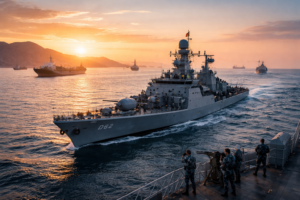
Guardians of the Gateway: Inside the Indian Navy’s High-Stakes Mission Near the Strait of Hormuz
The Arabian Sea stretches out in an endless expanse of blue, deceptively calm under the relentless sun. But for the men and women on the bridge of an Indian warship stationed near the mouth of the Persian Gulf, the horizon holds a tension that is anything but tranquil. In the distance, the superstructures of merchant vessels—tankers laden with crude and container ships packed with goods—creep along the sea lanes, their silhouettes a reminder of the immense economic lifeline that flows through these waters.
In mid-March 2026, this vital artery of global trade has become a potential flashpoint. As conflict escalates in West Asia, the Indian Navy has once again stepped into its most critical peacetime role: the guardian of its maritime interests and the protector of its seafarers. Recent reports confirm the deployment of multiple Indian warships near the Persian Gulf, a proactive measure to ensure the safe passage of Indian-flagged vessels transiting the notoriously volatile Strait of Hormuz. This isn’t just a military exercise; it is a high-stakes mission of reassurance, diplomacy, and deterrence.
The Chokepoint: Why the Strait of Hormuz Holds the World to Ransom
To understand the gravity of the Indian Navy’s deployment, one must first appreciate the strategic anatomy of the Strait of Hormuz. This narrow waterway, at its widest point just 39 kilometers (21 nautical miles), funnels a fifth of the world’s total oil consumption—roughly 20% of global supply. For India, the world’s third-largest oil importer and consumer, the strait is not just a chokepoint; it is a gateway to its energy security. A significant portion of India’s crude oil, along with a considerable volume of its liquefied petroleum gas (LPG) imports, sails through this corridor.
The stakes were laid bare in the recent report confirming that two India-flagged LPG carriers, the Shivalik and the Nanda Devi, were recently granted passage through the strait. The word “granted” is telling. It underscores a new, uncomfortable reality where the free movement of commercial shipping is subject to the whims of regional powers and the fluctuating temperatures of a conflict. While Iranian authorities have publicly assured safe passage for Indian vessels, the very need for such assurances signals a profound shift from the norms of open navigation.
“The sea is supposed to be a highway, not a toll road with armed checkpoints,” a veteran Mumbai-based shipping master, who has navigated these waters for over two decades, told us. “But in the Gulf, politics and trade are inseparable. Every time a radio crackles with a warning or we see a warship on the horizon that isn’t from a familiar navy, the tension in the engine room rises. It’s a different kind of pressure than battling a storm.”
Operation Sankalp: A Legacy of Protection
The Indian Navy’s response to this escalating risk is not an ad-hoc measure. It is the latest chapter in a long-standing commitment known as Operation Sankalp. Launched during the Iran-Iraq War in the 1980s to protect Indian merchant shipping, the operation has been reactivated and adapted over the decades in response to regional crises, from the 2019 Gulf of Oman tanker attacks to the current, more widespread conflict.
Under Operation Sankalp, the Indian Navy maintains a persistent, visible presence in the region. This isn’t about seeking a fight; it’s about preventing one. The deployment involves front-line warships—destroyers, frigates, and missile corvettes—equipped with advanced surveillance radars, helicopters, and marine commandos. These vessels aren’t just floating sentinels; they are mobile command centers, tracking hundreds of merchant ships, maintaining communication links, and serving as a visible symbol of India’s resolve.
“This deployment serves multiple purposes,” explains Commodore R. Hari Kumar (Retd.), a former naval strategist. “Firstly, it’s about ‘showing the flag.’ A warship is a powerful diplomatic tool. It tells all parties involved—state and non-state actors alike—that India has tangible interests here and the means to protect them. Secondly, it’s about real-time intelligence. The Navy’s surveillance aircraft and ships build a comprehensive maritime picture, identifying potential threats before they can materialize. And thirdly, it’s about immediate response. If a distress call goes out, an Indian warship can have a helicopter in the air or a fast interceptor craft in the water within minutes, not hours.”
The Ministry of Ports, Shipping, and Waterways has reported that 24 India-flagged vessels carrying 668 Indian seafarers were operating in the Persian Gulf region at the time of the report. For these men and women, the sight of the Indian Naval Ensign—the white and red cross on a blue background—on the horizon is more than just a morale booster; it is a lifeline.
The Human Element: More Than Just Cargo
Beyond the barrels of oil and the geopolitical chess game, this story is profoundly human. The Indian Navy’s 24-hour control room, activated to handle distress calls, has fielded over 2,425 calls and 4,441 emails. More importantly, it has facilitated the repatriation of over 223 stranded Indian seafarers. These numbers represent real people—engineers, cooks, electricians, and officers—who found themselves caught in a geopolitical storm far from home.
“We were on anchor off a port, waiting for orders, when the news of the escalation came,” recalls a second engineer who recently returned to Kochi. “The company told us it was safe, but we could see the tension. Then we got word that an Indian warship was in the vicinity. It was like a weight was lifted. Just knowing they were there, monitoring our frequency, ready to respond… it made all the difference between feeling trapped and feeling protected.”
The Indian government’s efforts extend beyond naval might. The Directorate General of Shipping is working in overdrive, coordinating with shipowners, recruitment agencies (RPSL), and Indian missions abroad. This multi-pronged approach—combining military deterrence, diplomatic negotiation, and administrative oversight—is what makes India’s response uniquely robust. It’s a whole-of-nation effort to bring its citizens home safely.
A Delicate Diplomatic Dance: The Promise of Friendship
While the Navy provides the muscle, diplomacy provides the roadmap. The situation in the Strait of Hormuz is a diplomatic minefield, and India is navigating it with characteristic dexterity. The recent statements from Iranian officials highlight the complex relationship at play.
On one hand, Iran’s Ambassador to India, Mohammad Fathali, offered a reassuring message rooted in friendship and shared interests: “Suffering of the people of India is our suffering and vice versa… we have a common fate and common interest.” This sentiment was echoed by the representative of Iran’s Supreme Leader in India, who stated that Tehran never intended to block the strait, even if traffic had slowed.
On the other hand, Iranian Foreign Minister Abbas Araghchi drew a clear red line, stating that while the Strait of Hormuz is open to most, vessels linked to the United States and Israel are barred. This selective approach to navigation, based on a vessel’s nationality or ownership, is a dangerous precedent and places neutral shipping nations in a precarious position.
India’s challenge is to leverage its historical goodwill with Iran to ensure the continued safe passage of its ships, without being seen as taking sides in the wider US-Iran conflict. The fact that two Indian LPG carriers were given the green light is a testament to the success of this balancing act. However, as one strategic analyst in New Delhi noted, “Friendship in geopolitics is often a matter of convenience. We must ensure our readiness is not based on promises, but on our own capabilities. The Navy’s deployment is that insurance policy.”
What Happens Next? The View from the Bridge
As of mid-March 2026, the immediate crisis appears contained for Indian shipping. The vessels Shivalik and Nanda Devi are expected to reach the Gujarat coast, their safe passage a small victory in a much larger, more volatile conflict. But the underlying tensions in West Asia show no signs of abating.
For the Indian Navy, this means Operation Sankalp will likely continue for the foreseeable future. The warships will remain on station, their crews rotating in and out, maintaining a vigil that is as exhausting as it is essential. The cost of this operation—in terms of fuel, manpower, and wear on equipment—is significant, but it is dwarfed by the potential cost of inaction: an Indian ship hijacked, an Indian sailor harmed, or a critical energy supply line severed.
The situation in the Strait of Hormuz is a stark reminder that in the 21st century, national security is inextricably linked to economic security. For India, a nation with a rapidly growing economy and a vast diaspora, the ability to project power, provide reassurance, and conduct delicate diplomacy in its extended maritime neighborhood is no longer a luxury—it is a necessity.
As the sun sets over the Gulf of Oman, painting the sky in hues of orange and purple, the Indian warship remains a silent, steadfast sentinel. On board, the radar operator continues his watch, the communication officer listens for any distress call, and the crew stands ready. They are the first and last line of defense for a nation whose prosperity floats on the high seas. They are the guardians of the gateway.
You must be logged in to post a comment.