
Greenwashing Occupation: How Israel’s “Settlement Farms” Strategy Reshapes the West Bank
The Palestinian presidency has condemned an Israeli plan to legalize 140 settlement farms in the occupied West Bank, characterizing it as a major escalation in annexation and a strategic effort to expel Palestinian pastoral communities. These agricultural outposts, operating under army protection, seize large tracts of land, effectively creating irreversible facts on the ground that fragment the territory and systematically undermine the viability of a future Palestinian state. This move, deemed illegal under international law including UN Security Council Resolution 2334, represents a sophisticated form of settlement expansion that uses the guise of benign farming to deepen occupation, fuel local violence, and test the resolve of an international community whose diplomatic efforts for a two-state solution are being rendered obsolete by these calculated, incremental actions.
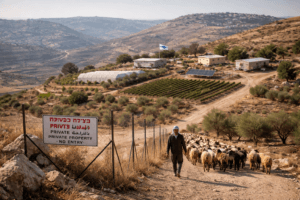
Greenwashing Occupation: How Israel’s “Settlement Farms” Strategy Reshapes the West Bank
The announcement from Israeli Defense Minister Israel Katz seemed, to a casual observer, almost banal: a plan to “legalize” 140 agricultural settlement farms in the occupied West Bank. Yet, in Ramallah, the Palestinian presidency reacted not with a sigh of bureaucratic frustration, but with a declaration of “a major escalation.” This disconnect lies at the heart of a sophisticated, decades-long strategy where the pastoral image of the farm is weaponized as a tool of annexation, slowly redrawing the map of the West Bank and foreclosing the possibility of a viable Palestinian state.
To understand why a “farm” is more threatening than a high-rise apartment block, one must first look beyond the dirt and seedlings to the strategic landscape of the Israeli-Palestinian conflict. Since its victory in the 1967 war, Israel’s settlement project has evolved through various phases—from ideologically driven hilltop communities to sprawling suburban cities. International law, including the Fourth Geneva Convention and a consensus of UN Security Council resolutions (most notably Resolution 2334), has consistently deemed these constructions illegal, as they transfer a civilian population into occupied territory.
Faced with growing, though often ineffective, international condemnation, the “farm” strategy offers a potent workaround. These are not densely populated urban centers that draw immediate global headlines. They are often presented as benign, ecological, even romantic ventures—a return to the land. In reality, as Palestinian spokesperson Nabil Abu Rudeineh stated, they are “settlement outposts that complement settler violence.” An agricultural outpost requires vast tracts of land for grazing and cultivation, far exceeding the physical footprint of its few trailers or barns. It establishes a fait accompli on remote hilltops and deep within the West Bank’s Area C, which comprises about 60% of the territory and is under full Israeli military and civil control.
The Mechanics of Annexation-by-Farm
The process typically follows a pattern. First, a small group of settlers, often from the more radical fringes of the settler movement, establishes an illegal outpost, sometimes with tacit state support. They fence off hundreds of dunams of land, claiming it is “state land” or disputing Palestinian ownership—a system heavily weighted against Palestinian claimants in Israeli military courts. They then introduce livestock or plant vineyards.
This “agricultural” claim becomes a legal and security pretext. The Israeli military, citing the need to protect these Israeli civilians, secures the perimeter. Access roads are paved or improved, which are then off-limits to the adjacent Palestinian communities. The land itself becomes a de facto Israeli zone. The recent plan to “legalize” 140 such farms is not about granting building permits for homes; it is about the state formally retroactively approving this seizure and integrating these satellite claims into Israel’s security and infrastructure apparatus.
The human impact on Palestinian communities, particularly pastoral Bedouin villages, is devastating and deliberate. Abu Rudeineh framed it accurately: this is a “gradual effort to expel Palestinian residents from pastoral communities.” A Palestinian shepherd suddenly finds ancient grazing routes blocked by a fence marked with a Hebrew sign warning of “private property” or “military zones.” Water sources are appropriated for irrigation of the new farms, while Palestinian wells face restrictions on repair or deepening. Harassment by settlers from these outposts—intimidation, crop destruction, livestock theft—becomes a daily reality, often with the Israeli military standing by as a passive observer. The goal is not always a violent expulsion, but a slow, grinding pressure that makes a traditional way of life impossible, forcing families to abandon their land and drift toward Palestinian urban centers.
The Broader Geopolitical Chessboard
This escalation does not occur in a vacuum. The current Israeli government is its most right-wing and settlement-friendly in history, with key ministers publicly committed to annexation. Legalizing these farms serves multiple political ends domestically: it appeases the powerful settler lobby, reinforces the ideological narrative of Jewish redemption of the land, and creates irreversible facts on the ground before any potential future diplomatic negotiations.
Internationally, it is a direct challenge. It systematically undermines the stated goal of a negotiated two-state solution, which requires territorial contiguity for a future Palestine. These farms act like pins on a map, slicing the West Bank into disconnected Palestinian cantons surrounded by Israeli-controlled land. It also tests the resolve of the international community, which routinely condemns settlements but has taken little tangible action to penalize Israel for their expansion. Abu Rudeineh’s call for “immediate intervention” highlights a deep Palestinian frustration with what they see as international paralysis in the face of a changing reality.
Furthermore, this “agricultural” framing is a public relations maneuver. It attempts to recast a violation of international law as an issue of zoning and development. It speaks to a narrative of “making the desert bloom,” obscuring the reality of displacing an indigenous population from its own cultivated fields and pastures.
The Path Ahead: More Than Just Condemnation
The condemnation from Ramallah is necessary, but it is insufficient. For readers seeking to understand the true weight of this news, it is critical to see it not as an isolated policy but as the latest chapter in a methodical campaign. The legalization of these farms represents the institutionalization of creeping annexation. Each farm is a node in a network of control, governing land, resources, and movement.
The consequences are profound. First, it fuels endless cycles of violence, as despair and confrontation rise in friction-point communities. Second, it erodes any remaining trust in a diplomatic process, empowering extremists on both sides. Third, it pushes Palestinian society toward a one-state reality of unequal rights under perpetual occupation—an outcome unsustainable for both peoples.
Addressing this requires moving beyond routine diplomatic statements. For the international community, it means moving from condemnation to consequence, aligning trade and diplomatic relations with the defense of international law. For Israeli civil society, it means a harder internal reckoning with the direction of the state. For all of us as observers, it means sharpening our perception: to see a “farm” for what it truly is in this context—not just a piece of land, but a potent political instrument reshaping a conflict, one dunam at a time.
The vineyards and pastures now being legalized are not just growing crops; they are sowing the seeds of a future defined not by peace or coexistence, but by permanent conflict and inequality. Recognizing that truth is the first step toward challenging it.
You must be logged in to post a comment.