
Gold and Silver Crash: Is This a Buying Opportunity or the Start of a Deeper Downtrend?
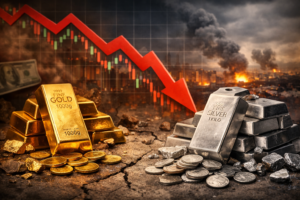
Gold and Silver Crash: Is This a Buying Opportunity or the Start of a Deeper Downtrend?
Precious Metals Plunge as Traditional Safe Havens Fail to Deliver Amid US-Iran Conflict
In a dramatic turn of events that has left investors scrambling for answers, gold and silver prices have suffered one of their most brutal corrections in recent memory. The precious metals, traditionally viewed as the ultimate safe havens during times of geopolitical turmoil, have instead delivered a harsh lesson in market complexity as the US-Iran conflict enters its fourth week.
Since tensions escalated on February 28, spot gold has plummeted more than 15%, falling from its all-time high of $5,594.82 per ounce recorded on January 29 to recent lows near $4,300. Silver has endured an even more violent reversal, with May futures crashing 51% from their peak of Rs 4.39 lakh per kilogram to below Rs 2.15 lakh in just two months.
For the average investor who piled into precious metals expecting protection from geopolitical storm clouds, the past few weeks have been nothing short of bewildering.
The Paradox of Safe Havens in a War Zone
When Iranian tensions first erupted in late February, gold initially did what gold has done for centuries—it surged. But that spike proved fleeting. What followed was a steady, grinding decline that has confounded conventional market wisdom.
“Gold should do well in a stagflationary environment, it always has, but there may be more profit taking and liquidation first,” notes John Reade, senior market strategist at the World Gold Council. His observation cuts to the heart of what’s happening: the market is unwinding 2025’s winning trades before deciding where to place its bets for 2026.
The pattern we’re witnessing isn’t unprecedented. Analysts at ANZ point out that gold’s sharp one-day surge at the onset of the Iran conflict, followed by sustained decline, mirrors patterns seen during past major shocks. In such situations, immediate liquidity needs tend to outweigh demand for safe-haven assets in the initial phase.
What’s Really Driving Prices Lower?
Several forces are working in concert to push precious metals lower, and understanding them is crucial for anyone trying to navigate this volatile market.
The Relentless US Dollar
The dollar’s strength has been a primary culprit. A firmer greenback increases the cost of bullion for investors holding other currencies, dampening demand. When the dollar rises, gold typically falls—and the dollar has been on a tear, driven by expectations that US interest rates will remain elevated for longer than previously anticipated.
Interest Rates: The Silent Killer
This brings us to perhaps the most significant factor: interest rates. While gold is traditionally seen as an inflation hedge, it generates no yield. When real interest rates rise or are expected to remain high, the opportunity cost of holding gold increases substantially.
The Iran conflict has pushed energy prices higher, which paradoxically has strengthened expectations that central banks, particularly the Federal Reserve, will keep rates elevated to combat inflation. Higher rates make yield-bearing assets more attractive relative to non-yielding gold.
Profit-Taking After a Historic Run
Let’s not forget where we started. Gold had an extraordinary run in 2025 and carried that momentum into early 2026. Silver, in particular, was one of the best-performing assets of 2025 with returns as high as 170%, adding another 74% in January 2026 alone. When assets appreciate that dramatically, profit-taking becomes almost inevitable when any hint of weakness appears.
The Silver Story: A Cautionary Tale
Silver’s collapse deserves special attention because it highlights the risks of chasing momentum in volatile commodities. The metal that seemed unstoppable just months ago has seen its rally come to an abrupt and painful halt.
What’s striking about silver’s fall isn’t just its magnitude but its speed. A 51% drop from all-time highs within two months represents a loss of over Rs 2.23 lakh per kilogram in absolute terms. For investors who entered near the peak, the pain has been acute.
The silver market’s behavior offers valuable lessons about the dangers of extrapolating recent performance into the future. The same momentum that carried silver to extraordinary heights has now reversed with equal force, demonstrating how quickly sentiment can shift in commodity markets.
The Indian Context: Household Wealth and Market Implications
For Indian investors, the stakes in the gold market are particularly high. A recent report by Kotak Institutional Equities reveals that Indian households now hold an estimated $5 trillion worth of gold—roughly 125% of the country’s GDP. This gold hoard has more than quadrupled in value over five years, from Rs 109 lakh crore in March 2019 to Rs 445 lakh crore by January 2026.
The report raises important macroeconomic concerns. Sustained gold imports to meet domestic demand effectively represent a drain on household capital that could otherwise flow into financial savings. The authors warn that continued strong gold imports could deplete foreign exchange reserves if other external sector flows don’t compensate.
This dynamic creates an interesting tension. While individual households may view gold as a store of value, the aggregate effect of sustained gold purchases has macroeconomic implications that policymakers must consider.
ETFs and Investment Vehicles: What’s Happening?
Gold and silver exchange-traded funds have declined by as much as 13% amid the recent turmoil, leaving investors confused about how to position themselves. The sharp correction has sparked debate over whether investors should hold on, rebalance their portfolios, or trim exposure.
Market participants note that decisions regarding commodity-based ETFs should be guided by long-term asset allocation strategies rather than short-term price movements. For investors with appropriate strategic allocations to precious metals, the current correction may represent a rebalancing opportunity rather than a reason to exit.
What Analysts Are Saying About the Outlook
Despite the recent carnage, many analysts maintain a constructive long-term view on precious metals.
“The structural case for gold’s positive outlook remains intact. Current levels offer a more attractive entry than chasing prices higher for ETF investors,” says Chirag Mehta, chief investment officer at Quantum AMC. “For those underweight, buying during such phases of correction builds a better cost basis. Treat this dip as an accumulation opportunity as such opportunity has become more and more rare in the current gold bull cycle.”
Others are more cautious about the near term. Aksha Kamboj, vice president at India Bullion & Jewellers Association, expects the current pause and correction to influence retail sentiment in the near future. “Global factors, like the strength of the US dollar and the uncertainty over interest rates would likely prevail, which may cause prices to fluctuate, hence encouraging customers to hold back on making investment-led purchases.”
Key Levels and Technical Considerations
From a technical perspective, gold’s pullback from its January highs represents a retracement of roughly 20%—a significant correction but not historically unusual in a bull market. The metal found support near $4,100 before recovering some ground, suggesting buyers are beginning to emerge at lower levels.
Silver’s technical picture is more concerning given the severity of its decline. A 51% drop typically signals a change in market character, and investors should be prepared for the possibility that the metal may take time to rebuild momentum.
The Week Ahead: What to Watch
Market participants will keep a close watch on several key economic indicators for direction in the coming days:
- Preliminary manufacturing and services PMI data from the US, UK, and Japan
- Consumer sentiment figures
- Jobless claims
- Crude oil price movements
Geopolitical developments remain crucial as well. President Trump’s recent comments about constructive discussions with Iran and delayed strikes on energy infrastructure triggered a sharp reversal in gold prices, demonstrating how sensitive the market remains to headline risk.
Practical Considerations for Investors
For those navigating this volatile environment, several principles bear remembering:
First, understand your time horizon. Gold’s role in a portfolio has traditionally been as a long-term store of value and portfolio diversifier, not a short-term trading vehicle. The current correction, while painful, may represent a normal consolidation within a longer-term uptrend.
Second, consider your entry point carefully. As Quantum AMC’s Mehta notes, corrections offer attractive entry opportunities for those who are underweight precious metals in their portfolios. Trying to time the exact bottom is impossible, but scaling into positions during weakness can build a better cost basis.
Third, distinguish between physical gold and paper gold. The dynamics affecting physical demand—particularly in India with the wedding and festival seasons—can differ from those affecting futures and ETF prices.
Finally, maintain perspective. The current decline follows an extraordinary run that saw gold reach all-time highs. Corrections are normal, even healthy, in any market cycle. What matters is whether the fundamental case for owning precious metals remains intact.
The Bottom Line
The recent crash in gold and silver prices offers a masterclass in market complexity. Geopolitical tensions that would typically support precious metals are instead contributing to their decline through the channel of interest rate expectations and dollar strength.
For long-term investors, the key question isn’t whether prices will bounce next week or next month, but whether the structural case for gold—as a hedge against currency debasement, a diversifier against equity market risk, and a store of value in an increasingly uncertain world—remains valid.
Most analysts believe it does. The path higher may be bumpier than many anticipated, and the correction may not be over, but the fundamental forces that drove gold to record highs in early 2026—including persistent inflation concerns, geopolitical instability, and questions about fiat currency stability—haven’t disappeared.
They’ve simply been temporarily overshadowed by the market’s focus on interest rates and dollar strength. When the dust settles, precious metals may once again demonstrate why they’ve been considered stores of value for millennia.
You must be logged in to post a comment.