
Goa Nightclub Tragedy: How a Deadly Fire Sparked a Nationwide Safety Reckoning
Following a deadly nightclub fire in Goa that killed 25 people, the Indian owners who fled to Thailand were extradited and arrested. The brothers, Saurabh and Gaurav Luthra, escaped to Phuket after the December 7 blaze but were detained and deported back to Delhi through coordinated international action. The fire, likely sparked by electrical firecrackers in a venue with poor safety measures, caused most deaths by suffocation. They now face charges related to the fatalities, highlighting issues of negligence and regulatory enforcement in India.
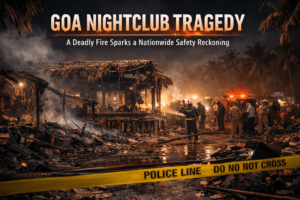
Goa Nightclub Tragedy: How a Deadly Fire Sparked a Nationwide Safety Reckoning
The Rush to Escape Justice
On December 11, 2025, in the tourist district of Patong, Phuket, Thai authorities located and detained two Indian nationals at Hotel Indigo. Saurabh and Gaurav Luthra, the owners of the now-infamous “Birch by Romeo Lane” nightclub in Goa, had been on the run for days. Their attempt to flee India just hours after a catastrophic fire at their venue had set in motion an international manhunt, culminating in their deportation back to Delhi. This sequence of events is more than a dramatic crime story; it exposes a grim pattern of systemic negligence, lax enforcement, and the human cost of prioritizing profit over fundamental safety.
The Luthra brothers’ return to India on an emergency certificate marks a pivotal moment of accountability. However, the blaze that killed 25 people—20 staff members and five tourists—has ignited urgent questions that resonate far beyond Goa’s sandy beaches. As one fire official stated bluntly in the aftermath, the establishment had “zero fire safety measures”. This tragedy is a stark case study in regulatory failure and a sobering reminder of the vulnerabilities in India’s commercial entertainment sector.
A Night of Celebration Turns to Ashes
On the evening of December 6, the Birch nightclub in Arpora, North Goa, was packed with over 100 revelers enjoying a “Bollywood Banger Night”. At approximately 11:45 PM, a festive atmosphere turned to horror. Preliminary investigations point to indoor electrical firecrackers as the ignition source. The flames quickly spread, fueled by highly flammable dried palm leaves used for decoration.
Panic ensued as patrons and staff scrambled for exits. The club’s design, however, made escape nearly impossible for many. The venue was located on an island, accessible only by a narrow lane, severely hampering rescue efforts. Fire trucks were forced to park roughly 400 meters away. As smoke and fire engulfed the structure, a group of people, including many staff, sought refuge in the basement and kitchen area. This decision proved fatal. The basement lacked adequate ventilation, and the space became a deadly trap where 23 of the 25 victims succumbed to suffocation.
Table: Breakdown of Victims in the Arpora Nightclub Fire
| Category | Number | Details |
| Total Fatalities | 25 | |
| Staff Members | 20-21 | From Indian states like Jharkhand, Uttarakhand, Maharashtra, and one from Nepal |
| Tourists | 4-5 | Including four members of the same family from Delhi |
| Primary Cause of Death | Suffocation | For 23 victims; 3 died from burn injuries |
A Cascade of Failures: How Prevention Broke Down
The post-tragedy investigation revealed a stunning litany of violations that transformed the nightclub from a place of leisure into a deathtrap. The fire service directorate concluded the disaster resulted from a critical failure in “fire prevention engineering, regulatory compliance, and life safety preparedness”.
The club operated without the most basic safeguards. A fire department audit found it had no valid No Objection Certificate (NOC), meaning it never received official clearance for its fire safety arrangements. The list of absent safety features is extensive and alarming:
- No functional fire detection or alarm systems
- No automatic sprinkler systems
- Inadequate and poorly marked emergency exits
- No smoke extraction or basement ventilation systems
- Lack of fire-rated doors and compartmentalization
- No trained fire wardens or emergency evacuation plans
Compounding these absences were known legal issues. The structure was built illegally on a salt pan near a beach and had been issued a demolition notice by local authorities, though this order was stayed on appeal. For at least 18 months, the nightclub operated on an expired license without any authority taking decisive action to shut it down. This points to a broader ecosystem of enforcement apathy that allowed known risks to persist until catastrophe struck.
The Pursuit of Accountability: From Phuket to the Courtroom
As rescue operations continued on December 7, the Luthra brothers booked flights to Phuket, Thailand, and fled the country. Their attempt to evade justice was short-lived. Indian authorities moved swiftly:
- The Ministry of External Affairs suspended their passports.
- An Interpol Blue Corner Notice was issued to track their movements.
- Indian agencies coordinated with Thai police under the India-Thailand extradition treaty that has been in force since 2015.
Their detention in Phuket and subsequent deportation highlights the effectiveness of international legal cooperation. Back in India, they face serious charges under the new Bharatiya Nyaya Sanhita (BNS), including culpable homicide not amounting to murder, which can carry a prison sentence of up to ten years. A Delhi court, rejecting their anticipatory bail plea, noted they had booked their escape tickets just one hour after the fire and criticized their conduct as a clear attempt to “evade the legal process”.
They are not alone in facing charges. Police have also arrested several managerial staff and a business partner, while the local village council head (sarpanch) has been detained for questioning, indicating the investigation is examining potential complicity in overlooking violations.
Ripples of a Tragedy: National Reckoning and Regulatory Response
The Goa fire has acted as a wake-up call for authorities across India, prompting a scramble to prevent the next disaster.
Table: Immediate Regulatory Responses to the Goa Fire
| Authority | Action Taken | Key Focus |
| Goa State Government | Fire safety audit of all nightclubs; ban on pyrotechnics in tourist venues. | Closure of non-compliant clubs, including two in Vagator. |
| Haryana State Government | Statewide fire safety audit of nightclubs, bars, and pubs. | Compliance with National Building Code; 7-day deadline for audit reports. |
| Mumbai Fire Brigade | Week-long inspection drive of entertainment venues. | Verification of fire safety compliance. |
| High Court of Bombay (Goa bench) | Converted a civil suit into a Public Interest Litigation (PIL). | Broader judicial oversight of the case and systemic issues. |
The political response was immediate. Prime Minister Narendra Modi and President Droupadi Murmu expressed condolences, with the PM announcing compensation from the National Relief Fund. Goa’s Chief Minister Pramod Sawant pledged support for victims’ families and promised stringent action.
Perhaps the most significant reaction is the nationwide ripple effect. Following Goa’s lead, the state of Haryana ordered immediate comprehensive audits of all similar establishments, stressing the need for “heightened vigilance and enforcement of safety regulations”. This indicates the tragedy is being viewed not as an isolated incident, but as a symptom of a national problem.
A Persistent National Problem in Search of a Solution
The Arpora fire is sadly not an anomaly. It fits a devastating pattern in India, where fires in commercial and entertainment venues repeatedly claim lives. In 2023 alone, commercial buildings were the second-deadliest site for accidental fire deaths in the country. Recent years have seen fatal fires at an amusement park in Gujarat (24 dead), a hotel in Kolkata (15 dead), and a building in Hyderabad (17 dead).
These recurring tragedies share common roots: poor building practices, overcrowding, and a chronic lack of enforcement of safety regulations. The challenge is systemic, involving a tangled web of:
- Builder Negligence: Cutting corners on safety to reduce costs.
- Owner Complicity: Operating without licenses or ignoring violations for profit.
- Regulatory Failure: Inspections that are lax, infrequent, or subject to corruption.
- Public Apathy: A societal tolerance for minor violations until a major disaster strikes.
The Road Ahead: Beyond Symbolic Actions
The extradition and prosecution of the Luthra brothers are crucial steps for justice and deterrence. However, real change requires moving beyond symbolic audits and temporary crackdowns. Sustainable solutions must include:
- Transparent Licensing Systems: Making the compliance status of venues publicly accessible.
- Strict Personal Liability: Holding owners and responsible officers personally and criminally accountable for safety lapses.
- Empowered Whistleblower Protections: Encouraging employees to report hazards without fear.
- Technology-Enabled Monitoring: Using sensors and centralized systems for real-time monitoring of safety systems in high-occupancy venues.
- Public Awareness Campaigns: Educating patrons on their right to safety and how to identify basic exit routes and hazards.
The deaths of 25 individuals in Goa are a profound tragedy for their families and a stain on India’s reputed hospitality and tourism sector. Their story underscores a simple, painful truth: fires don’t kill people; unsafe buildings do. As legal proceedings against the accused move forward, the enduring legacy of this disaster must be a fortified and uncompromising culture of fire safety. Only then can the nation ensure that places of leisure and work are not, through neglect, transformed into chambers of unimaginable horror. The spotlight is now on whether this tragic catalyst will lead to enduring reform or fade into memory until the next preventable disaster strikes.
You must be logged in to post a comment.