
“Globalize the Intifada”: How a Chant Became a Crime in the UK’s Battle Over Protest and Safety
Following deadly attacks on Jewish communities in Manchester and Sydney, UK police chiefs have enacted a significant policy shift by declaring that chanting “globalize the intifada” at protests will now result in arrest, arguing that in an “escalating threat context,” such words constitute incitement. This decision has ignited a fierce debate between those who see the phrase as a legitimate call for non-violent, global solidarity with Palestinians and Jewish communities who interpret it as a direct call to violence against them, highlighting a profound societal rift over the meaning of language and the limits of free speech. The move forms part of a broader UK trend toward tightening protest laws, placing police and courts at the center of a charged struggle to balance democratic rights with community safety in a polarized climate.
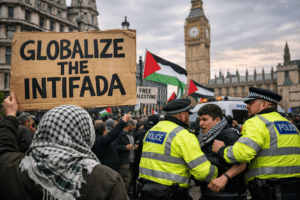
“Globalize the Intifada”: How a Chant Became a Crime in the UK’s Battle Over Protest and Safety
The phrase “globalize the intifada” has moved from protest placards to police directives. Following a deadly attack on a Jewish celebration in Australia, UK police have declared that chanting this slogan will now lead to arrest, marking a profound shift in how authorities balance free speech against community safety. This decision has ignited fierce debate, exposing a deep societal rift over the meaning of words and the limits of protest in a time of heightened fear.
The Breaking Point: From Sydney to London
The catalyst for this sudden change was a wave of violence that brought the distant conflict violently home. On December 15, 2025, a horrific attack on a Hanukkah celebration at Sydney’s Bondi Beach left 15 people dead, an act Australian Prime Minister Anthony Albanese condemned as “an act of evil antisemitism, terrorism”. This massacre followed another attack closer to home for British authorities: on October 2, a vehicle and knife assault on a synagogue in Manchester during Yom Kippur services resulted in two fatalities.
For police chiefs, these were not isolated tragedies but connected events that changed the context in which protests occur. The “escalating threat context” compelled a recalibration. In a landmark joint statement, London’s Metropolitan Police Commissioner Sir Mark Rowley and Greater Manchester Police Chief Constable Sir Stephen Watson announced a new “more assertive” approach. “Violent acts have taken place, the context has changed – words have meaning and consequence. We will act decisively and make arrests,” they declared.
This policy shift was not a drawn-out legislative change but an immediate operational directive. Hours after the announcement, its effect was tested and proven at a pro-Palestinian demonstration outside London’s Ministry of Justice. Metropolitan Police arrested protesters for “racially aggravated public order offences,” specifically for “shouting slogans involving calls for intifada”.
Timeline of Key Events Leading to the Policy Shift
| Date | Event | Significance |
| Oct 2, 2025 | Vehicle and knife attack at a Manchester synagogue | Two people killed on Yom Kippur; heightened security concerns in UK. |
| Dec 15, 2025 | Mass shooting at Hanukkah event, Bondi Beach, Sydney | 15 people killed; described as a terrorist act motivated by antisemitism. |
| Dec 17, 2025 | Joint police announcement by Met and GMP | New “assertive” policy to arrest for “globalize the intifada” chants. |
| Dec 17, 2025 (evening) | Arrests at London protest | Immediate enforcement of new policy. |
A Word Divided: The Battle Over “Intifada”
At the heart of this controversy is a fundamental disagreement over the meaning of a single word. “Intifada” is an Arabic term that translates to “uprising” or “shaking off”. In a Palestinian context, it refers to periods of intense struggle against Israeli occupation. However, the historical and emotional weight it carries differs drastically depending on one’s perspective.
For many pro-Palestinian protesters and organizers like Ben Jamal of the Palestine Solidarity Campaign (PSC), the call to “globalize the intifada” is a plea for worldwide solidarity and non-violent resistance against injustice. Jamal argues the word signifies “shaking off or uprising against injustice” and is rooted in a history of civil disobedience. He and others see the police action as a dangerous conflation, using the “grotesque racist violence on Bondi beach” to delegitimize any protest against Israel’s actions in Gaza.
For many in Jewish communities, however, the same chant evokes terror and incitement. The Second Intifada (2000-2005) was marked by suicide bombings that killed hundreds of Israeli civilians. Therefore, calls to “globalize” this concept are interpreted not as abstract solidarity but as a direct call to export violent tactics to cities like London, Manchester, or Sydney. Britain’s Chief Rabbi, Ephraim Mirvis—whose own cousin was present at the Bondi Beach attack—stated he believes such chants incite violence and that authorities must be “far stricter” about what is allowed in public discourse. Jewish advocacy groups like the Board of Deputies of British Jews welcomed the police intervention as “necessary,” arguing they have long warned that these slogans incite violence.
This is not merely an academic debate about semantics. It strikes at a core challenge for liberal democracies: How do you police the line between political speech and hateful incitement when communities hear the same words in utterly different ways?
A Broader Crackdown: Part of a UK-Wide Trend
The crackdown on this specific chant did not occur in a vacuum. It is part of a wider, ongoing reassessment of protest laws in the United Kingdom, driven by concerns over public safety, community cohesion, and the security of elected officials.
In recent months, the UK government has introduced or proposed several legislative measures aimed at curbing protest disruptions:
- Restricting Protests at Homes: A new law will create a criminal offence for protesting outside the home of a public office holder (like an MP) with the intention to influence them, punishable by up to six months in prison.
- Assessing “Cumulative Impact”: New police powers will allow officers to consider the repeated disruptive impact of protests at the same location when imposing conditions, potentially forcing organizers to move their events.
- Banning Specific Protest Items: The government is also moving to ban the possession of pyrotechnics at protests and criminalize the climbing on war memorials.
Home Secretary Shabana Mahmood framed these changes as a necessary balance, acknowledging the “considerable fear within the Jewish community” while protecting the right to protest. Critics, however, see a pattern of incremental erosion of democratic freedoms. The International Centre of Justice for Palestinians (ICJP) condemned the “intifada” arrests as a “crackdown on freedom of expression” that represents “policing must be rooted in the law, not in buckling to reactionary political pressure”.
The Road Ahead: Enforcement and Legal Challenges
The immediate future poses significant challenges for both police and protesters. The police directive, while clear in intent, operates in a complex legal landscape. Authorities acknowledged they have “consistently been advised” by the Crown Prosecution Service (CPS) that many problematic phrases “don’t meet prosecution thresholds” under existing laws. This new approach relies heavily on interpreting the Public Order Act, and its success in court is not guaranteed.
Gideon Falter of the Campaign Against Antisemitism called the ban on one chant a “useless token measure,” questioning how it could possibly be enforced amidst large marches. This skepticism points to the practical difficulty of policing specific speech in the heat of mass demonstrations.
Furthermore, the move has intensified political divisions. Prime Minister Keir Starmer announced increased funding for Jewish community security while ordering a review of protest and hate crime laws. Opposition to the police action is equally firm, with protest organizers vowing to continue and decrying the repression of fundamental democratic rights.
The tragedy in Sydney and the policy response in London reveal a Western society at a crossroads. As argued in The Atlantic, there is a growing realization that “symbolic violence is a rehearsal for actual violence,” and a reluctance to confront extreme rhetoric can have fatal consequences. The core question remains: Can a society protect a minority community from what it perceives as deadly incitement without unduly silencing political speech about a grievous overseas conflict? The arrests on the streets of London are just the first act in a much longer and more difficult legal and social drama, where the ultimate judge may be the fragile concept of community harmony itself.
You must be logged in to post a comment.