
Global Alerts on Fake Rabies Vaccines Expose Critical Gaps in India’s Health Governance
Global Alerts on Fake Rabies Vaccines Expose Critical Gaps in India’s Health Governance
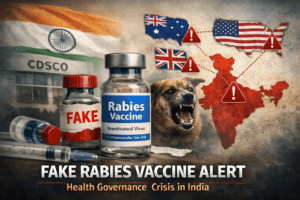
A major international health alert over alleged counterfeit rabies vaccines in India has escalated into a pointed examination of the country’s drug regulatory systems, supply chain integrity, and crisis communication protocols. The dispute, pitting foreign health authorities against a major Indian vaccine manufacturer, reveals fundamental challenges in ensuring the safety of one of the world’s most critical medical countermeasures against a 100% fatal disease.
The controversy centers on “Abhayrab,” a rabies vaccine produced by the government-owned Indian Immunologicals Limited (IIL), which commands a formidable 40% share of India’s domestic rabies vaccine market and has supplied over 210 million doses globally. While the manufacturer insists the issue is isolated and resolved, health agencies in Australia, the United Kingdom, and the United States have taken the extraordinary step of advising citizens and travelers to seek replacement vaccinations, citing risks that may extend back over a year.
A Clash of Narratives: International Alarm vs. Domestic Assurance
The core of the controversy lies in a significant discrepancy in timelines and risk assessments between international regulators and the Indian manufacturer.
- The International Perspective: Health authorities in Australia, the UK, and the US have issued advisories based on information that counterfeit versions of Abhayrab have been circulating in India since November 2023. The Australian Technical Advisory Group on Immunisation (ATAGI) has explicitly advised that people vaccinated in India from that date onward should consult a healthcare provider, as they “may not be fully protected”. The UK’s National Travel Health Network and Centre (NaTHNaC) is conducting a “look-back exercise” to identify affected travelers for the same period.
- The Manufacturer’s Stance: Indian Immunologicals Limited has strongly rejected this timeframe, calling the international advisory “over-cautionary” and “misplaced“. The company states it proactively identified a single counterfeit batch (KA24014) in January 2025—over a year after the international start date—and immediately notified Indian regulators. IIL maintains that this was an isolated incident, the batch is no longer in circulation, and all vaccines from its authorized channels are safe.
This conflicting information creates a dangerous limbo for patients. As the Australian alert notes, “It is difficult to confirm whether a person has received genuine or counterfeit vaccine“, leading to the blunt recommendation for replacement doses as a precaution.
The table below summarizes the divergent positions and actions taken by the key parties involved.
| Aspect | International Health Advisories (AU, UK, US) | Indian Immunologicals Ltd (IIL) & Regulatory Stance |
| Timeline of Risk | Counterfeits circulating since November 2023. | Single batch identified in January 2025; calls reference to 2023 “misplaced”. |
| Scope of Problem | Advisories imply potential ongoing risk, advising on vaccines received from late 2023 “onwards”. | An “isolated incident” confined to one specific batch (KA24014), now removed from market. |
| Primary Action | Public alerts advising travelers and citizens to seek medical review and potential revaccination. | Internal regulatory and law enforcement action; emphasis on safety of authorized supply channels. |
| Communication | Proactive, direct communication to the public and healthcare providers via official health channels. | No initial public alert from Indian regulator; response issued after international advisories became public. |
The Silent Regulator: A Systemic Failure in Public Alert
Perhaps the most glaring issue exposed is the failure of India’s drug regulatory apparatus to initiate transparent public communication. The Central Drugs Standard Control Organisation (CDSCO) and IIL did not issue any public alert until after the Australian advisory was published in December 2025. This silence forced Indian citizens and doctors to learn about a potential threat to their health from foreign government websites.
This incident spotlights a known, critical weakness in India’s pharmaceutical regulatory framework: the lack of a mandatory, enforceable drug recall and public alert system. Experts point out that despite revised guidelines, India’s drug recall norms remain non-binding guidelines that place the onus on manufacturers, with no clear protocol for statutory, government-enforced recalls or public communication.
As highlighted by public health experts, the consequence is direct: “Many veterinarians, animal handlers and people bitten by dogs or cats may have taken the counterfeit version. They should have been informed through a public advisory so they could take a genuine and effective vaccine”.
Why Rabies Makes This a Catastrophic Risk
The gravity of this incident is magnified exponentially by the unique deadliness of rabies.
- Almost 100% Fatality: Once clinical symptoms appear, rabies is almost invariably fatal. Prevention through timely and effective post-exposure prophylaxis (PEP) is the only reliable defense.
- India’s Disproportionate Burden: India accounts for approximately 36% of global rabies deaths, with thousands of fatalities reported annually, many of them children. Any compromise in vaccine efficacy directly translates to potential loss of life.
- The Illusion of Protection: A patient who receives a counterfeit vaccine may believe they are protected after completing a full course. This false sense of security is perhaps the greatest danger, as it can delay or prevent the seeking of correct treatment until it is too late.
Governance at a Crossroads: Lessons for a Global Supplier
This episode is more than a dispute over a single vaccine batch; it is a stress test for India’s health governance as the country positions itself as the “pharmacy of the world.”
- Transparency is Non-Negotiable: The first lesson is the imperative for proactive, transparent risk communication. Public health depends on public trust, which is eroded when citizens learn of domestic threats from external sources. A robust, legally mandated public alert system for drug recalls is urgently needed.
- Modernizing the Supply Chain: The incident underscores the vulnerability of pharmaceutical supply chains to diversion and counterfeiting. Reliance on visual inspection of packaging is inadequate. As industry analysts note, this crisis highlights the urgent need for digital track-and-trace systems and serialization that allow units to be verified from factory to patient.
- Coordinated Global Response: In an interconnected world, health threats are transnational. The conflicting messages between Indian and international authorities create confusion and risk. This case argues for more streamlined protocols for international notification and data sharing between national regulators when counterfeit medicines are detected.
- Balancing Reputation and Accountability: While IIL has defended its product and reputation, the broader interest must be uncompromising patient safety. For India’s pharmaceutical sector, long-term global credibility will be built not on the absence of problems, but on demonstrably rigorous and transparent systems to detect, contain, and communicate them when they occur.
The alleged fake rabies vaccine saga is a stark reminder that health governance in the 21st century requires more than manufacturing prowess. It demands unshakeable regulatory vigilance, ironclad supply chain integrity, and a commitment to transparency that places the citizen’s right to know and right to safety above all else. For the thousands in India for whom a rabies vaccine is a literal lifeline, and for the global community that relies on Indian medicines, closing these governance gaps is not just administrative—it is a moral imperative.
You must be logged in to post a comment.