
Geopolitical Whodunit: The Dubious Disappearance of an Osman Hadi Murder Suspect
The Osman Hadi murder case escalated into a diplomatic rift when Bangladeshi authorities, facing intense domestic pressure, first claimed prime suspect Faisal Karim Masud fled to India—a narrative India’s border forces categorically refuted—before pivoting within 48 hours to an unverified video placing him in Dubai. Indian intelligence agencies, highlighting Masud’s status as a “notified person” who could not fly without institutional clearance, deem the forensically weak video and Dhaka’s refusal to share travel data as evidence of a deliberate, state-facilitated exit to externalize the crisis, severely damaging bilateral trust and security cooperation.
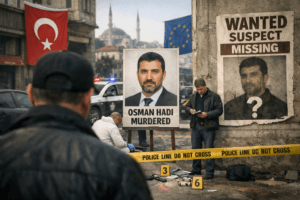
Geopolitical Whodunit: The Dubious Disappearance of an Osman Hadi Murder Suspect
In a case where narratives have shifted faster than a suspect can cross a border, the truth seems to be the first casualty. The mysterious travel of a notified murder suspect from Bangladesh has exposed not just investigative flaws but a deepening fracture in regional trust.
The assassination of Bangladeshi student leader Sharif Osman Hadi on December 20, 2025, was more than a crime. It was a political earthquake that ignited street violence and threw a nation into deeper turmoil. Yet, the subsequent hunt for the prime suspect, Faisal Karim Masud, has morphed into a geopolitical puzzle that threatens to undermine a critical regional partnership.
Indian intelligence agencies now allege that Bangladesh’s shifting stories and lack of cooperation suggest a deliberate attempt to quietly move Masud beyond reach, transforming a murder investigation into a test of diplomatic credibility and security cooperation.
The Contradictory Tale: From Meghalaya to Dubai in 48 Hours
The official narrative from Dhaka has been anything but consistent. The timeline and changing claims reveal a story struggling to hold up under scrutiny.
The India Escape Theory (December 28) Bangladesh police held a media briefing claiming that Masud and an accomplice, Alamgir Sheikh, had fled across the border into India. Their story was specific: the suspects crossed at the Haluaghat sector in Mymensingh, entered the Indian state of Meghalaya, were met by local contacts, and taken by taxi to Tura. Dhaka even suggested it had “informal reports” that Indian security agencies had detained those who assisted the suspects.
The Swift and Complete Rebuttal Within hours, this theory collapsed. Indian security forces on the ground issued a unified and categorical denial:
- Border Security Force (BSF): The BSF chief in Meghalaya stated there was “no evidence” of any illegal crossing in the Haluaghat sector and that the force had “neither detected nor received any report of such an incident”.
- Meghalaya Police: A senior officer said there was “no input or intelligence to corroborate” the claim and that local units had detected no such movement.
The Dubai Pivot (Within 48 Hours) Faced with this firm rebuttal, Dhaka’s narrative abruptly changed. A video surfaced, purportedly showing Faisal Karim Masud. In it, he denies any involvement in the murder, claims he was forced to leave Bangladesh, and states, “I am in Dubai.” He added that he held a valid five-year UAE visa.
This new story was not presented as an investigative discovery but was instead launched into the public domain via the unverified video, effectively abandoning the India narrative without explanation.
Table: Conflicting Narratives in the Masud Manhunt
| Timeline | Bangladesh’s Claim | Indian Counter/Evidence Gap |
| Dec 28, 2025 | Suspects Faisal Masud & Alamgir Sheikh flee to India via Meghalaya’s Haluaghat border. | BSF & Meghalaya Police state no evidence of any illegal crossing; border under constant surveillance. |
| Within 48 Hours | Pivot: A video surfaces of Masud claiming he is innocent and in Dubai. | Video is forensically weak (neutral background, no markers); released publicly, not shared officially for verification. |
| Ongoing | Relies on public video as proof of location. | Asks: Why has Dhaka not shared flight manifests, PNR, or transit data typically exchanged in such cases? |
The Critical Gaps: Why Indian Agencies Are Not Convinced
From New Delhi’s perspective, the problems with Bangladesh’s “Dubai narrative” are not merely about a change of story but about fundamental breaches of protocol and logic.
- The Impossible Journey of a “Notified Person”Indian intelligence sources stress a critical point:Faisal Karim Masud was a “notified person”—a formal suspect in a high-profile murder case. For such an individual to board an international flight from a major airport like Dhaka would require bypassing multiple layers of institutional security.
As one senior source framed it, “He is a notified person. Such an exit cannot happen quietly or without institutional approval”. The implied question is stark: which institutions approved it?
- The Forensically Vacant VideoThe centerpiece of the new claim is viewed with deep skepticism. Investigators note the video is shot against aneutral, unidentifiable background with no verifiable landmarks, date, or time stamps. Intelligence officials suspect it could have been recorded earlier and released strategically to project that the suspect is now beyond Bangladesh’s legal reach.
“This appears designed to remove pressure from Dhaka and to control public anger by suggesting the suspect is beyond reach,” an official noted.
- The Refusal to Share Basic DataPerhaps the most damning indicator for Indian agencies is Dhaka’ssilence on data exchange. Despite established counter-terror and intelligence-sharing mechanisms, Bangladesh has not provided flight manifests, passenger name records (PNR), or airport transit details related to Masud’s alleged travel to Dubai.
This withholding of routine information is seen as highly irregular. “This silence suggests the intent was to move him quietly,” an intelligence official concluded.
A Murder That Ignited a Nation and a Disinformation Campaign
Understanding the pressure on Dhaka requires understanding who Osman Hadi was and how his death was exploited.
Hadi was not just any student leader. He was the spokesperson for Inquilab Moncho, a key platform in the July-August 2024 mass protests that ultimately led to the fall of Prime Minister Sheikh Hasina’s government. He was a parliamentary candidate in the upcoming February 2026 elections when he was gunned down. His death triggered massive funeral processions and violent unrest, including attacks on media houses and cultural institutions.
Into this volatile mix stepped a third actor: Pakistan. An NDTV investigation revealed that within a day of Hadi’s death, a coordinated propaganda network of Pakistani social media accounts launched a campaign to falsely implicate India in the murder.
Using hashtags like #India_Hadi_Killer, these accounts, some linked to government and military narratives, spread the claim that “Indian pig RAW is involved in Hadi’s murder”. This operation sought to fuel existing anti-India sentiments in Bangladesh, which have grown since the Hasina government’s fall.
The Larger Fallout: Trust and Regional Security at Stake
For India, the Masud case has transcended a manhunt. It now touches on core issues of regional security cooperation and diplomatic trust.
Erosion of a Key Partnership India and Bangladesh have long maintained robust counter-terrorism and intelligence coordination. This incident strikes at the heart of that partnership. The abrupt, non-transparent handling of a suspect, followed by a refusal to share basic information, is seen as a breach of protocol.
Indian officials view the sequence not as a fact-based investigation but as “narrative control.” A source described it as a “classic case of moving the issue outside national jurisdiction” to reduce domestic pressure.
The Domestic Pressure Cooker in Dhaka Bangladesh’s interim government is caught in a vise. It faces:
- Intense public fury from Hadi’s massive support base demanding swift justice.
- A fragile political landscape ahead of pivotal elections.
- External narratives, amplified by actors like Pakistan, seeking to blame India and destabilize the region.
In this context, the mysterious “disappearance” of the prime suspect to a third country can be seen as a convenient pressure valve, even if it damages foreign relations.
Broader Implications for Neighbourhood Policy The case exemplifies India’s challenges in its own neighbourhood. It reflects how internal political crises in neighbouring states can spiral, drawing in India either as a scapegoat or as a party questioning transparency. The recall of Bangladesh’s High Commissioner to India for consultations underscores the diplomatic chill.
Table: The Web of Actors and Interests in the Hadi Case
| Actor | Primary Interest | Action/Posture |
| Bangladesh Interim Govt | Quell domestic unrest, manage election transition. | Shifting suspect narrative; withholding travel data; recalling envoy from India. |
| Indian Security Agencies | Maintain border integrity, ensure credible security partnership. | Rejecting border crossing claim; demanding forensic proof and data transparency. |
| Pakistan-linked Networks | Exploit chaos to fuel anti-India sentiment in Bangladesh. | Running coordinated disinformation campaign blaming India for murder. |
| Hadi’s Inquilab Moncho | Achieve justice, mobilize political support. | Issuing ultimatums to government; protests; anti-India rhetoric. |
The Path Forward: A Test of Transparency
The way forward is fraught but clear. Credible, transparent action from Dhaka is the only remedy. This would require:
- Formally sharing all evidence of Masud’s travel to Dubai with Indian counterparts through official channels.
- Collaborating with UAE authorities to forensically verify the suspect’s location and the video’s authenticity.
- Re-engaging in transparent dialogue with India to repair the damaged protocol of security cooperation.
Without these steps, the shadow over this investigation will only grow longer. The murder of Osman Hadi exposed Bangladesh’s deep political fractures. The handling of his alleged killer now risks exposing a crisis of credibility that extends beyond borders, proving that in geopolitics, a cover-up can often be more damaging than the crime one seeks to obscure. The ball is in Dhaka’s court to prove that justice, not expediency, is its guiding principle.
You must be logged in to post a comment.