
Geopolitical Earthquake: Decoding Venezuela’s “Zionist Undertones” Claim and the New Cold War in Latin America
Venezuela’s Acting President Delcy Rodríguez’s accusation that the U.S. seizure of Nicolás Maduro carried “Zionist undertones” is a calculated geopolitical maneuver, not merely inflammatory rhetoric. By framing the intervention as part of a perceived U.S.-Israeli axis, Rodríguez seeks to shift the narrative away from Maduro’s domestic record and instead rally domestic support and solidify crucial alliances with anti-Western blocs like Russia, China, and Iran. This claim, prompted by Israel’s swift endorsement of the operation, exposes a deepening new Cold War fault line, where the event has shattered the already weakened post-Cold War consensus on international law. The global schism—with much of the Global South and Venezuela’s allies condemning the act as illegal, while Western support remains tepid and legally uneasy—highlights a world increasingly divided between a doctrine of inviolable sovereignty and a discredited model of interventionism, setting a perilous precedent for the future of interstate conflict and regime change.
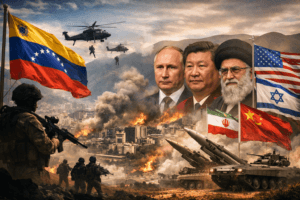
Geopolitical Earthquake: Decoding Venezuela’s “Zionist Undertones” Claim and the New Cold War in Latin America
In a televised address that reverberated through diplomatic chambers worldwide, Venezuela’s Acting President Delcy Rodríguez leveled an accusation that framed a dramatic military intervention not merely as an act of hemispheric power, but as a proxy in a broader, ideological war. The U.S. seizure of Nicolás Maduro, she asserted, carried “Zionist undertones.” To the casual observer, this might seem like a non-sequitur, a piece of inflammatory rhetoric disconnected from the reality of U.S. Special Forces operations in Caracas. But within the intricate tapestry of 21st-century geopolitics, Rodríguez’s charge is a deliberate thread, woven from decades of alliance, ideology, and a burgeoning new world disorder. This event is not an isolated incident; it is a fissure revealing the deep fault lines of a new Cold War, with Latin America as a pivotal battleground.
The Statement in Context: More Than Just Words
When Delcy Rodríguez stood before the cameras, she was performing a critical act of geopolitical framing. By invoking “Zionist undertones,” she was not solely referencing the state of Israel, though that relationship provides essential context. Venezuela and Israel have maintained strained ties for over a decade and a half. Under Hugo Chávez and continued by Maduro, Caracas positioned itself as a staunch critic of Israeli policies toward Palestine, framing its own anti-imperialist struggle as parallel to the Palestinian cause. This alignment deepened Venezuela’s bonds with Iran, Israel’s primary regional adversary, creating a direct pipeline of ideological and, reportedly, economic and technical cooperation between Caracas and Tehran.
Therefore, Rodríguez’s statement was a dog whistle to a specific global coalition. It immediately contextualized the U.S. operation not as a unilateral American action, but as part of a perceived alliance between Washington and what the Venezuelan, Iranian, and Russian leaderships often term the “Zionist entity.” This rhetoric serves to cast the conflict in civilizational terms, transforming a regional regime-change operation into a skirmish in a clash between a U.S.-Israeli-Saudi axis and an anti-Western bloc comprising Russia, China, Iran, and their allies.
The “Why Now?” of the Accusation
The timing and content of the accusation are profoundly strategic. Firstly, it is a direct response to Israel’s swift and unequivocal endorsement of the U.S. operation. Israeli Foreign Minister Gideon Sa’ar’s praise for President Trump’s action and his alignment with “the freedom-loving Venezuelan people” provided Rodríguez with the tangible evidence needed to substantiate her claim. In the narrative battle that follows any military intervention, controlling the “why” is paramount. By introducing the “Zionist” element, Venezuela and its allies attempt to shift the discussion away from Maduro’s domestic record—allegations of authoritarianism, economic collapse, and human rights abuses—and onto a more resonant, globally divisive platform of anti-colonialism and resistance to a U.S.-led world order.
Secondly, it is a rallying cry for consolidation at home and abroad. Domestically, it aims to unite Chavista loyalists and nationalists under the banner of defending sovereignty against a familiar, composite enemy: U.S. imperialism and its “Zionist” partners. Internationally, it is a signal flare to Caracas’s powerful patrons. The statement is crafted for audiences in Moscow, Beijing, and especially Tehran, reinforcing the notion that an attack on one member of this axis is an attack on their shared ideological front. It demands a response and solidifies loyalty.
The International Schism: A World Divided
The global reaction to the U.S. operation perfectly illustrates the new bipolarity taking shape. The condemnation was swift and predictable from Venezuela’s allies: Russia denounced a “blatant violation of international law,” China warned against “power politics,” and Iran decried “American banditry.” Crucially, major South American powers like Brazil, Colombia, and Chile—countries that have recognized and worked with Venezuela’s opposition—also condemned the military action, highlighting a deep-seated regional principle of non-intervention, regardless of their feelings toward Maduro.
Conversely, the support was tepid and fraught with legal unease. While some European nations welcomed Maduro’s removal, few wholeheartedly endorsed the means. Spanish Prime Minister Pedro Sánchez’s statement was emblematic of this liberal internationalist dilemma: rejecting Maduro’s legitimacy but unable to sanction an offensive war. This leaves the U.S. and a handful of allies, including Israel and possibly some Gulf states, in a starkly isolated position of outright approval.
This schism reveals a critical insight: the post-Cold War consensus on “liberal interventionism” is utterly bankrupt. The Iraq War (2003) haunted the responses from Europe and Latin America. The world is now split between a doctrine of sovereignty-as-inviolable (championed by the Russia-China bloc and many Global South nations) and a weakened, discredited doctrine of humanitarian or democratic intervention.
The Dangerous Precedent and the Road Ahead
The capture of a sitting head of state by the military forces of another nation, outside any UN Security Council mandate, sets a precedent of breathtaking gravity. It effectively normalizes regime change via military abduction as a tool of statecraft. For nations in the crosshairs of U.S. foreign policy—be it Iran, North Korea, or even larger adversaries—the Venezuela operation is a dark harbinger. It signals that Washington, under certain administrations, may feel unconstrained by international law.
For Acting President Rodríguez and the remnants of Maduro’s government, the path forward is perilous but clear. Their strategy will involve:
- Legal & Diplomatic Warfare: Challenging the action at the UN, the International Court of Justice, and every other multilateral forum, casting the U.S. as an international outlaw.
- Asymmetric Mobilization: Rallying loyalist militias and state forces under the banner of a patriotic war, leveraging the U.S. attack as the ultimate unifying tool.
- Cultivating the Patronage Lifeline: Ensuring continued support from Russia and China, not just rhetorically, but potentially through increased military or economic aid to sustain a resistance or insurgency.
The claim of “Zionist undertones” is far more than incendiary propaganda. It is a calculated geopolitical maneuver. It defines the battle, identifies the players, and summons the allies in a global contest where the rules are being rewritten in real-time. The seizure of Nicolás Maduro may have been a lightning strike, but the thunder that follows—the reshaping of alliances, the erosion of international norms, and the hardening of a world into competing blocs—will echo for years to come. Latin America is no longer America’s “backyard”; it has become the frontline in a much colder, and potentially more dangerous, war.
You must be logged in to post a comment.