
Gaza’s Unseen Winter: How a Fragile Ceasefire Is Failing to Shelter the Dispossessed
Gaza’s Unseen Winter: How a Fragile Ceasefire Is Failing to Shelter the Dispossessed
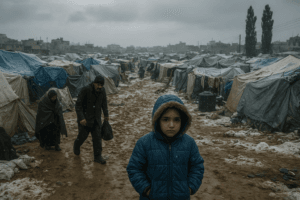
“The wind tore through the plastic sheeting and the rain came from all directions,” recounted Eman Abu Zayed, describing the night Storm Byron flooded her family’s tent. “We woke to a shallow pool where our floor had been. Our mattresses, clothes, even the bags we use as closets—everything was submerged.”
For the third consecutive winter since the war began, displaced Palestinians in Gaza are facing an environmental and humanitarian catastrophe of unprecedented scale. While a ceasefire has halted mass bombardment since October 2025, it has failed to deliver meaningful relief to the 1.4 million displaced people who now face winter without adequate shelter, food, or medical care.
A lethal convergence of factors—collapsed infrastructure, a crippled health system, contaminated water, and critical shortages of basic supplies—is creating conditions where nature itself has become a weapon of suffering. This winter is testing whether a population that survived two years of war can survive what comes after.
A Temporary Ceasefire, A Permanent Crisis
The humanitarian situation in Gaza remains catastrophic despite the October 2025 ceasefire. The United Nations estimates that 1.5 million people are in urgent need of shelter assistance, with approximately 90% of Gaza’s population displaced. The statistics paint a grim picture of systemic failure:
Table 1: Gaza’s Humanitarian Crisis at a Glance
| Category | Key Statistic | Source/Impact |
| Shelter Need | 1.5 million people require urgent shelter assistance | 90% of population displaced |
| Tent Shortage | 48,600 tents entered since ceasefire for 1.3 million needing shelter | Massive gap in provision |
| Medical Crisis | 52% of essential drugs completely out of stock | Life-saving treatments unavailable |
| Food Security | Food prices 132% above pre-war levels (down from 3,000% in July) | Improvement, but still severe |
| Flood Risk | 761 displacement sites vulnerable to flooding | Impacts approximately 850,000 people |
Jonathan Crickx of UNICEF describes conditions as “extremely dramatic,” noting that while markets show more food, “many types of food are still very expensive” and the most vulnerable families continue to struggle. The ceasefire has brought “a little respite,” but the living conditions remain devastatingly challenging.
When Rain Becomes a Weapon: The Environmental Health Crisis
Winter storms in Gaza are no ordinary weather events. Storm Byron’s arrival in December 2025 exposed how environmental devastation compounds human suffering in predictable, preventable ways.
The Gaza Strip’s infrastructure has been shattered by years of conflict and blockade. With most municipal wastewater networks destroyed or severely damaged, floodwater inevitably mixes with raw sewage. This contaminated water then floods into tents and living areas, creating what Dr. Muneer al-Bursh of Gaza’s Health Ministry calls “a direct health threat amid overcrowding and severe shortages of food and medicine”.
Even before the current war, 97% of Gaza’s groundwater was already considered unfit for human consumption. Today, the environmental degradation is far worse. None of Gaza’s wastewater treatment plants are operational, according to the UN. Solid waste collection has largely halted, allowing “vast piles of rubbish” to accumulate across the territory. When heavy rains fall, this waste—including medical waste, plastics, and animal remains—mobilizes into areas where displaced families are sheltering.
Table 2: Health Risks Amplified by Winter Conditions
| Health Risk | Cause | Impact |
| Waterborne Diseases | Sewage-contaminated floodwater, compromised water sources | Increased risk of cholera, dysentery |
| Respiratory Infections | Damp living conditions, lack of heating, overcrowding | Rising meningitis and respiratory infections |
| Hypothermia | No heating, inadequate shelter, wet conditions | Deaths reported among infants and children |
| Malnutrition Complications | Cold increases energy needs, insufficient food intake | Severely malnourished children at extreme risk |
| Hygiene-related Infections | Lack of menstrual products, contaminated water | Increased risk of infection, particularly for women |
The health system, already on the brink of collapse, cannot cope with these mounting challenges. Medical facilities operate with minimal resources, facing severe shortages of essential supplies—from life-saving antibiotics and chemotherapy drugs to surgical gauze and orthopedic equipment.
The Invisible War on Women and Girls
Winter in Gaza disproportionately impacts women and girls, transforming daily survival into what journalist Ola Almadhoun calls “a season of danger, deprivation and systemic neglect”.
More than 57,000 women now head their households alone in Gaza, caring for children in environments that offer neither privacy nor protection from the elements. When tents flood, women lose not only physical shelter but the minimal privacy required for basic safety, hygiene, and dignity.
The scarcity of essential supplies creates impossible choices. During the war, women were forced to cut up old clothing for improvised sanitary pads. Flooded toilets and contaminated pathways deter girls from leaving their tents, isolating them from healthcare, safe spaces, and aid distribution. According to UN estimates, nearly 700,000 women and girls of reproductive age lack access to menstrual hygiene products.
Mothers face particular psychological strain. As Almadhoun notes, “Many mothers describe staying awake through entire nights, holding their children close as heavy rain and freezing winds push through soaked blankets and torn walls”. This constant cycle of fear, sleeplessness, and physical strain has created what UN Women warns are “invisible wounds that cannot be healed by food or water alone”.
The Shelter Gap: When Aid Cannot Reach Those Who Need It
The mathematics of Gaza’s shelter crisis reveals a stark discrepancy between need and provision. According to OCHA data, only 48,600 tents have entered Gaza since the ceasefire for approximately 1.3 million people requiring urgent shelter assistance.
Several factors constrain shelter provision:
- Logistical bottlenecks: Despite improvements in aid delivery, “customs delays, insecurity, and limited crossings continue to hinder aid delivery”.
- Restricted materials: Israeli authorities have reportedly rejected thousands of pallets of shelter materials, including tarps, tents, and sealing kits.
- Blocked humanitarian access: Many international NGOs remain blocked from operating in Gaza, limiting distribution capacity.
Even when aid enters Gaza, distribution faces challenges. The UN has acknowledged that while over 131,000 pallets of aid have reached warehouses since the ceasefire, only 2% of uplifted aid was intercepted during transit within Gaza. This suggests that the primary bottleneck occurs before aid reaches Gaza, not after.
The Norwegian Refugee Council, which oversees shelter distribution, has accused Israel of “impeding the entry of supplies” and rejecting 4,000 pallets of shelter materials. Israeli authorities have declined to disclose how many tents have entered Gaza during the ceasefire period.
A Question of Responsibility Under International Law
The winter crisis in Gaza raises fundamental questions about legal obligations and humanitarian responsibility. Under international law, Israel maintains obligations as the occupying power to ensure the welfare of the civilian population.
UN officials have expressed alarm at what appears to be a systematic failure to meet these obligations. Ajith Sunghay, head of the UN human rights office in the Occupied Palestinian Territory, has warned that certain actions “raise concerns about forcible transfer which is prohibited under international law”.
The blockade on construction materials and shelter supplies has drawn particular criticism. “This predictable pattern, in which winter weather exposes the fragility of makeshift camps that cannot be rebuilt or reinforced, repeats because Israel blocks construction materials from entering Gaza,” notes Almadhoun.
Meanwhile, the international community’s response has been mixed. In December 2025, the UN General Assembly gave “a strong endorsement” to an International Court of Justice ruling that allegations about UNRWA being infiltrated by Hamas “lack substance”. The resolution backing UNRWA passed with support from 139 member states, while only 12 voted against. This political support, however, has yet to translate into tangible improvements on the ground.
Beyond Immediate Relief: The Path Forward
Addressing Gaza’s winter crisis requires more than temporary fixes. While emergency distributions of winter clothing, blankets, and tents continue, humanitarian workers emphasize that only sustained, unhindered access can prevent further loss of life.
UNICEF’s Jonathan Crickx outlines what is needed: “We need to have more tents going in. We need to have more oil supplies. It’s also important that we have all the entry points possible… We also need things like caterpillars, you know, big machinery, heavy machines to remove big piles of rubble”.
The environmental dimensions of the crisis demand particular attention. As Rajaa Musleh, a nurse and humanitarian worker, observes: “This war, I call it a climate war. It has created catastrophe, an environmental health crisis… and I think this will affect Gaza for generations”.
The most vulnerable populations—infants, the elderly, pregnant women, and those with chronic illnesses—require targeted interventions. Medical evacuations continue, with 16,500 patients in Gaza still requiring urgent medical treatment outside the territory, but the pace remains insufficient given the scale of need.
The ceasefire provided hope that the most intense suffering might end, but as winter tightens its grip on Gaza, that hope is fading. Displaced families who survived bombardment now face a slower, quieter threat—one that arrives not from the sky but from the clouds, that seeps not through shattered walls but through soaked tent fabric, that kills not with sudden violence but with relentless, creeping cold.
The coming months will test whether the international community can mobilize not just to deliver blankets and tents, but to address the systemic failures that have turned seasonal weather into a humanitarian catastrophe. For the children shivering in flooded tents, the elderly struggling to maintain body heat, and the mothers staying awake through freezing nights to shield their families, the question is no longer about surviving war, but about surviving what comes after.
You must be logged in to post a comment.