
Gaza’s Precarious Ceasefire: Violence Persists Amid New Peace Plan Phase
Despite the United States announcing the start of Phase Two of a ceasefire and governance plan aimed at Gaza’s reconstruction and demilitarization, Israeli strikes the following day killed at least ten people, including senior Hamas and Islamic Jihad commanders and a 16-year-old boy, highlighting the profound disconnect between diplomatic initiatives and the ongoing violence on the ground. Since the nominal ceasefire began in October, over 450 Palestinians, including more than 100 children, have been killed, underscoring the agreement’s fragility as Israel continues targeted operations and Hamas refuses to disarm, with both sides locked in a cycle of blame while Gaza’s devastated population endures a daily struggle for survival in a shattered territory.
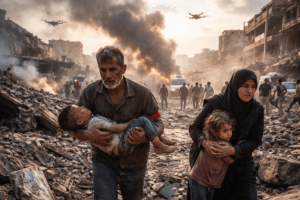
Gaza’s Precarious Ceasefire: Violence Persists Amid New Peace Plan Phase
A new phase in Gaza’s peace plan was declared this week, yet the reality on the ground remains one of continued violence and death. Just a day after the United States announced the start of Phase Two of a major ceasefire agreement, Israeli strikes across Gaza killed at least ten people on Thursday, including senior militant figures and a teenager. This incident starkly highlights the profound disconnect between high-level diplomatic announcements and the daily struggle for survival faced by Gaza’s two million residents, casting serious doubt on the viability of the newly launched governance plan.
The Fragile “Calm”: A Ceasefire in Name Only
The ceasefire agreement, which took effect in October 2025, was designed to halt active combat and begin a process toward lasting peace. In theory, it established a cessation of hostilities. In practice, the suspension of fighting has been partial and inconsistent.
According to Gaza authorities, more than 450 Palestinians have been killed since the ceasefire began. An analysis by Al Jazeera found that Israel attacked Gaza on 82 out of 97 days during the ceasefire period, meaning there were only 15 days without reported violence, deaths, or injuries. This near-daily pattern of strikes, drone attacks, and shootings has led local and international observers to question the agreement’s effectiveness.
The recent strikes that killed senior Hamas commander Mohammed Al-Holy and Islamic Jihad operative Ashraf Al-Khatib are part of this ongoing pattern. Israel stated these were targeted operations against militants, but the casualties regularly include civilians. On the same day, a 16-year-old boy, Mohammad Raed al-Barawi, was shot in the head by Israeli forces in northern Gaza.
Key Casualty Statistics Since the War Began
| Category | Reported Figure | Source / Context |
| Total Palestinian Deaths | Over 71,000 | Gaza Health Ministry count to Jan 2026 |
| Children Killed | At least 20,179 | ~28% of total Palestinian fatalities |
| Deaths Since Oct 2025 Ceasefire | More than 450 | Gaza Health Ministry, as of Jan 2026 |
| Children Killed Since Ceasefire | More than 100 | UNICEF report, Jan 2026 |
| Israeli Deaths (Oct 7 Attacks) | 1,195 | Israeli tallies |
| Israeli Soldiers Killed Since Ceasefire | 3 | Israeli military reports |
Phase Two: A Plan Meets Reality
The second phase of the peace plan, announced by U.S. Special Envoy Steve Witkoff, aims to transition from a simple ceasefire to “demilitarization, technocratic governance, and reconstruction”. Its centerpiece is the creation of a Palestinian technocratic committee—the National Committee for the Administration of Gaza (NCAG)—tasked with day-to-day governance under the oversight of an international “Board of Peace”.
This committee, led by engineer and former Palestinian Authority official Ali Shaath, has held its first meetings in Cairo. Shaath has expressed optimism, suggesting reconstruction could take about three years, a stark contrast to UN estimates that clearing rubble alone may require seven years.
However, the plan faces immense immediate challenges:
- Disarmament of Hamas: A key tenet of Phase Two is the “full demilitarization” of Gaza and the disarmament of Hamas. The group has so far refused to lay down its weapons, viewing armed resistance as a fundamental right. U.S. and Israeli officials have openly expressed skepticism that Hamas will comply.
- Skeptical Leadership: Israeli Prime Minister Benjamin Netanyahu has downplayed the announcement, calling the governing committee a largely “declarative move”. His priority remains the return of the remains of the last Israeli captive, Ran Gvili, warning Hamas to do so “IMMEDIATELY”.
- Public Cynicism: For displaced Palestinians living in makeshift tents, the political announcements feel “distant and abstract”. Their urgent concerns are for “food, shelter, water and safety”—needs not yet met by the ceasefire.
The Unending Toll on Gaza’s Children
Perhaps the most searing indictment of the ceasefire’s fragility is its failure to protect children. UNICEF reports that more than 100 children have been killed in Gaza since the ceasefire began in early October—roughly one child every day.
“Life in Gaza remains suffocating. Survival is still conditional,” stated UNICEF spokesperson James Elder. “Whilst the bombings and shooting have slowed during the ceasefire, they have not stopped”.
Children are dying from airstrikes, drone attacks, and tank shelling. Others are succumbing to the elements; this winter alone, at least six children have died from hypothermia as bitter cold and wind rip through flimsy tents. The psychological damage on an entire generation is profound and untreated, “becoming deeper and harder to heal the longer this goes on”.
A poignant example is nine-year-old Abid Al Rahman, who was collecting wood in Khan Younis when an airstrike hit. Shrapnel tore into his eye and remains lodged there, yet he has been denied a medical evacuation. His story reflects a broader crisis: despite the ceasefire, approvals for critically ill or injured children to leave Gaza for treatment have seen “no noticeable improvement”.
A Gridlock of Blame and Strategic Divergence
The path forward is blocked by a deep-seated mutual distrust and conflicting endgames. Israel and Hamas consistently trade blame for ceasefire violations. Israel maintains its objective of dismantling Hamas’s military and governing capabilities, while Hamas, though signaling willingness to hand over civilian administration, refuses to disarm.
Complicating the picture are other armed factions, like Palestinian Islamic Jihad (PIJ). As the second-largest armed group in Gaza, PIJ is considered even more uncompromising than Hamas, rejecting any political peace process and seeking an Islamic state across all historic Palestine. Although it collaborates with Hamas, the groups are rivals with different structures and tactics. The killing of senior PIJ figure Ashraf Al-Khatib in the recent strikes underscores that Israel’s campaign continues to target multiple militant networks simultaneously.
The international community watches with cautious concern. A UK Parliament report noted that while ceasefires are crucial, “some of Israel’s recent actions in Gaza are difficult to justify given the death toll among civilians”. It also stressed that Hamas and criminal gangs have been accused of impeding aid, creating a “lethal chaos” in distribution.
Conclusion: A Ceasefire That Buries Children Is Not Enough
The launch of Phase Two represents a critical diplomatic test. The technocratic committee in Cairo and the planned Board of Peace must now confront the monumental tasks of governing a shattered territory, overseeing a reconstruction that could cost over $50 billion, and navigating the disarmament of entrenched armed groups.
Yet, as the smoke from Thursday’s strikes clears, the words of UNICEF’s James Elder resonate with grim truth: “A ceasefire that slows the bombs is progress — but one that still buries children is not enough”. For the people of Gaza, the measure of success will not be in signed documents or announced phases, but in the tangible cessation of violence, the unimpeded flow of life-saving aid, and the ability of children to live without fear. Until then, the ceasefire remains a fragile concept, struggling to become a lived reality.
You must be logged in to post a comment.