
Gaza’s Post-War Future: A US-Backed “Board of Peace” Meets Israeli and Palestinian Resistance
Gaza’s Post-War Future: A US-Backed “Board of Peace” Meets Israeli and Palestinian Resistance
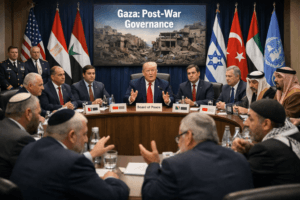
The United States has unveiled an ambitious, multi-tiered plan to govern a post-war Gaza Strip, but the proposal is facing immediate and fierce resistance from all sides. As the ceasefire enters a critical second phase focused on demilitarization and reconstruction, the Trump administration’s “Board of Peace” finds itself caught between Israeli far-right demands for permanent control, Palestinian fears of disenfranchisement, and its own expansive geopolitical ambitions.
At the heart of the controversy is a complex administrative structure that places ultimate authority in a U.S.-led international board, relegating Palestinians to a technocratic committee with limited power, and has provoked a rare public rebuke from Israel’s leadership.
The Three-Tiered Governance Blueprint
The U.S. plan establishes a clear, top-down hierarchy for Gaza’s administration, which critics argue resembles a form of international trusteeship or a “corporate takeover” of Palestinian governance.
| Governance Tier | Primary Function | Key Members/Composition |
| 1. Board of Peace (Strategic Oversight) | Sets strategic vision, controls funding, mobilizes international resources. Chaired by U.S. President Donald Trump. | Trump (Chair), world leaders (e.g., Egypt’s Sisi, Turkey’s Erdogan invited), Founding Executive Board (Rubio, Kushner, Blair, Rowan, Banga, etc.). |
| 2. Gaza Executive Board (Regional Coordination) | Supports governance on the ground, advises the Palestinian committee, ensures regional buy-in. | Mix of U.S. envoys (Witkoff, Kushner), regional diplomats (Turkey’s Fidan, Qatar’s Al-Thawadi, UAE’s Al-Hashimy), and others (Tony Blair, UN’s Sigrid Kaag). |
| 3. National Committee for Admin. of Gaza (NCAG) (Day-to-Day Governance) | Manages civil services and daily administration (health, education, municipal affairs). Holds no political authority. | 15 Palestinian technocrats, led by Dr. Ali Shaath. Composed of sector-specific professionals (e.g., finance, health, interior). |
This structure is operationalized by two key on-the-ground appointments: Nickolay Mladenov as the High Representative linking the boards to the NCAG, and Major General Jasper Jeffers as commander of an International Stabilization Force (ISF) tasked with security and disarmament.
Israeli Objections: Far-Right Revolt and Strategic Posturing
The announcement triggered a strong and immediate backlash from within Israel’s ruling coalition. Far-right Finance Minister Bezalel Smotrich rejected the plan outright, calling Prime Minister Netanyahu’s “unwillingness to take responsibility for Gaza” the “original sin.” Instead, he demanded Israel establish a military government to encourage “immigration and settlement” in the territory.
The inclusion of Turkey and Qatar on the Gaza Executive Board is a primary flashpoint. Smotrich argued, “The countries that inspired Hamas cannot be the ones that replace it,” a sentiment echoed by National Security Minister Itamar Ben-Gvir. Netanyahu’s office issued a rare public objection, stating the board’s composition “was not coordinated with Israel and [is] contrary to its policy”.
However, analysts suggest Netanyahu’s protest may be partly political theater. With his coalition dependent on far-right parties for survival, public opposition allows him to appease allies like Smotrich and Ben-Gvir, who never supported the U.S.-brokered ceasefire. A source cited by Haaretz indicated the Prime Minister was consulted and aware of the appointments, framing the rebuke as a performative act. The ultimate goal for Netanyahu may be to outsource Gaza’s humanitarian and administrative crisis to the international community while Israel retains overarching security control.
Palestinian and Regional Perspectives: Sovereignty Versus Survival
For Palestinians, the plan is met with profound ambivalence. The NCAG is viewed by some desperate citizens as a potential lifeline to restore basic services and rebuild a shattered land. However, the structure systematically excludes Palestinians from strategic decision-making. Gaza-based analyst Iyad al-Qarra describes it as treating Gaza “not as a homeland, but as a bankrupt company in need of a new board of directors”.
The relegation of Palestinians to a technocratic, municipal role separates the “service file from the political file,” effectively burying the Palestinian national project of self-determination. Wissam Afifa, a writer in Gaza, notes the committee members are professionals, but the model is one of “sovereignty-minus,” where a “National Committee” takes orders from a “High Representative” who takes orders from the White House.
Regionally, the inclusion of Turkey, Qatar, Egypt, and the UAE is a U.S. attempt to secure buy-in from key Muslim and Arab states. For Turkey, which has strained relations with Israel but influence with Hamas, the invitation is a significant diplomatic nod.
The “Board of Peace”: A New Global Ambition?
Intriguingly, the Gaza plan may be a pilot for a broader U.S. foreign policy vision. Letters from Trump to invited leaders like Argentina’s Javier Milei describe the board as a “bold new approach to resolving Global Conflict”. An accompanying charter positions it as an organization to “promote stability… in areas affected or threatened by conflict,” with one diplomat dubbing it a “Trump United Nations”.
A controversial financial dimension supports this expansive view. A draft charter suggests countries can secure permanent membership by contributing $1 billion in cash, a move the White House says rewards “deep commitment to peace”. This blending of diplomatic ambition with a pay-to-play model underscores the board’s unconventional nature.
The Rocky Road Ahead: A Timeline of Challenges
The immediate challenges are stark. The International Stabilization Force (ISF), led by General Jeffers, must navigate the perilous task of disarming Hamas in a volatile environment. Meanwhile, life in Gaza remains precarious and deadly; even after the ceasefire, hundreds of Palestinians have been killed by ongoing violence and severe humanitarian conditions.
Conclusion: Managing Conflict Versus Solving It
The U.S.-backed “Board of Peace” represents a monumental effort to impose a governance structure on Gaza from the outside. While it may succeed in managing the immediate crisis—restoring services and coordinating reconstruction—it fails to address the core political issues at the heart of the Israeli-Palestinian conflict.
The plan’s fundamental contradiction is that it seeks to build peace without politics, stability without sovereignty. It satisfies Israel’s immediate security demands by mandating demilitarization and excluding hostile actors, but at the cost of Palestinian political aspirations. It appeases the Israeli far-right’s wrath through performative disputes, while potentially locking in a long-term arrangement that relieves Israel of direct responsibility for Gaza.
As the second phase begins, the board will be tested not on paper, but in the rubble of Gaza. Its success will depend on whether it can evolve from a top-heavy, externally imposed framework into a mechanism that genuinely addresses the legitimate grievances and aspirations of both Palestinians and Israelis. Currently, it appears less a roadmap to a just peace and more a sophisticated mechanism for crisis management—an attempt to administer the symptoms of a conflict whose disease remains untreated.
You must be logged in to post a comment.