
Gaza’s Fragile Truce: Why This Ceasefire Is Failing Where It Matters Most
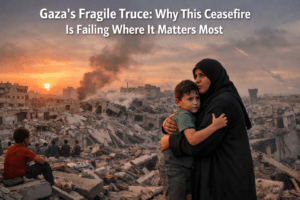
Gaza’s Fragile Truce: Why This Ceasefire Is Failing Where It Matters Most
Amid high-level meetings in Washington and diplomatic assurances of progress, the grim reality in Gaza tells a different story. While U.S., Egyptian, Qatari, and Turkish officials urge restraint and celebrate the “first stage” of a ceasefire, the humanitarian catastrophe for Palestinians deepens daily. The so-called truce, in effect since October 10, 2025, has failed to stop the killing, lift the siege, or deliver the lifesaving aid it promised, revealing a dangerous chasm between diplomatic rhetoric and human suffering on the ground.
This analysis explores why this ceasefire is crumbling and what its failure reveals about the international community’s approach to a crisis that has claimed over 70,700 Palestinian lives, including 20,179 children, since October 2023.
Promises vs. Reality: A Ceasefire in Name Only
The U.S.-brokered 20-point peace plan, announced with fanfare in September 2025, outlined a clear path: an immediate end to hostilities, a full lifting of the blockade on aid, and a phased Israeli withdrawal. A comparison of its key promises against the documented outcomes reveals a systemic failure.
| Ceasefire Provision (Phase One) | What Was Promised | Documented Reality (as of Dec 2025) | Source |
| End to Hostilities | Cessation of attacks between Israel and Hamas. | 738 documented violations by Israel from Oct 10-Dec 12. Attacks occurred on 58 of 69 days, killing at least 394 Palestinians. | |
| Humanitarian Aid Access | “Full aid will be immediately sent into Gaza”. | Only 39% of needed aid trucks are entering. UN-coordinated aid is around 100 trucks/day, far below requirements. | |
| Withdrawal of Israeli Forces | Israeli forces withdraw to the “yellow line”. | Israeli military retains control over 53% of Gaza territory, calling the yellow line a “new border”. | |
| Release of Captives/ Prisoners | Release of all captives in Gaza and ~2,000 Palestinian prisoners. | All 20 living Israeli captives released. Hamas has returned 27 bodies, with one remaining. Israel has returned over 300 Palestinian bodies. | |
| Humanitarian Crisis Mitigation | Surge in aid to address famine and prepare for winter. | 104,000 people remain in Catastrophe (IPC Phase 5). Over 300,000 winter tents are blocked; a two-week-old infant froze to death. |
The data paints an undeniable picture: the mechanisms designed to protect civilians and provide relief are not functioning. The continuation of lethal force, the strangled aid pipelines, and the maintenance of Israeli military control have created a “ceasefire” that has changed little for the average Palestinian.
The Mechanics of a Broken Truce
Understanding why this ceasefire is failing requires looking beyond the violation tallies to its structural flaws.
- The “Yellow Line”: A Border of Division, Not Withdrawal
A cornerstone of the first phase was the Israeli withdrawal to a pre-defined “yellow line”. However, this has not meant a return of Palestinian sovereignty or safety. The Israeli military now frames this line as a “new border” and a “forward defensive line,” over which it maintains “operational control”. This re-framing turns a temporary security measure into a potential permanent division of Gaza, preventing the return of normal life and freedom of movement that a genuine ceasefire would enable.
- Aid as a Bargaining Chip, Not a Right
The agreement promised an immediate and full flow of humanitarian aid. Instead, aid delivery remains a daily negotiation, subject to political and bureaucratic obstruction. While COGAT (the Israeli military body governing Palestinian civilian affairs) reports 600-800 trucks entering daily, this figure includes commercial supplies. UN-coordinated humanitarian aid—the kind that delivers specialized nutritional treatment, medical supplies, and winter shelter—hovers around a mere 100 trucks per day. Essential items like meat, dairy, and vegetables are routinely blocked, while snacks and soft drinks are allowed in, doing little to stem a malnutrition crisis that still threatens 101,000 children under five with acute malnutrition.
- A Climate of Impunity for Violations
The international response to ceasefire violations has been muted, creating an environment of impunity. When asked about Israeli attacks that killed over 100 people in a single day in late October, U.S. President Donald Trump characterized them as justified “retribution”. This rhetoric undermines the agreement’s foundational principle of a mutual cessation of violence and signals that violations may not incur meaningful diplomatic consequences.
The Deepening Humanitarian Catastrophe
Beneath the diplomatic discussions lies a human emergency of staggering proportions, now compounded by winter.
- A Famine Pushed Back, But Not Averted: Recent IPC analysis indicates that famine (IPC Phase 5) has been “pushed back” in Gaza due to improved aid access since the ceasefire. However, this is a perilously fragile gain. The entire population of Gaza remains in crisis-level hunger or worse, with 571,000 people in Emergency (Phase 4) and 104,000 still facing Catastrophe (Phase 5) conditions. UN Secretary-General António Guterres has warned that without sustained access, the entire Strip could rapidly fall back into famine.
- Winter as a New Weapon: With over 90% of Gaza’s population displaced and living in damaged homes, tents, or makeshift shelters, the onset of winter storms has been catastrophic. Roofs of war-damaged buildings are collapsing under rain and wind. Families are living in “sewage-tinged flooding,” which mixes with untreated waste, escalating risks of disease outbreaks. The UN has 300,000 winter tents for 1.5 million people ready but blocked from entry by Israeli authorities. The reported death of a two-week-old infant from hypothermia is a grim testament to these failing “winterization” efforts.
- A System in Ruins: The war has shattered Gaza’s civilian infrastructure. Most hospitals are damaged or non-functional, water and sanitation systems are destroyed, and unexploded ordnance litters the landscape. The ceasefire has not enabled the large-scale reconstruction or clearing necessary for recovery. As Refugees International states, “This is not stabilization or peace. It remains sustained, large-scale deprivation”.
The Road Ahead: A Precarious “Phase Two”
With Phase One demonstrably failing to meet its core objectives, discussions are nervously turning to Phase Two, which is meant to establish a transitional administration and deploy an international stabilization force. This next stage is fraught with even greater obstacles.
- The Disarmament Dilemma: A central Israeli and U.S. demand for Phase Two is the “disarmament of Hamas”. Hamas officials have publicly stated they will not accept an international force with a disarmament mandate on Palestinian territory. They are only willing to discuss “freezing or storing” weapons during a truce and insist on retaining the “right to resist” as part of any long-term political process. This fundamental disagreement over sovereignty and security threatens to derail negotiations before they begin.
- The Vagueness of the “Stabilization Force”: The U.S. plan calls for an international force but offers no concrete details on its composition, command structure, rules of engagement, or timeline. While countries like Indonesia have expressed willingness to contribute troops, the force’s mandate remains dangerously vague. Is it to facilitate aid and protect civilians, or to actively disarm Palestinian factions? This lack of clarity leaves potential contributing nations hesitant and the plan unstable.
- The Shadow of Past Failures: This is not the first attempted ceasefire. A prior agreement in January 2025 collapsed in March when Israel launched a surprise attack, accusing Hamas of refusing to release more hostages. That history of breakdowns looms over the current talks, fostering mutual distrust and the constant threat that any incident could trigger a full-scale return to war.
The calls for “restraint” from the U.S., Egypt, Qatar, and Turkey are not enough. The current trajectory suggests that without a fundamental change in approach—one that prioritizes an immediate end to violence and the unconditional flow of aid as legal and moral imperatives, rather than bargaining chips—this ceasefire will join its predecessors in failure. The people of Gaza, already pushed beyond endurance, will continue to pay the price in a limbo of violence, hunger, and cold that the world has chosen, through inaction, to accept.
You must be logged in to post a comment.