
Gaza’s Cold Crisis: How Winter Storms Are Pushing a Displaced Population to the Brink
Gaza’s Cold Crisis: How Winter Storms Are Pushing a Displaced Population to the Brink
A Deluge on Top of Devastation
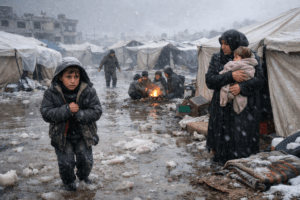
In the predawn darkness of mid-December 2025, the sound of wind and lashing rain added a new layer of misery to the Gaza Strip. For approximately one million people living in tents and makeshift shelters, the storm was not an inconvenience but a direct assault on their fragile existence. Jonathan Crickx, UNICEF’s chief of communications for the State of Palestine, described waking to find 10 to 15 centimeters (4-6 inches) of water pooling on the ground. “Last night was really horrendous for the families,” he reported, painting a picture of parents desperately bailing out their shelters with buckets as the cold seeped into everything they owned.
This is the new reality for hundreds of thousands of displaced Palestinians: a struggle for survival where the enemy is not only the legacy of conflict but now also the weather. Heavy winter storms, including Storm Byron which made landfall in early December, have transformed crowded displacement sites into flooded, muddy quagmires, pushing an already catastrophic humanitarian situation into uncharted territory. The storms have laid bare a terrifying truth—that for a population stripped of homes, infrastructure, and resilience, even a routine winter can be deadly.
The Scale of the Crisis in Numbers
The statistics emerging from UN agencies and humanitarian groups quantify a disaster unfolding in slow motion:
- At Immediate Risk: Nearly 795,000 displaced Palestinians are at heightened risk from flooding as severe weather systems move through the region.
- Already Affected: Initial assessments found that earlier rains had already flooded 219 active displacement sites, affecting more than 140,000 people. By mid-December, heavy rains had severely flooded more than 40 designated emergency shelters in a single day, forcing already displaced families to relocate once again.
- Direct Impact: The UN and its partners estimate that almost 55,000 families have had their belongings and shelters damaged or destroyed by the rains. On just December 15-16, flooding directly impacted over 4,700 displaced people and damaged more than 691 tents.
- The Human Cost: The cold has turned lethal. Gaza’s health ministry reported the death of a two-week-old boy from hypothermia. Furthermore, the collapse of war-damaged buildings under the stress of wind and rain had, by some accounts, killed at least 17 people, including four children.
A Converging Catastrophe: Shelter, Health, and Environment
The winter storms are not a standalone crisis but a force multiplier that exacerbates every existing vulnerability in Gaza.
The Failure of Flimsy Shelter: The most visible failure is in shelter. Makeshift structures—often nothing more than tarpaulin or plastic sheeting nailed to fragile wood—are completely inadequate. They offer no insulation against nighttime temperatures that drop to 7-8°C (45-46°F) and cannot withstand strong winds. Haitham Aqel of the Palestinian Housing Council described the futility: “We used sandbags to create drainage, but many people’s bedding and mattresses were damaged as water entered through worn-out tents”. These sites are often on low-lying, debris-filled land with nonexistent or overwhelmed drainage systems, meaning even moderate rain quickly becomes a flood that ruins the few possessions families have left.
The Looming Health Epidemic: Wet clothing, damp blankets, and flooded living spaces create a perfect incubator for disease. The combination of poor sanitation, overcrowding, and contaminated floodwater dramatically accelerates the spread of respiratory infections, skin diseases, and diarrheal illnesses. For children, this is particularly deadly. Malnutrition, which remains at crisis levels, weakens their immune systems, while the cold dramatically increases their bodies’ energy needs. A child who is both cold and malnourished is at severe risk of hypothermia, as they lack the fat and muscle reserves to generate warmth. UNICEF has launched a catch-up immunization campaign for diseases like measles and polio, recognizing that the environment is ripe for outbreaks.
A Broken Environment: Two years of conflict have decimated Gaza’s infrastructure. Water and sewage systems are shattered, garbage collection is sporadic, and the landscape is scarred with rubble. The rains wash waste and sewage through populated areas, turning floods into toxic streams. Basic tools and materials needed for mitigation—sandbags, water pumps, timber, and plywood—are among the items frequently delayed or blocked at crossings, leaving communities powerless to protect themselves.
The Special Peril for Gaza’s Children
If the crisis has a most vulnerable face, it is that of Gaza’s children. An estimated 30,000 children have been directly affected by storm damage. They are the most likely to succumb to hypothermia and illness in wet clothing, and they bear the brunt of the psychological trauma of constant displacement and insecurity.
UNICEF has mobilized one of its largest-ever winter responses, but the need is bottomless. Their efforts include:
- Distributing hundreds of thousands of winter clothing kits (containing jackets, hats, gloves, and shoes), blankets, and tarpaulins.
- Providing digital cash payments to 100,000 families so parents can meet urgent needs.
- Rehabilitating water infrastructure and trucking in safe water.
- Screening for malnutrition at immunization points; of nearly 7,000 children screened in one round, 508 were identified as acutely malnourished.
The poignant testimony of mothers like Worod, living in Beach camp with her four children, cuts through the statistics: “I was thinking about what we will do… since it will be raining. The kids need sweaters. They’re small, and they have to keep warm. I can handle it, but the children can’t”.
The Humanitarian Response: A Race Against Time and Bureaucracy
Aid agencies are engaged in a massive, yet frustratingly hampered, operation. Since the ceasefire began on October 10, 2025, significant volumes of aid have entered:
- The UN has collected 67,800 tents, 372,500 tarpaulins, and 318,100 bedding items from crossings.
- UNICEF alone has brought in over 250,000 winter clothing kits, 600,000 blankets, and 7,000 tents.
- Daily, between 600 and 800 aid trucks are reported to enter Gaza.
However, a stark disconnect exists between these figures and the reality on the ground. UN officials consistently state that aid is still not getting in at the scale or speed required. They report that essential items, including construction materials for shelter repair and winterization supplies, remain “blocked or restricted” at Israeli-controlled crossings. The UN’s daily coordination reports are a ledger of impediments: missions to collect medical supplies denied access, monitors kept out of crossing areas, and key roads inside Gaza interdicted for aid transport.
This bottleneck at the border means distribution cannot keep pace with need. As UNICEF warned, “the distributed supplies are not being replaced quickly enough with the significant volume of winter supplies awaiting entry at the borders”. The result is a gap—between the pallets offloaded at Kerem Shalom and the dry blanket a child needs in a flooded tent in Khan Younis.
Beyond the Storm: A Ceasefire Fraught with Uncertainty
The winter crisis unfolds against the backdrop of a fragile, nine-week ceasefire brokered by the US and mediated by Egypt, Qatar, and Türkiye. While the truce has stopped large-scale fighting, it has not stopped suffering. The second phase of the agreement, which includes plans for Gaza’s reconstruction, remains elusive, stuck on difficult issues of post-war governance and security.
International diplomats, like Qatar’s Prime Minister, stress that humanitarian assistance must be allowed in “unconditionally” to stabilize the situation. Meanwhile, at the UN Security Council, officials plead for the “safe, rapid and unimpeded movement of humanitarian aid,” framing it not just as a moral imperative but as a prerequisite for any lasting peace. The political will to implement a comprehensive recovery plan seems absent, leaving humanitarians to manage a disaster with stopgap measures.
A Call Amidst the Cold
The story of Gaza’s winter is a story of compounding failures. It is the failure of flimsy shelters against a storm, the failure of a political process to unlock reconstruction, and the failure of the world to prioritize humanity over bureaucracy. As Ahmed al-Hosari, who lost a relative in a building collapse, pleaded: “We call on the world to solve our problems and rebuild the territory so that people can have homes instead of being displaced and living in the streets”.
The storms will eventually pass, but the water they leave behind will seep into the foundations of Gaza’s crisis. It will take more than sunshine to dry out the damp clothes of a child or to rebuild the walls that keep out the cold. It will require a sustained, unimpeded, and massive humanitarian operation, followed immediately by the political courage to fund and facilitate real reconstruction. Until then, for hundreds of thousands in Gaza, winter is not a season—it is a life-threatening condition.
You must be logged in to post a comment.