
Gaza’s Ceasefire Paradox: Why Less Attention Now Means More Suffering
The October 2025 ceasefire in Gaza created a dangerous illusion of peace, allowing global attention to fade while mass suffering continued through other means. Though large-scale bombing decreased, Israeli violations persisted through targeted attacks, a strangling blockade on adequate aid and medicine, and bureaucratic obstacles for relief organizations. Consequently, Palestinians face a “low-grade” genocide where death comes slowly from starvation, preventable disease, and exposure to winter storms in flooded tents, all while the world, convinced the war is over, has largely turned away, making the ongoing catastrophe invisible.
Gaza’s Ceasefire Paradox: Why Less Attention Now Means More Suffering
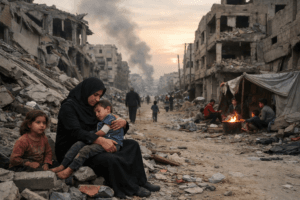
For displaced Palestinians in Gaza, the winter storms are not just a weather pattern but another slow-acting weapon in a war that never truly stopped.
When the October 2025 ceasefire announcement echoed through Gaza’s shattered streets, it was met not with unbridled relief, but with a weary mixture of hope and deep-seated fear. Two months later, that fear has tragically materialized. The guns have not fallen silent; they have simply changed their cadence. The world, convinced the war is over, has largely moved on, turning Gaza from a global headline into an invisible crisis. Yet for the 1.9 million displaced Palestinians facing winter in tents, and for the orphans begging for bread on muddy streets, the mass death continues—quietly, persistently, and out of the spotlight.
The Ceasefire That Wasn’t: A By-the-Numbers Betrayal
The term “ceasefire” suggests a halt to violence. The reality on the ground reveals a different story—one of systematic violation and controlled devastation. According to Gaza’s Government Media Office, from the ceasefire’s start on October 10, 2025, through late December, Israel violated the agreement at least 969 times. These were not minor infractions but sustained attacks that have resulted in the deaths of over 400 Palestinians and injuries to more than 1,100.
A breakdown of the violations recorded from October 10 to December 28, 2025, reveals the scope of the ongoing military pressure:
| Type of Violation | Number of Recorded Incidents | Description / Impact |
| Shootings at Civilians | 298 times | Direct fire on Palestinian civilians. |
| Raids Beyond Agreed Lines | 54 times | Incursions into residential areas past the negotiated “yellow line”. |
| Bombings and Shelling | 455 times | Aerial and artillery attacks across Gaza. |
| Property Demolitions | 162 occasions | Systematic destruction of homes and infrastructure. |
The violence is near-daily. An analysis shows Israel attacked Gaza on 68 out of the first 83 days of the supposed truce, meaning Gazans experienced only 15 days without reported deaths, injuries, or violent incidents. Major bombing campaigns have occurred well after the ceasefire began, such as the October 29 raids that killed 109 people, including 52 children.
The stated goal of the U.S.-brokered agreement was to halt hostilities and ensure the “full entry of humanitarian aid”. Israel has failed to meet its obligations on both fronts, while simultaneously tightening its control over information. It continues to block the entry of journalists, enforcing a media blackout that makes independent documentation nearly impossible. This has contributed to a deadly year for the press; the International Federation of Journalists recorded 56 journalists killed in Palestine in 2025 alone, many in targeted attacks.
Suffering by Design: The “Low-Grade” Genocide
Without the dramatic spectacle of full-scale invasion, the mechanisms of suffering have shifted. The author Eman Abu Zayed describes this as a new stage: “low-grade mass killing”. The tools are no longer just missiles but deliberately engineered deprivation and environmental hardship.
- Weaponized Aid Blockades: The ceasefire explicitly required Israel to lift the blockade on aid. Instead, it has choked its flow. By late December, only about 42% of the negotiated number of aid trucks had been allowed into Gaza. What does get through is often inadequate; Israel has blocked nutritious foods like meat and vegetables while allowing non-essential items like snacks and soft drinks. This policy exacerbates a malnutrition crisis that had already claimed hundreds of lives before the ceasefire.
- The Silent Killers of Winter: For families living in tents fashioned from scraps, winter is a lethal force. Recent storms have flooded camps, collapsed damaged buildings, and blown away shelters. The Gaza Ministry of Health has reported deaths from hypothermia, including a two-month-old baby, and from walls collapsing due to rain. As a joint statement from eight nations, including Qatar, Egypt, and Turkey, warned, “Flooded camps, damaged tents… and exposure to cold temperatures coupled with malnutrition, have significantly heightened risks to civilian lives”.
- A Collapsed Future: The war has orphaned more than 39,000 children and destroyed the livelihoods of over 80% of Gaza’s workforce. The result is a generation forced into survival mode. Children like 11-year-old Ahmed, whose father was killed, now stand barefoot in the rain begging for three shekels to buy a loaf of bread. Education, once a point of pride with a 97% literacy rate, has effectively ceased, with schools damaged or serving as shelters. “Our children today have no education or anything else,” says one mother, describing days consumed by the search for food, water, and warmth.
The Architecture of Invisibility
This ongoing catastrophe has faded from the world’s front pages due to a confluence of factors that serve to normalize the suffering.
- The “Not-War” Narrative: International actors, particularly the United States, maintain the fiction that the “ceasefire is still holding,” despite the overwhelming evidence to the contrary. This political framing allows the world to disengage, satisfying a public desire for resolution.
- The Bureaucratic Stranglehold: Israel has implemented new, arbitrary regulations making it difficult for international NGOs to register and operate. Organizations as large as Save the Children and Doctors Without Borders have been targeted, with demands for detailed staff lists that could endanger Palestinian employees. This systematically cripples the humanitarian response and stifles eyewitness reporting from credible international bodies.
- Donor Fatigue and Redirected Attention: Palestinian aid groups report a dramatic collapse in donations since the ceasefire was announced. The Samir Project, which supports impoverished families, saw a steep drop in individual donors once the world believed the emergency had ended. Global media cycles, meanwhile, have moved on to newer “hot spots,” leaving Gaza in a silent, second-tier status.
The Path Forward: From Invisibility to Accountability
Breaking this cycle requires moving beyond humanitarian appeals to address the political architecture that enables it.
- Enforce the Agreements: The international community, particularly the agreement’s guarantors, must move beyond statements to concrete consequences for violations. This includes demanding the immediate, full, and unhindered access for aid that eight nations have called for and halting arms transfers that facilitate ongoing attacks.
- Protect Witnesses and Lifelines: The targeted killing of journalists and the bureaucratic war on NGOs must be recognized as deliberate tactics to conceal facts. Stronger diplomatic and legal protections for media and humanitarian workers are essential.
- Listen to Palestinian Voices: The central demand from Gaza is not just for aid, but for self-determination, safety, and a political future. As historian Abdullatif Abu Hashem in Gaza notes, any truce not translated into a binding political solution remains fragile and destined to collapse. The hope for 2026, as expressed by displaced Palestinians, is for “a State where we can live in peace and security”.
The tragedy of Gaza’s “invisible” ceasefire is that it exposes a brutal calculus: mass death is more palatable to the world when it is slow, quiet, and framed as a regrettable consequence rather than an active policy. The test for the global conscience in 2026 is whether it will continue to look away from this engineered suffering or finally insist that a ceasefire must mean an end to killing in all its forms. The lives of Ahmed, Noor, and nearly two million others depend on that choice.
You must be logged in to post a comment.