
Gaza’s 70,000: The Human Toll Behind a Grim Milestone and a Fragile Ceasefire
The reported death toll of over 70,000 Palestinians in Gaza marks a catastrophic milestone in a conflict characterized by immense civilian suffering and the widespread destruction of essential infrastructure. This figure, which includes a devastatingly high percentage of women and children, is further compounded by thousands more missing under rubble and indirect deaths from famine and disease, stemming from a crippled healthcare system and severe aid restrictions.
Even a U.S.-brokered ceasefire has failed to halt the violence entirely, with hundreds reported killed since its implementation. The international response has escalated to accusations of serious violations of international law, with UN experts and courts emphasizing the obligations to protect civilians and facilitate humanitarian relief, while the path forward remains uncertain without a durable political solution to the underlying crisis.
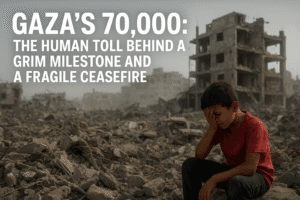
Gaza’s 70,000: The Human Toll Behind a Grim Milestone and a Fragile Ceasefire
- A Grim Mileterone: Over 70,000 Palestinians have been killed in Gaza, a figure representing a catastrophic loss of life and the destruction of a society.
- Ceasefire in Name Only: Despite a U.S.-brokered ceasefire, hundreds have been killed since it began, underscoring its fragility and the ongoing violence.
- Beyond the Battlefield: The crisis extends far beyond direct casualties, encompassing a collapsed healthcare system, famine, and the trauma of a displaced population.
The recent news that the death toll in Gaza has surpassed 70,000 is more than a grim statistic; it is a testament to a humanitarian catastrophe of staggering scale and complexity. This number, reported by Gaza’s Health Ministry and widely cited by international bodies, marks one of the deadliest conflicts of the 21st century. Yet, it represents only a fraction of the story. Behind the figure lies the near-total destruction of civilian infrastructure, a healthcare system under deliberate siege, and a population pushed to the brink of famine. Even a long-sought ceasefire, which took effect in October 2025, has provided only a fragile and violated respite, with hundreds reported killed in the weeks following its announcement. This article explores the human reality behind the numbers, the international response, and the uncertain path toward lasting peace.
The Scale of Devastation: Understanding the 70,000
The figure of over 70,000 Palestinians killed is a foundational metric for grasping the war’s severity. However, its true meaning emerges when contextualized.
- A Demographic Catastrophe: Scholars and analyses consistently estimate that a staggering 80% of those killed are civilians. A peer-reviewed study in The Lancet estimated that by late 2024, likely over 70,000 had died just from traumatic injuries, with women, children, and the elderly comprising nearly 60% of the fatalities. The toll on children is particularly harrowing. At various points, children have constituted between 30% and 44% of the reported fatalities, a result of Gaza’s very young population and the nature of the bombardments.
- The “Known Unknowns”: The official death toll is considered a significant undercount. It does not include the thousands of bodies believed buried under the rubble of destroyed buildings. More critically, it excludes deaths from what a UN-backed analysis calls “the consequences of the war”—preventable disease, malnutrition, and complications from birth due to the collapsed health system. One projection suggested that when these indirect deaths are accounted for, the total excess mortality could reach approximately 93,000.
- A Society Shattered: The casualty figures translate into profound societal trauma. Surveys indicate that over 60% of Gazans have lost immediate family members. Furthermore, the UN reports that as of September 2025, over 2,500 children had lost both parents, and more than 53,000 had lost one. The scale of injury is also vast, with more than 170,000 wounded, including tens of thousands with life-altering disabilities.
The table below breaks down key metrics that illustrate the comprehensive nature of the devastation:
| Metric | Scale of Impact | Source / Note |
| Reported Deaths | Over 70,000 Palestinians | Gaza Health Ministry figure as of late 2025. |
| Estimated Civilian Percentage | ~80% | Analysis by scholars and media investigations. |
| Injured | >170,000 | Includes over 40,000 with life-altering injuries. |
| Population Displaced | ~1.9 million (90% of Gaza) | Most have been displaced multiple times. |
| Homes Damaged/Destroyed | 9 out of 10 | Based on UN satellite imagery analysis. |
| People Facing Famine | >640,000 | IPC confirmation of famine in Gaza City. |
The Crumbling Ceasefire and Intensified Suffering
The announcement of a U.S.-brokered ceasefire in October 2025 was met with desperate hope. UN officials welcomed it as a “desperately needed breakthrough” and a “glimmer of hope” for children. Humanitarians saw a critical window to scale up aid to a starving population.
However, reality quickly undermined the agreement. The Gaza Health Ministry reported that over 350 Palestinians were killed in the first several weeks after the ceasefire began. These included incidents like an Israeli drone strike that killed two young brothers, Fadi and Juma Abu Assi, who were gathering firewood. This pattern is tragically familiar. Earlier in the year, the UN Secretary-General condemned the killing of over 1,000 people in just over a month following the collapse of a previous ceasefire in March 2025.
The failure of ceasefires to hold points to a deeper crisis: the transformation of Gaza’s infrastructure into a landscape of ruin where survival itself is a struggle. The World Health Organization (WHO) documented 735 attacks on healthcare between October 2023 and June 2025, killing 917 medical personnel and damaging most hospitals. In September 2025, the UN Human Rights Office reported that intensified attacks on hospitals in Gaza City were leaving the sick and injured with nowhere to turn for lifesaving care.
This systematic destruction, coupled with severe Israeli restrictions on aid, has fueled a man-made famine. By August 2025, the Integrated Food Security Phase Classification (IPC) confirmed that famine had taken hold in Gaza City, with over 640,000 people living under its catastrophic conditions. UN experts have accused Israel of using starvation as a “weapon of war,” stating that the deliberate depletion of essential necessities is a violation of its obligations as the occupying power.
International Response: From Condemnation to Calls for Accountability
The international community’s reaction has evolved from expressions of grave concern to direct accusations of serious international crimes.
- UN Warnings and Terminology: UN officials have described Gaza as a “death trap” and the war as one “without limits”. Special Rapporteurs, who are independent human rights experts, have issued increasingly stark warnings. In May 2025, they stated that escalating atrocities presented an urgent “moral crossroads” and demanded action to “end the unfolding genocide”. In August 2025, experts introduced the term “medicide” to describe the targeted destruction of Gaza’s healthcare system, calling it a “sinister component” of acts calculated to destroy the Palestinian population.
- The ICJ Advisory Opinion: A significant development came in October 2025 when the International Court of Justice (ICJ) issued an Advisory Opinion. It reaffirmed Israel’s binding obligations as the Occupying Power to facilitate humanitarian relief and ensure the essential needs of the population are met. The court stressed that security claims cannot justify obstructing aid and recognized UNRWA’s indispensable role, directly challenging Israeli allegations against the agency.
- A Crisis of Conscience and Law: The overarching theme from UN human rights bodies is a failure of the international system. Experts have warned that continued material or political support for Israel, especially through arms transfers, risks complicity in serious crimes. The Special Rapporteur for the occupied Palestinian territories, Francesca Albanese, published a report titled “Gaza Genocide: A Collective Crime,” arguing that third states have breached their duty to prevent genocide by supplying Israel with aid, arms, and political cover.
The Uncertain Road Ahead
The current ceasefire, however fragile, has allowed humanitarian agencies to begin a massive, though daunting, scale-up of operations. The UN has outlined a 60-day plan to restore food, health, water, and shelter services, acknowledging a need for tens of billions of dollars to rebuild the shattered enclave.
Yet, analysts warn that without a durable political solution, any ceasefire is merely a pause. The Wilson Center notes that the agreement may have strengthened Hamas’s political standing while allowing the locus of violence to shift to the West Bank, where Israeli operations and settler violence have intensified. The fundamental issues—the occupation, the blockade, and the lack of a political horizon for Palestinian self-determination—remain unaddressed.
The path forward is fraught. It requires not just the immediate and unimpeded flow of humanitarian aid to stem famine and disease but also a genuine commitment to a political process that addresses root causes. As UN experts have framed it, the world faces a defining choice: act decisively to enforce international law and ensure accountability, or bear witness to consequences that will leave an indelible stain on global conscience and the multilateral order.
For the civilians of Gaza, the milestone of 70,000 dead is not an end point but a marker in an ongoing nightmare. Their immediate future depends on whether the ceasefire can solidify into lasting peace and whether the international community can translate its condemnations into effective action to protect the most fundamental of human rights: the right to life.
You must be logged in to post a comment.