
Gaza Tragedy: 7 Shocking Truths Behind the “Technical Error” That Killed Innocent Children
The recent Israeli strike near a water point in Nuseirat, Gaza, which killed six children, was dismissed by the IDF as a “technical malfunction,” a phrase that now haunts grieving families. These children weren’t caught in crossfire—they were fetching water in a region where survival itself is a gamble. Similar strikes in Zawaida and Gaza City on the same day further exposed the terrifying normalcy of civilian deaths in this conflict.
While the IDF routinely issues regrets and blames Hamas, these explanations ring hollow amid recurring tragedies and rising casualties. With ceasefire negotiations stalled and Gaza’s death toll surpassing 58,000, the disconnect between diplomatic rhetoric and ground realities is stark. Doctors and communities bear unbearable trauma, while children grow up in fear. The true crisis lies in a system that continues to fail civilian protection despite promises of precision warfare. Words like “error” and “regret” cannot hide the systemic disregard for human life.
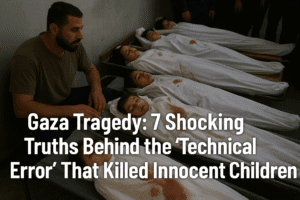
Gaza Tragedy: 7 Shocking Truths Behind the “Technical Error” That Killed Innocent Children
The sterile military phrase “technical malfunction” now haunts the families of at least six children killed near a water distribution point in Nuseirat, Gaza, this past Sunday. They were among ten lives erased instantly—not in a crossfire, not as collateral in a precision strike on a militant, but due to what the Israeli Defense Forces (IDF) described as munitions falling “dozens of metres from the intended target.” This incident, while officially regretted, reveals recurring, devastating patterns in this conflict that demand closer scrutiny.
The Unseen Calculus of Survival: Water points like the one struck in Nuseirat aren’t mere locations; they are desperate lifelines in a territory where clean water is scarce and survival is a daily calculation. Families gather there knowing the risks but bound by necessity. The strike underscores a grim reality: even routine acts of survival—collecting water, walking down a street—carry lethal potential in an environment saturated with military surveillance and firepower. Hours later, separate strikes on a home in Zawaida (killing nine, including three children) and pedestrians in Gaza City (killing eleven) further illustrated this terrifying normalcy. The IDF stated unawareness of the home strike, highlighting the chaotic opacity of battlefield accountability.
The Hollow Echo of “Regret”: While the IDF expressed regret for “any harm to uninvolved civilians” in the Nuseirat incident, this language rings increasingly hollow for Gaza’s civilians. “Technical errors,” “malfunctions,” and strikes on locations later deemed unintended are tragically frequent. Each apology follows a familiar script: an investigation is promised, Hamas is blamed for embedding itself in populated areas, and the war grinds on. For parents burying children killed while fetching water, the technical distinction between intent and error offers no solace. It underscores a systemic failure to prioritize civilian protection despite advanced surveillance and precision weaponry claims.
The Negotiation Stalemate and its Human Cost: These deaths occur against a backdrop of frozen ceasefire talks. The core deadlock—Israel’s insistence on continued troop deployment versus Hamas’s demand for full withdrawal—seems intractable. Meanwhile, the human toll escalates relentlessly. Gaza’s Health Ministry reports over 58,000 Palestinian deaths, mostly women and children. Israel mourns 890 soldiers lost. The original Hamas attack that killed 1,200 Israelis and took 251 hostages remains an open wound. Yet, as negotiators debate troop positions, children die fetching water. This disconnect between diplomatic maneuvering and ground-level carnage fuels despair and radicalization.
The Unquantifiable Trauma: Beyond the numbers lie shattered realities:
- Medical Workers: Doctors at Al-Aqsa Martyrs and Al-Awda hospitals, already operating beyond breaking point, faced yet another influx of mangled bodies, including multiple children. The psychological toll on these responders is immeasurable.
- Community Trust: Every “errant” strike erodes any remaining trust in safety assurances or conflict boundaries, making families feel nowhere is truly safe.
- A Generation Scarred: For surviving children in Nuseirat, Zawaida, and Gaza City, the act of collecting water or playing near home is now irrevocably linked to terror and loss.
The Imperative Beyond the Immediate: Labeling these deaths as “technical errors” or attributing blame solely to Hamas tactics avoids confronting the deeper crisis. It demands asking:
- Are current rules of engagement and targeting protocols, even when followed, sufficient to prevent recurring catastrophic failures in one of the world’s most densely populated areas?
- Can “regret” translate into tangible, systemic changes in military procedures to demonstrably reduce civilian harm?
- Does the current negotiation framework adequately address the urgency of preventing more “errors” that kill children pursuing basic survival?
Sunday’s deaths are not isolated tragedies. They are symptoms of a conflict where civilian life has become unacceptably cheapened by rhetoric, failed safeguards, and political paralysis. Until these fundamental questions are addressed with more than statements of regret, the next “technical malfunction” and the next funeral shroud for a child are grim inevitabilities. The value of their lives demands more than an apology buried in a press release.
You must be logged in to post a comment.