
Gaza on the Brink: As Peace Plan Stalls, Military Buildup Signals Return to War
In early 2026, Gaza stands on the precipice of renewed war despite a U.S.-brokered ceasefire and political gestures toward peace. While Hamas has publicly agreed to dissolve its Gaza government in favor of a technocratic committee as outlined in Trump’s peace deal, it is simultaneously violating the ceasefire’s core terms by actively rebuilding its military tunnels, recruiting fighters, and refusing to disarm its small arms. Conversely, the Israeli military, distrustful of the international “Board of Peace” tasked with overseeing disarmament, has drawn up contingency plans for a major new ground offensive in Gaza City slated for March. This fatal contradiction—between a stalled diplomatic process struggling to enforce disarmament and both sides preparing for further conflict—sustains a cycle of violence that continues to claim civilian lives and points toward an imminent return to full-scale war.
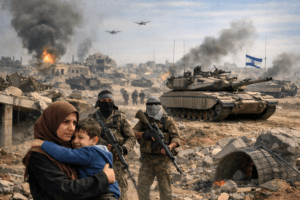
Gaza on the Brink: As Peace Plan Stalls, Military Buildup Signals Return to War
The Fragile Cease-Fire and Conflicting Signals
A tense and unstable calm hangs over the Gaza Strip in January 2026. A U.S.-brokered cease-fire, which took effect on October 10, 2025, and forms the first phase of President Donald Trump’s “Comprehensive Plan to End the Gaza Conflict,” is showing severe signs of strain. While political announcements suggest a move toward governance transition, military movements and continued violence tell a different story—one that points toward a potential resumption of full-scale conflict by March.
In a significant political gesture, Hamas announced on January 11, 2026, its readiness to dissolve its administrative government in Gaza. The group stated it has issued directives to all its government agencies to prepare to hand over authority to an independent Palestinian technocratic committee, as envisioned in Trump’s peace plan. Hamas spokesman Hazem Kassem called this decision “clear and final,” framed as acting in the “higher national interest”.
However, this declared willingness to cede day-to-day administrative control stands in stark contradiction to simultaneous actions on the ground. Reports from Israeli, Arab, and Western officials indicate that instead of disarming—a core requirement of the cease-fire agreement—Hamas has been actively rebuilding its military capabilities. This includes reconstructing destroyed tunnel networks, recruiting new fighters to replace lost commanders, and replenishing its war chest. The Israeli military has reportedly drawn up plans for new ground operations focused on Gaza City, slated for March, aimed at expanding the Israel Defense Forces’ (IDF) control over the territory.
The Core Contradiction: Governance vs. Weapons
The central fault line threatening the entire peace plan is the unresolved issue of disarmament. The agreement outlines a process where a “Board of Peace,” an international body led by the U.S., would oversee the transition. This board is tasked with implementing the second phase of the deal, which includes the critical steps of disarming Hamas and deploying an International Stabilization Force to police Gaza.
While Hamas speaks of handing over governance, it has repeatedly stated it will not give up its arms unless Israel agrees to a clear pathway for a Palestinian state. Arab officials indicate the group might be willing to relinquish heavy weapons but refuses to surrender its small arms. This creates an impossible paradox for the peace plan and for Israel. Israeli Prime Minister Benjamin Netanyahu, meeting with newly appointed Board of Peace director-general Nickolay Mladenov, insisted that “Hamas must be disarmed and the Gaza Strip must be demilitarized”.
President Trump has issued stark warnings, stating Hamas would be given “a very short period of time” to surrender weapons or “there will be hell to pay”. Yet, he has also indicated he is not willing to pause the broader peace process while waiting for disarmament to happen. This ambiguity leaves a dangerous gap between diplomatic expectations and on-the-ground realities.
Table: Key Stakeholder Positions and Contradictions in Early 2026
| Stakeholder | Public Position/Political Gesture | On-the-Ground Reality/Preparation |
| Hamas | Willing to dissolve Gaza government; hand over to technocratic committee. | Rebuilding military tunnels & capabilities; refuses to disarm small arms; recruiting fighters. |
| Israel (Netanyahu Govt.) | Committed to Trump’s peace plan; engaged with Board of Peace. | IDF preparing March offensive plans for Gaza City; conducting strikes for “cease-fire violations”. |
| U.S. (Trump Admin.) | Pushing forward with Board of Peace and Phase 2. | Warning of “hell to pay” if Hamas doesn’t disarm, but not pausing process. |
| Civilians in Gaza | Seeking stability, reconstruction, and an end to blockade. | Enduring continued strikes and casualties; facing humanitarian crisis. |
Financing the Rebuild: How Hamas Funds Its Military Revival
A critical component enabling Hamas’s rearmament is its sophisticated and resilient financial network. Despite the devastating toll of the war, the group has been channeling significant funds—tens to hundreds of thousands of shekels daily—into its recovering treasury. This revenue flows from multiple sources:
- Taxation and Control of Aid: Hamas generates substantial income by taxing goods, services, and commercial trade within Gaza. This includes exploiting the flow of humanitarian aid, with about 4,200 truckloads entering Gaza weekly.
- Hidden War Chests: The group had stockpiled approximately $700 million in cash, along with hundreds of millions of shekels, in underground tunnels prior to the October 2023 conflict, providing a vast internal reserve.
- International Networks: The IDF and Shin Bet have revealed intelligence on a significant Hamas financial apparatus operating in Turkey under direct Iranian supervision. This network, involving money changers and exchange companies, facilitates the movement of hundreds of millions of dollars, with Iranian capital being laundered and transferred to Gaza and other regional nodes.
This financial infrastructure allows Hamas to pay its fighters, support bereaved families (bolstering loyalty and recruitment), and crucially, fund the reconstruction of military infrastructure lost during the Israeli campaign. It underscores a key Israeli and American concern: without dismantling these financial lifelines, any disarmament or demilitarization will be superficial and temporary.
The Human Cost and the Specter of March
The so-called cease-fire has not meant peace for Gaza’s civilians. Since the truce began in October 2025, continued Israeli bombardments and operations have killed more than 400 Palestinians, according to the Hamas-run Ministry of Health. Recent reports detail incidents such as an Israeli drone strike killing four Palestinians, including two children, in a tent shelter in Khan Yunis, and gunfire killing individuals in areas supposedly withdrawn from.
The IDF states these actions are responses to violations of the agreement, such as attempted rocket launches or militants approaching troops. For example, a wave of Israeli airstrikes on January 9, 2026, which killed at least 13 people, was launched after the IDF blamed Hamas for a failed rocket attack from Gaza City.
This cycle of accusation and retaliation erodes the truce’s foundation. With Hamas militarily regrouping and Israel publicly preparing a major contingency operation, the March 2026 timeline looms large. An Arab diplomat noted that Israel’s planned offensive would need U.S. support, which for now remains committed to moving the peace plan forward. However, Netanyahu reportedly lacks faith in the international board’s ability to disarm Hamas, hence the military “contingency plan”.
An Uncertain Path Forward
The immediate future hinges on several precarious developments:
- The formation and authority of the Board of Peace, which has yet to be fully constituted or announce its member states. Its ability to mediate between Israel’s demand for complete demilitarization and Hamas’s refusal to disarm will be its first major test.
- The creation of the technocratic Palestinian government. Hamas has called for its rapid formation, but its members are to be selected from a list vetted and approved by Israel, a process fraught with potential disagreement.
- The behavior of external patrons, particularly Iran, which continues to fund Hamas, and regional states that might influence the group’s calculations.
The tragic irony is that the peace plan’s first phase—the cease-fire and hostage exchange—was achieved, creating a fragile window for diplomacy. Yet, the fundamental lack of trust and the contradictory preparations for both governance and war are rapidly closing that window. The people of Gaza, caught between a political process they cannot control and a military buildup that promises more devastation, face the grim prospect that the relative quiet of early 2026 may merely be the prelude to a violent and bloody spring. The world is watching to see whether the mechanisms of the “Board of Peace” can avert the plans for war that are actively being drawn up.
You must be logged in to post a comment.