
Gaza Ceasefire at Fragile Turning Point: Will Phase Two Unravel Historic Deal?
The Gaza ceasefire faces a critical impasse as Israel conditions advancing to Phase Two—which includes disarming Hamas, withdrawing troops, and deploying an international force—on the return of one final hostage’s remains, a point Hamas cites logistical difficulties in fulfilling due to bodies being trapped under rubble.
The core disagreement lies in fundamentally divergent visions for Gaza’s future: Israel demands Hamas’s complete disarmament and demilitarization, while Hamas is only willing to discuss temporarily “freezing” its weapons, insisting on its right to resist until Palestinian statehood is achieved. Further complicating the process are disputes over the mandate of a proposed international force and Israel’s declaration of a current military line as a “new border,” against Arab mediators’ calls for a full withdrawal. With mutual distrust high from the collapse of a prior deal and ongoing low-level violence, the fragile process risks unraveling, potentially plunging the region back into full-scale conflict if a compromise on sequencing and political horizon is not found.
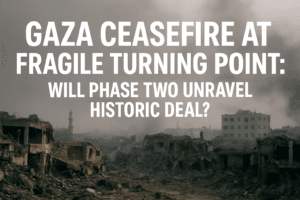
Gaza Ceasefire at Fragile Turning Point: Will Phase Two Unravel Historic Deal?
The announcement by Israeli Prime Minister Benjamin Netanyahu that Israel and Hamas are “very shortly expected to move into the second phase” of a U.S.-brokered ceasefire signals a critical juncture in the Gaza conflict. This phase, part of President Donald Trump’s 20-point peace plan, promises the complex tasks of disarming Hamas, deploying an international force, and establishing a new governance structure for Gaza. However, beneath the surface of diplomatic progress lies a fragile arrangement where fundamental disagreements on core issues threaten to derail the entire process, potentially plunging the region back into violence.
The Precarious Present: A Ceasefire Under Strain
The current ceasefire, which took effect on October 10, 2025, halted a devastating two-year Israeli offensive triggered by the Hamas-led October 7, 2023 attacks. The first phase centered on the exchange of hostages and prisoners. While 20 living Israeli hostages and the remains of 27 others have been returned, the body of one hostage, police officer Ran Gvili, remains in Gaza. Netanyahu has stated that the return of Gvili’s remains is the final condition for moving to phase two.
Despite the truce, the situation on the ground remains tense and violent. According to Gaza’s Hamas-run Health Ministry, more than 370 Palestinians have been killed by Israeli fire since the ceasefire began. Israel maintains these strikes are responses to Palestinian violations, including individuals entering Israeli-held areas. Three Israeli soldiers have also been killed in clashes with what officials describe as dozens of Hamas operatives still in underground tunnels. This persistent violence underscores what the Qatari Prime Minister termed a “critical moment,” warning that what has been achieved is merely “a pause,” not a durable peace.
The Core Sticking Points: Divergent Visions for Gaza’s Future
The second phase, as outlined in Trump’s plan, is ambitiously broad. It includes the disarmament of Hamas, the withdrawal of Israeli troops from Gaza, the deployment of an international stabilization force (ISF), and the formation of a temporary Palestinian administration under international supervision. The profound lack of consensus on how to implement these goals is the greatest threat to progress.
- Disarmament vs. “Freezing” Weapons: A Fundamental GulfThe most contentious issue is the future of Hamas’s arsenal. Israel’s stated priority is the complete “disarmament of Hamas and the demilitarization of Gaza”. Netanyahu has emphasized that ending Hamas’s rule and ensuring it gives up weapons are non-negotiable. In contrast, senior Hamas official Bassem Naim has signaled a rare public willingness to discuss “freezing or storing or laying down” its weapons as part of the ceasefire. However, he frames this as a temporary measure during a truce, explicitlyretaining the group’s “right to resist” and linking permanent disarmament only to the establishment of a sovereign Palestinian state. This gap between permanent disarmament and temporary weapon storage represents a diplomatic chasm.
- The International Force: Peacekeeper or Combatant?The proposed international stabilization force is trapped in a mandate dilemma. Hamas has stated it welcomes a UN force to monitor borders and report violations butflatly rejects giving it any mandate to operate inside Palestinian territories or to disarm the group. Netanyahu has expressed public skepticism about whether any international force would be willing or able to forcibly disarm Hamas, asking rhetorically if there were “volunteers” for such a dangerous task.
Key potential contributing nations like Turkey advocate for a limited role. Turkish Foreign Minister Hakan Fidan argues the ISF’s first task should be to “separate Palestinians from the Israelis” along the ‘Yellow Line’—the current demarcation line in Gaza—not to disarm Hamas. This view is shared by Egypt and others who believe the force’s mandate should be “peace monitoring not peace enforcement”. Norway’s foreign minister has warned that without a clear, agreed-upon sequence of tasks, the process could deadlock, with each party waiting for the other to act first.
- The “Yellow Line”: A New Border?Complicating security discussions is the status of the current frontline. Israeli military Chief of Staff Lt. Gen. Eyal Zamir has called the Yellow Line a “new border,” serving as a defensive line for Israeli communities. This declaration clashes with the ceasefire plan’s requirement for an Israeli withdrawal and with statements from Arab mediators. The Qatari Prime Minister has stressed that a true ceasefire “cannot be completed unless there is a full withdrawal” of Israeli forces.
Table: Competing Visions for Phase Two Key Issues
| Issue | Israel’s Position | Hamas’s Position | Key International Mediators’ View |
| Disarmament | Complete, verifiable disarmament of Hamas. | Discuss “freezing or storing” weapons; permanent disarmament only with statehood. | A political process is needed; disarmament cannot be the first step. |
| International Force Mandate | Force should ensure Hamas’s disarmament. | Only for border monitoring, not internal operations or disarmament. | Initial priority should be separation of forces along the Yellow Line. |
| Israeli Withdrawal | Withdrawal is part of phase two, but security guarantees are paramount. | Full withdrawal is a prerequisite for a complete ceasefire. | Withdrawal and stabilization must proceed together to build trust. |
The Shadow of History: Why Trust is in Short Supply
The fragility of the current moment is magnified by the recent collapse of previous ceasefires. A January 2025 agreement, which also had multiple phases, broke down in March when Israel launched a surprise attack on Gaza. That deal faltered over similar issues: Hamas wanted to proceed to later stages guaranteeing a permanent ceasefire and Israeli withdrawal, while Israel sought to extend the initial phase indefinitely. Each side blamed the other for the collapse. This history fuels mutual suspicion. Hamas officials now accuse Israel of failing to meet its phase one commitments, such as flooding Gaza with aid and fully reopening the Rafah border crossing. Israel, in turn, accuses Hamas of deliberately delaying the return of hostage remains and violating the truce.
The Path Ahead: A Narrow Corridor to Peace
With Netanyahu and Trump scheduled to meet on December 29 to discuss advancing the plan, the diplomatic machinery is grinding forward. Germany, a close Israeli ally, is already assisting by sending officers to a U.S.-led coordination center. However, analysts warn that phase two involves “trying to square circles that simply cannot be squared”.
The most likely path forward is a precarious and incremental process. It may begin with the simultaneous deployment of an international force along the Yellow Line and the formation of the U.S.-backed “board of peace” and Palestinian technocratic committee. This could create a fragile stability, allowing reconstruction aid to flow more reliably. The intractable issue of disarmament may be deferred through ambiguous language—perhaps a “freezing” of weapons under international observation—that both sides can interpret differently. However, this would only be a temporary patch. As many regional ministers insist, without a clear political horizon addressing Palestinian self-determination, any security arrangement will remain inherently unstable.
The alternative, as the Norwegian foreign minister starkly put it, is that the region could either “go forward or backward,” with the options being a “back to war and descent into total anarchy”. The window for building on the current pause is narrow. The coming weeks will determine whether the second phase becomes a bridge to a more stable future or merely an intermission between rounds of conflict. The world watches to see if the lessons of previous failures have been learned, or if history is doomed to repeat itself.
You must be logged in to post a comment.