
G-RAM-G: Can India’s Tech‑Driven Rural Jobs Guarantee Build a More Resilient Future?
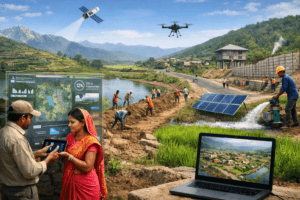
India’s newly enacted G-RAM-G (Guarantee for Rozgar and Ajeevika Mission – Gramin) represents a fundamental evolution of its rural employment guarantee, aiming to fuse social welfare with cutting-edge technology to build long-term climate resilience. Moving beyond its predecessor MGNREGA, the program employs a “trust-tech” backbone—using biometric authentication, AI-powered dashboards, and a geospatial “digital twin” of rural infrastructure—to enhance transparency, reduce leakages, and ensure timely wage payments.
Its core innovation lies in mandating that created assets, from ponds to roads, explicitly address climate vulnerabilities, using satellite data and predictive analytics to guide proactive adaptation in flood-prone or heat-stressed regions. However, this ambitious tech-driven vision faces significant practical hurdles, including a contentious new funding model that requires states to share costs, which critics warn could dilute the legal guarantee and overwhelm administrative capacity, making its success dependent on balancing digital innovation with grounded implementation and sustained political will.
G-RAM-G: Can India’s Tech‑Driven Rural Jobs Guarantee Build a More Resilient Future?
In late 2025, India’s Parliament passed a law that quietly aims to rewrite the social contract between the state and its rural citizens. The Viksit Bharat–Guarantee for Rozgar and Ajeevika Mission (Gramin), or G‑RAM‑G, replaces the nearly two‑decade‑old Mahatma Gandhi National Rural Employment Guarantee Act (MGNREGA)[reference:0]. On paper, it increases the annual employment guarantee from 100 to 125 days per rural household[reference:1]. But the real revolution lies not in the number of days, but in how the work is delivered, monitored, and leveraged. G‑RAM‑G represents India’s most ambitious attempt yet to fuse a welfare guarantee with cutting‑edge technology—biometric authentication, geospatial planning, AI‑powered dashboards, and a “digital twin” of rural infrastructure—all in the service of building grassroots resilience against climate shocks and economic uncertainty.
This article unpacks the promise and the perils of this new model. It explores how G‑RAM‑G seeks to turn “trust‑tech” into tangible development, why its climate‑resilience focus is timely, and what serious hurdles it must overcome to truly empower India’s villages.
- What Is G‑RAM‑G? The Framework of a “Viksit Bharat” Village
G‑RAM‑G is not merely a rebranding of MGNREGA. It is a legislative overhaul designed to align rural development with the national Viksit Bharat 2047 vision[reference:2]. The Bill introduces several structural shifts:
- Enhanced Guarantee: A statutory guarantee of 125 days of unskilled wage employment per rural household per financial year[reference:3].
- Thematic, Asset‑Focused Works: All projects must fall into four priority domains: (i) water security, (ii) core rural infrastructure, (iii) livelihood‑related infrastructure, and (iv) works to mitigate extreme weather events[reference:4]. This ensures that every day of work creates a durable, productive asset.
- Convergence and Saturation: The scheme mandates a “whole‑of‑government” approach, forcing different departments and programs to coordinate at the Gram Panchayat level to systematically close development gaps[reference:5].
- New Funding Model: While MGNREGA was largely centrally funded, G‑RAM‑G operates as a centrally sponsored scheme with a defined cost‑sharing pattern: 60:40 between the Centre and most states, and 90:10 for northeastern and Himalayan states[reference:6]. The Centre also determines a “normative allocation” for each state, with any excess expenditure to be borne by the state[reference:7].
These changes are framed as a modernization drive, moving from a fragmented safety net to an integrated, future‑oriented rural development engine.
- The “Trust‑Tech” Backbone: Digital Transparency in Real Time
The most talked‑about aspect of G‑RAM‑G is its technological architecture, designed to tackle the perennial ghosts of rural schemes: corruption, leakages, and opacity.
- Digital Authentication: Attendance at worksites is recorded via biometric authentication (thumbprint/iris scan), virtually eliminating ghost workers and fake job cards[reference:8].
- Geospatial Monitoring: Supervisors upload geo‑tagged photographs and progress updates. These are cross‑verified against satellite imagery and expenditure records on AI‑powered dashboards, flagging irregularities in minutes[reference:9].
- The National Rural Infrastructure Stack (NRIS): This is the crown jewel. G‑RAM‑G mandates that every created asset—a pond, a road, a solar pump—be mapped into the Viksit Bharat National Rural Infrastructure Stack (VB‑NRIS)[reference:10]. Think of it as a “digital twin” of rural India, a living, geospatial database that allows planners to visualize gaps, overlaps, and synergies in real time.
- Integration with National Planning: The NRIS is designed to integrate with the PM Gati Shakti national master plan for infrastructure[reference:11]. This means a rural road in Assam can be digitally linked to a national highway corridor, and a watershed in Maharashtra can be assessed for its downstream impact on agriculture and flood mitigation.
This “trust‑tech” ecosystem aims to shift governance from being reactive and paper‑based to being predictive, transparent, and data‑driven.
- Climate Resilience: Building Assets That Withstand Shocks
G‑RAM‑G’s thematic focus on “extreme weather events” is not accidental. It explicitly positions the scheme as a tool for climate adaptation[reference:12]. The tech stack turns this intention into actionable insight:
- In flood‑prone Assam, satellite imagery can detect inundation hotspots, and AI models can recommend where new embankments or drainage channels are most needed.
- In Odisha, drone surveys can help design cyclone‑resilient housing and coastal green belts.
- In the Himalayan foothills, villagers with mobile tools can map landslides, feeding real‑time alerts into district disaster dashboards.
- In heat‑vulnerable regions of Telangana, thermal satellite data can guide where to plant shade trees, create water ponds, or implement cool‑roof projects.
By combining remote sensing, predictive analytics, and local knowledge, G‑RAM‑G attempts to pivot from reactive disaster recovery to proactive resilience building. Every asset created is now evaluated not just for its employment value, but for its role in making communities more shock‑proof.
- Predictability as Empowerment: The Human Impact
Beyond infrastructure, the scheme promises a more dignified experience for workers. Traditionally, delayed wage payments and uncertain work availability have undermined the guarantee. G‑RAM‑G’s digital verification is designed to ensure that fund releases are automatically triggered upon milestone completion, reducing payment delays[reference:13].
Furthermore, AI models are proposed to forecast demand for work based on rainfall patterns, crop cycles, and migration trends[reference:14]. In a drought year, the system could automatically prioritize water‑conservation projects; in a flood year, embankment works. For the rural worker, this translates to predictability—a confidence that work will be available when needed and that wages will arrive on time. This stability is itself a form of empowerment.
- The Challenges and Criticisms: A “Red Herring” or a Real Risk?
Despite its ambitious design, G‑RAM‑G faces significant skepticism and practical hurdles.
- Funding and Centralization: The new 60:40 cost‑sharing model has raised alarms. Critics argue that pushing 40% of costs onto states—many of whom are already fiscally strained—could lead to underfunding and a dilution of the legal guarantee[reference:15]. Economist Jean Drèze calls the increase to 125 days a “red herring,” noting that less than 10% of households under MGNREGA actually received 100 days of work, and that raising the ceiling is cosmetic if financial restrictions pull the other way[reference:16].
- Administrative Capacity: The scheme’s success hinges on states having the trained staff and digital infrastructure to implement it. As the BBC analysis notes, “states with trained staff can process requests on time, directly influencing how much employment is provided”[reference:17]. The digital divide could exclude the most marginalized.
- Over‑Reliance on Technology: While tech can reduce corruption, it cannot replace genuine political will and community ownership. A strong Social Audit mechanism is retained in the Bill[reference:18], but its effectiveness will depend on independent implementation.
- Broader Structural Issues: Some analysts, like Nitin Pai of the Takshashila Institution, argue that such schemes, while cushioning distress, do little to raise long‑term rural productivity or address India’s chronic inability to generate enough non‑farm jobs[reference:19].
- Conclusion: A Bold Experiment at Scale
G‑RAM‑G is a bold, high‑stakes experiment. It attempts to harness India’s digital public infrastructure prowess to solve entrenched problems of rural development and climate vulnerability. Its promise is a future where trust is built through transparency, resilience is engineered into assets, and predictability empowers the poorest.
The ultimate test, however, will be on the ground. Will the tech stack function seamlessly in remote villages? Will the new funding model strengthen or starve the guarantee? Will the focus on climate resilience translate into tangible protection for vulnerable communities?
The world will be watching. If successful, G‑RAM‑G could offer a new global model for tech‑enabled, climate‑smart social protection. If it stumbles, it risks undermining one of the world’s most studied anti‑poverty programs. The journey of G‑RAM‑G will be a definitive chapter in the story of whether technology can truly be harnessed as a bridge of empathy, connecting every citizen to a shared vision of progress.
You must be logged in to post a comment.