
Frozen in Displacement: How Winter’s Wrath Deepens Gaza’s Man-Made Catastrophe
A severe winter storm is exacerbating the already catastrophic humanitarian crisis in Gaza, where hundreds of thousands of Palestinians displaced by war are struggling to survive in makeshift tents rendered nearly universally unusable by harsh weather. This natural disaster is layered atop a man-made catastrophe, as Israeli restrictions severely block the entry of adequate aid, building materials, and winter-ready shelters, despite ceasefire agreements promising increased humanitarian support. The consequences are lethal: with families burning scraps for heat in flooded tents, deaths from cold exposure—including at least 21 children—are rising, previously bomb-damaged buildings are collapsing from rain, and hospitals are inundated with cold-related illnesses, revealing a profound failure of protection for a starving, exhausted, and exposed population.
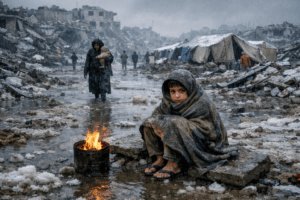
Frozen in Displacement: How Winter’s Wrath Deepens Gaza’s Man-Made Catastrophe
A biting wind whips inland from the Mediterranean, carrying not the scent of salt but of damp despair. Across Gaza, a territory already shattered by years of conflict, hundreds of thousands of displaced Palestinians brace not for another aerial bombardment, but for an assault from the skies of a different kind: a severe winter storm. This new weather system, forecast to bring freezing temperatures and torrential rain, is not merely a meteorological event; it is a multiplier of misery, exposing the raw truth of life for a population abandoned to the elements. The story of this storm is the story of a humanitarian collapse, where flimsy tents become tombs of cold, and the simple act of survival becomes a daily, brutal struggle.
The Unraveling of a Flimsy Sanctuary
The imagery of tent camps has become synonymous with Gaza’s displacement crisis. But these are not the organized, supplied shelters of a managed refugee operation. They are vast, desperate conglomerations of tarpaulin, nylon, and scavenged wood, erected on muddy fields, amidst the rubble of former neighborhoods, and along contaminated shorelines. As reported by Gaza’s Government Media Office, a staggering 127,000 of the estimated 135,000 tents in these camps have been rendered “unusable” by recent harsh weather. This statistic is not abstract; it translates to families of five or more huddling under saturated, torn fabric as temperatures plunge.
The “unusable” tent is a universe of suffering. Rainwater pools on sagging roofs before seeping through, turning earthen floors into quagmires. Belongings—the scant remnants of a past life—are perpetually damp. Children’s clothing never dries. The cold, a pervasive, bone-deep chill, becomes a constant companion. As Al Jazeera’s correspondent Tareq Abu Azzoum described, these are “torn tents and roofless homes exposed to the rain and cold, and the freezing nights.” The storm doesn’t just bring discomfort; it systematically dismantles the last shred of privacy and dignity for a traumatized population.
Beyond the Weather: The Architecture of Suffering
To attribute this crisis solely to winter is to misunderstand its origin. The storm is an acute crisis layered upon a chronic, man-made catastrophe. As Abu Azzoum notes, this suffering is “directly caused by Israeli restrictions.” The blockade and stringent limitations on aid create the conditions where a storm becomes lethal.
The Aid Deficit: A U.S.-brokered ceasefire promised a lifeline: at least 600 aid trucks daily to address Gaza’s comprehensive needs. The reality is a trickle averaging 145 trucks. This deficit isn’t just about food; it’s about the absence of winter-grade tents, thermal blankets, plastic sheeting, building materials for repairs, and affordable fuel for heating. Israel’s blockade on “prefabricated mobile housing units and… building materials essential for winter protection” condemns people to live in structures fundamentally unfit for purpose. The aid that does enter is a stopgap, unable to address the scale of systemic collapse.
Improvisation and Risk: In the face of this, Palestinian resilience manifests in dangerous improvisation. Families reinforce tents with plastic sheets, a feeble barrier against driven rain. With fuel unaffordable or unavailable, they burn scraps of wood or trash inside their tents for warmth, risking carbon monoxide poisoning and catastrophic fires in the cramped, flammable camps. They sleep fully clothed, layers doing little against the damp cold. Every “solution” carries a significant risk, a tragic calculus between freezing and poisoning, between cold exposure and fire.
The Most Vulnerable Bear the Deepest Chill
The human cost of this convergence of war and weather is measured in the most vulnerable bodies. Gaza’s Ministry of Health reports at least 25 deaths since mid-December from the collapse of bomb-damaged buildings weakened further by rain—a silent, secondary toll of the conflict. More directly, the Government Media Office states cold exposure deaths have risen to 24, including 21 children. These are not casualties of battle; they are victims of a sustained deprivation of shelter and protection.
Hospitals, themselves operating on scant resources, report an influx of patients, particularly children, with pneumonia, hypothermia, and severe respiratory infections. The elderly, often with pre-existing conditions, succumb to the compounded stresses of displacement, malnutrition, and cold. A Palestinian Civil Defence spokesperson described receiving “hundreds of calls for support due to extreme cold,” a testament to the widespread, unmanageable nature of the crisis. The storm does not discriminate, but its impacts fall hardest on those already physically depleted by months of trauma and hunger.
A Political Deep Freeze
The polar air mass threatening frost across Palestine is a grim metaphor for the political landscape. The “ceasefire” exists in name only, with Israel accused of hundreds of violations. Reconstruction is a distant dream; basic survival is the pressing, unmet need. The international community’s response appears as fragmented and inadequate as the plastic sheets on the tents. While diplomacy stalls on “phase two” of ceasefire plans concerning disarmament and long-term reconstruction, phase one—the immediate preservation of life—is visibly failing.
This winter exposes the hollow core of “humanitarian pauses” that do not facilitate meaningful humanitarian aid. It reveals a crisis where displacement is not a temporary condition but a protracted state of existence, and where the elements are as formidable an enemy as any. The storm underscores a fundamental truth: without a permanent ceasefire and the unrestricted flow of life-saving aid and shelter materials, any temporary calm is merely a prelude to further suffering.
Conclusion: The Forecast is Human-Made
The forecast for Gaza is more than a meteorological warning; it is a prognosis of a deepening humanitarian disaster. The coming storm will pass, but the underlying conditions—the blockade, the restrictions on aid, the shattered infrastructure, and the political impasse—remain. Each night of freezing temperatures, each flooded tent, each child lost to the cold, is a testament to a failure of protection on a colossal scale.
The story from Gaza this winter is not just about surviving a storm. It is about the world’s tolerance for a reality where millions are forced to live in a way that no human should, exposed and abandoned, their fate dictated by politics as much as by the weather. Until that reality changes, the forecast will remain bleak, and the resilience of Gaza’s people will continue to be tested against the cold indifference of a world that has, for too long, looked away.
You must be logged in to post a comment.