
From Yellow Lines to Earth Walls: How Israel is Cementing Gaza’s Division
Based on analysis of satellite imagery, the Israeli military is fundamentally transforming its occupation of the Gaza Strip by constructing extensive earth berms along the previously notional “yellow line” demarcating its controlled zone. This shift from a mapped boundary to a physical barrier, which in some areas extends hundreds of meters further into Gazan territory, effectively annexes more Palestinian land and solidifies a permanent partition of the enclave. By severing roads and creating imposing landscape features, these berms cut off Palestinian movement and access, fragmenting communities and infrastructure while entrenching a new, unilaterally imposed reality that preempts future negotiations and challenges international law.
From Yellow Lines to Earth Walls: How Israel is Cementing Gaza’s Division
From Yellow Lines to Earth Walls: How Israel is Cementing Gaza’s Division
An analysis of satellite imagery reveals a troubling shift from temporary demarcations to permanent physical barriers, reshaping Gaza’s landscape and future.
If you were to look at a satellite map of the Gaza Strip from early 2025, you would see a faint, conceptual line—often colored yellow in Israeli military briefings—snaking through the enclave. This was the “yellow line,” a notional boundary demarcating the roughly 53% of territory occupied by the Israeli Defense Forces (IDF) following the October 2025 ceasefire. It was a theoretical division, drawn on maps and occasionally marked by physical yellow blocks. Today, that line is being excavated, piled, and solidified into the earth itself. What began as a tactical withdrawal is transforming into a project of physical separation, with profound implications for Gaza’s territorial integrity and the daily lives of its Palestinian residents.
The Berms: More Than Just Mounds of Dirt
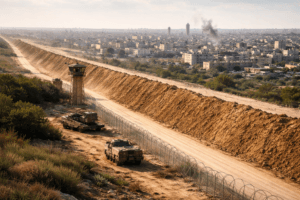
According to analysis by the research agency Forensic Architecture, corroborated by satellite imagery from Planet Labs, the Israeli military began construction last month on extensive earth berms along stretches of this yellow line. These are not minor fortifications. In Beit Lahia, in northern Gaza, a berm exceeding two kilometers in length now scars the landscape, first appearing in imagery from December 13, 2025. In Jabaliya, new berms run parallel to roads, following the path of moved yellow blocks that have been positioned hundreds of meters beyond the originally mapped line.
This transition from symbolic marker to physical barrier represents a significant escalation in the facts on the ground. Earth berms are a classic military tool for territorial control. They act as anti-vehicle barriers, observation platforms, and, most critically, as stark, immovable symbols of division. When constructed across roads, as seen in the imagery, they do not merely demarcate; they sever. They cut arteries of movement, commerce, and social connection, literally dividing neighborhoods from themselves.
The Shifting Line: A Creeping Annexation?
The most alarming insight from the satellite analysis is not just the construction, but the placement. The berms are not being built precisely on the previously publicized yellow line. Instead, they are extending further into Gaza, cementing in dirt the incremental encroachment signaled by the moved yellow blocks. This creates a dynamic where the “area of Israeli control” is no longer a fixed geography but an expanding one, absorbed meter by meter.
In practical terms, this means Palestinian land is being subsumed into a buffer zone without announcement or diplomatic process. The space between the old map line and the new earth wall becomes a no-man’s-land, its status ambiguous but its access firmly denied to Palestinians. This practice mirrors a long-standing tactic in the West Bank, where security barriers often deviate from the Green Line to incorporate settlements, thereby unilaterally altering the de facto border.
The Human Impact: Life in the Shadow of the Wall
To understand the true cost, one must look beyond the satellite view. For the Palestinian population crammed into Gaza’s western half, these berms are not a geopolitical abstraction. They are a daily reality of confinement.
- Access Denied: Farmers may be cut off from their fields, families from relatives, and communities from critical infrastructure that now lies on the “other side” of a several-meter-high mound of earth.
- The Shadow of Permanence: A yellow block can be moved. A line on a map can be redrawn in negotiations. But a massive, engineered earthwork sends a different message: permanence. It psychologically and physically solidifies a partition that was initially presented as temporary, shattering any lingering hope among residents for a swift return to a geographically unified Gaza.
- Fragmentation Within Fragmentation: Gaza, already one of the world’s most densely populated and besieged territories, is now being internally fractured. This internal division complicates humanitarian aid delivery, disrupts local economies that rely on movement across the entire strip, and creates new layers of administrative chaos.
A Historical Pattern, Accelerated
This move must be contextualized within the long history of Gaza’s borders. The enclave has been under a strict land, air, and sea blockade since 2007. Its perimeter has long been defined by Israeli security barriers. The construction of internal berms effectively creates a border within the border, further subdividing Palestinian territory and expanding Israeli-controlled space without formal annexation.
It represents an acceleration of a process that began with the occupation of the eastern half of the Strip: the systematic alteration of Gaza‘s geography to serve long-term security and political objectives. The dismantling of buildings in the controlled zone, coupled with the construction of military infrastructure and now these berms, points not to a temporary holding pattern, but to the establishment of a new, entrenched reality.
The Legal and Political Frontier
The construction of these barriers deep inside occupied territory raises sharp legal questions under international humanitarian law. The Fourth Geneva Convention prohibits the destruction of property unless rendered absolutely necessary by military operations, and forbids the permanent alteration of occupied land for the benefit of the occupying power. By carving out a expanded, physically separated zone, Israel appears to be moving beyond temporary security measures and toward a lasting alteration of Gaza’s territorial composition.
Politically, it pre-empts negotiations on Gaza’s future status. It unilaterally creates facts that any future discussion—whether about reconstruction, governance, or a final political settlement—must now confront. The question for the international community is whether this physical remapping of Gaza will be challenged or tacitly accepted as the new baseline.
Conclusion: When Earth Becomes a Border
The yellow line was always more than a cartographic detail. It was a statement of control. Now, as bulldozers reshape the terrain, that statement is being etched into the very earth of Gaza. The berms are more than military engineering; they are a form of non-verbal communication, announcing a division that is intended to last.
The story of Gaza is increasingly being written in layers of concrete, steel, and now, compacted soil. Each layer makes the prospect of a contiguous, viable Palestinian territory in Gaza more remote. The transformation from a temporary yellow line to a permanent earth wall reveals a stark trajectory: toward a Gaza not just under siege, but actively being carved apart, its geography reshaped to fit a vision of perpetual separation. The world is not merely watching a military occupation; it is witnessing the slow-motion construction of a new, unspoken border. The final, chilling question remains: once built, will such a border ever be dismantled?
You must be logged in to post a comment.