
From Tiny Microbes to Massive Cleanups: Can India Harness Nature’s Power to Heal Its Land and Water?
Bioremediation harnesses natural biological processes—using plants, microbes, or fungi—to detoxify pollutants like oil, heavy metals, and sewage, offering India a sustainable, low-cost tool for its severe pollution crisis. Its significance lies in leveraging native biodiversity for eco-restoration with minimal ecosystem disruption, yet application faces hurdles including slow treatment rates, risks of ecological imbalance from engineered strains, and a lack of standardized national protocols. Despite challenges, India is advancing through institutional efforts like the DBT’s Clean Technology Programme, CSIR-NEERI and IIT research collaborations, and TERI’s fermentation facility, aiming to scale homegrown, locally-adapted solutions that could transform environmental cleanup from a costly burden into a circular, nature-integrated process.
From Tiny Microbes to Massive Cleanups: Can India Harness Nature’s Power to Heal Its Land and Water?
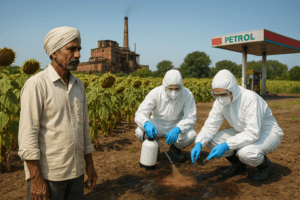
In the shadow of a rusted factory in Punjab, a farmer watches as sunflower stalks bend heavy with seeds—not for harvest, but for burial. A few kilometres away, a team of scientists carefully sprays a dull, brown powder onto an oily patch of soil near a petrol pump. These quiet scenes are frontlines in a revolutionary war against pollution, employing a weapon we are only beginning to master: life itself.
This is bioremediation, the practice of using living organisms—plants, bacteria, fungi—to detoxify our environment. For a nation grappling with the stark realities of its pollution crisis, from frothing lakes to heavy-metal-laced fields, it promises a solution that is not only sustainable but inherently Indian, rooted in the subcontinent’s own breathtaking biological wealth. Yet, bridging the gap between laboratory promise and widespread, effective application remains one of our most pressing ecological challenges.
Beyond the Definition: A Partnership with Nature
At its core, bioremediation is not a high-tech invention but a facilitated natural process. It’s the acceleration of what Earth already does: breaking down complex compounds into harmless ones. When we use phytoremediation, we deploy plants like sunflowers or mustard (known as hyperaccumulators) to suck heavy metals like lead and cadmium from the soil, storing them in their shoots to be safely disposed of. Mycoremediation leverages fungi, whose vast mycelial networks—nature’s internet—excrete powerful enzymes that can dismantle hydrocarbon chains in diesel or even degrade stubborn plastics.
The most prolific workers, however, are microbes. In biostimulation, we add nutrients like nitrogen or phosphorus to a contaminated site, turbocharging the native bacterial population already there. In bioaugmentation, we introduce specially selected or cultivated bacterial strains, like the famous Oilzapper consortium developed in India, to tackle specific contaminants like crude oil.
The choice between treating contamination in situ (on-site) and ex situ (excavating and treating elsewhere) hinges on the crisis. An ocean oil spill demands in-situ spraying of oil-eating bacteria. A severely poisoned industrial plot might require excavating soil into biopiles—engineered, aerated mounds where microbes are fed and monitored until the soil is clean.
The Compelling Case for a Bioremediation Revolution in India
The advantages of this approach align perfectly with India’s needs.
- Economic and Ecological Efficiency: Traditional “dig-and-dump” or incineration methods are astronomically expensive and energy-intensive, often just moving the problem elsewhere. Bioremediation, once established, can be significantly cheaper, running on solar energy and microbial labour. It’s inherently less invasive, avoiding the disruption of excavating entire landscapes, thus preserving what remains of the ecosystem’s structure.
- Harnessing Bharat’s Biodiversity: India’s real edge lies in its microbial reservoir. From the hot springs of Jharkhand to the alkaline soils of Gujarat, extremophiles—organisms thriving in conditions lethal to most—offer unparalleled genetic tools. A bacterium from a Rajasthan desert might excel at degrading pesticides under scorching heat; a fungus from a mangrove might process heavy metals in saline conditions. This isn’t about importing solutions, but cultivating homegrown, locally-adapted ones that communities can manage.
- Synergy with a Circular Ethos: Bioremediation fits into a broader philosophy of seeing waste not as an endpoint, but a misplaced resource. Treated wastewater can become irrigation; detoxified soil can return to agriculture. It moves us from a linear model of “take-make-dispose” towards a circular, restorative economy.
The Tangible Hurdles: Why Isn’t This Everywhere Yet?
Despite its promise, bioremediation faces steep, real-world barriers that explain its still-niche application.
- The Tyranny of Time: In a world demanding quick fixes, nature’s pace can feel glacial. While bacteria work 24/7, a thorough bioremediation project can take months or years, compared to weeks for a mechanical cleanup. This tests the patience of industries facing regulatory deadlines and a public demanding visible action.
- The Protocol Desert: Perhaps the most significant bottleneck is the lack of a robust, standardized regulatory framework. What are the approved microbial strains? How do we certify a site as “clean”? Without clear national standards and protocols, government agencies and private players are hesitant to adopt these methods at scale. The fear of liability—what if it doesn’t work completely?—looms large.
- The Ecological Balancing Act: Introducing any organism, especially a genetically modified one designed to be voracious, carries risk. Could it outcompete essential native species? Could its by-products be toxic? The spectre of unintended ecological consequences demands rigorous, long-term environmental impact assessments, which are often skipped in favour of faster approvals for conventional methods.
- The “Invisible” Solution Problem: Public and political perception matters. It’s harder to champion a cleanup where the heroes are invisible microbes, as opposed to the dramatic sight of excavators removing tonnes of soil. Building trust in a process that happens beneath the surface requires sustained communication and demonstrable success stories.
India’s Growing Arsenal: From Labs to Landfills
Thankfully, the institutional building blocks are being laid. The Department of Biotechnology’s Clean Technology Programme has been pivotal in funding research. Institutions like CSIR-NEERI and various IITs have moved beyond theory, developing deployable technologies for dye degradation in textile clusters, lake restoration, and heavy metal removal.
The establishment of facilities like TERI’s Fermentation Technology Research Centre is a game-changer, addressing the scaling problem. It’s one thing to grow a potent bacterial strain in a lab flask; it’s another to produce it by the tonne for a major oil spill. This facility aims to bridge that critical gap.
On the ground, successes, though scattered, light the path. The use of Oilzapper for ONGC spills, the remediation of chromium-contaminated sites in Kanpur using indigenous microbes, and the use of water hyacinth and specific algae to treat sewage in urban lakes showcase the potential. These projects prove that when scientific expertise, community engagement, and patient funding converge, results follow.
The Path Forward: Cultivating a Bioremediation Ecosystem
For bioremediation to transition from a promising tool to a default strategy, a multi-pronged effort is essential:
- Policy as a Catalyst: The government must accelerate the development of a National Bioremediation Protocol. This would create certification standards for microbial products, guidelines for monitoring, and clear definitions of cleanup completion, giving confidence to all stakeholders.
- Public-Private Synergy: Incentivizing private investment is key. This could include tax benefits for companies adopting bioremediation, or “green credits” that can be traded. Simultaneously, public awareness campaigns can create a demand for sustainable cleanup from communities themselves.
- Hyper-Localising Solutions: The next frontier is developing geographically tailored “microbial toolkits.” A lake in Bengaluru, a farmland in Punjab, and a mine in Odisha each require a unique biological recipe. Supporting decentralized, regional bio-resource centres can empower local scientists and entrepreneurs to create these solutions.
- Integrating Knowledge Systems: The future lies in combining bioremediation with other green technologies. Using bioremediated wastewater for constructed wetlands, or combining phytoremediation with solar energy production on reclaimed land (agrivoltaics), creates synergistic systems that are greater than the sum of their parts.
Bioremediation is more than a set of techniques; it is a paradigm shift. It asks us to move from seeing nature as a victim of pollution to recognizing it as the most sophisticated partner in remediation. For India, the path to cleaner soil and water will not be found solely in expensive, imported machinery, but in the vibrant, ancient, and incredibly potent life that already exists here. The mission is to learn, to cultivate, and to finally deploy it at the scale our nation desperately needs. The seeds of the solution, it turns out, are already sown—in our soil, our waters, and in the relentless, invisible workforce of a billion microbes.
You must be logged in to post a comment.