
From the Margins to the Lead: How India’s Tribal Women Are Rewriting the Rules of Farming
In India’s Mandla district, Indigenous Gond and Baiga women are transforming their families’ fortunes through an agroecological homestead farming model that has turned underutilized backyard plots into productive, diversified gardens. By adopting multilayer farming, bio-composting, rainwater harvesting, and livestock integration, women like Kusum Devi now earn steady income from vegetable sales while improving their families’ nutrition and reducing dependence on external markets. The initiative has catalyzed a profound shift in gender dynamics—women who once performed manual farm labor while men made decisions now manage production, finances, and even community water associations independently. Despite ongoing challenges from erratic weather and limited capital, the model has increased production diversity by 350 percent, doubled dietary diversity, and built women’s confidence as farmers and leaders, demonstrating how starting with small, women-controlled spaces can ripple outward to transform livelihoods, food security, and social norms in resource-constrained tribal communities.
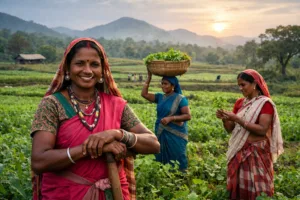
From the Margins to the Lead: How India’s Tribal Women Are Rewriting the Rules of Farming
The morning sun casts long shadows across the undulating hills of Mandla district as Kusum Devi moves methodically between rows of brinjal and cowpea plants, her hands dusted with soil. In one hand, she carries a bucket containing a murky brown liquid—a homemade concoction of cow dung, neem leaves, and fermented jaggery that she will spray across her vegetables before the day grows too hot.
“Earlier, we bought everything from the market,” she says, pausing to wipe her brow. “Now, we make it all at home.”
This simple statement represents something far larger than a change in farming technique. In the remote village of Chimkatola, perched in the hilly terrain of Madhya Pradesh’s Mandla district, Kusum is part of a quiet revolution that is reshaping not just how food is grown, but who gets to decide.
The Land Before
To understand what’s happening in Mandla today, you have to understand what existed before.
The district, populated predominantly by Gond and Baiga communities—both recognized as Scheduled Tribes in India—has long been characterized by the paradox of agricultural communities struggling to grow enough to eat. For generations, families here practiced a form of farming that left them perpetually vulnerable: maize planted in the uplands during monsoon, rice in the low-lying fields near rivers, and little else.
When the rains came late or arrived with too much force, when markets fluctuated wildly due to fuel price volatility hundreds of miles away, when the steep slopes continued their slow erosion—the people of Chimkatola and neighboring Kevlari had few buffers.
The backyard plots that surrounded their homes, typically around 400 to 500 square meters of land, remained largely fallow. Occasionally, a family might plant some maize, but the returns were meager. For women like Kusum, now 35, farming meant waiting—waiting for husbands to decide what would be planted, waiting for rain that grew increasingly erratic, waiting for market days that might or might not bring fair prices.
“My husband would go to Jabalpur for work,” Kusum explains, referring to the city where many local men find employment in construction or transport. “I would do the sowing, the weeding, the harvesting. But the decisions happened elsewhere.”
This separation between labor and decision-making is not incidental—it is structural. In Mandla’s Narayanganj block, male migration for seasonal work has long been an economic necessity. Women remained, managing households and contributing to farms, but rarely controlling them. The land itself seemed to reinforce this hierarchy: what could be grown on these degraded, rain-dependent plots was so limited that farming felt less like an enterprise and more like a holding action against hunger.
A Different Kind of Intervention
When the CGIAR Multifunctional Landscapes Program and the grassroots organization Pradan (Professional Assistance for Development Action) began working in the region, they faced a familiar challenge: how to introduce change in communities where so many previous interventions had failed.
The answer, it turned out, lay in starting small—and starting with women.
“We didn’t arrive with a fixed blueprint,” explains Saurav Kumar, team coordinator for Pradan. “We worked with women’s self-help groups already existing in these villages, and we built the model with them.”
That model, which has come to be known as the agroecological homestead approach, is deceptively simple in concept but transformative in execution. Instead of focusing on the larger fields where men traditionally controlled decision-making, the project turned attention to the backyard plots—the spaces immediately surrounding homes that had been underutilized for generations.
Here, women could experiment, learn, and eventually lead, without immediately challenging every existing norm about gender and agriculture.
The technical elements of the model are straightforward: multilayer farming that cultivates different vegetables at different heights to maximize space; crop rotation to maintain soil health; bio-composting that turns kitchen and farm waste into fertilizer; rainwater harvesting through portable tanks called Jal Kunds that can store up to 12,000 liters; and integration with livestock, where chickens provide eggs, meat, and manure while consuming crop residue.
But the social elements are what make it work. Every practice was introduced through peer learning, with women from Chimkatola and Kevlari visiting four pilot villages in Mandla’s Narayanganj block in 2024 to see for themselves what was possible. When they returned, they brought not just knowledge but conviction.
The Numbers Behind the Transformation
The data emerging from the project tells a compelling story. According to monitoring by the International Water Management Institute (IWMI) and Pradan, production diversity on participating farms has increased by 350 percent. Dietary diversity has doubled. Consumption of nutrient-rich foods like leafy greens has risen by 70 percent.
But numbers alone don’t capture what these changes mean in daily life.
Yashoda Devi, a farmer in Kevlari, now regularly supplies vegetables to a hostel in the nearby town of Bichhiya. “Last month alone, I harvested 33 kilograms of brinjal and earned about INR 1,200 (US$14) profit from selling vegetables,” she says. “It may seem small, but for us, it makes a big difference.”
That INR 1,200—roughly what an urban professional might spend on a single restaurant meal—covers school tuition, buys medicine, or provides a cushion against unexpected expenses. For families living on the margin, such sums are not small at all.
Pushpa Devi describes how her homestead income now supplements the remittances her husband sends from Jabalpur. “When my husband is away working, I manage everything here. With off-season prices, we earn enough to support children’s tuition fees and pay small household expenses.”
The phrase “off-season prices” is significant. By accessing irrigation through Jal Kunds and drip systems, women can now grow vegetables when market supplies are low and prices correspondingly higher. This isn’t just farming—it’s strategic market participation.
Learning to Fail, Then Succeed
The path to these outcomes was not smooth. When the project began, many women were hesitant to adopt natural inputs like jeevamrut and panchagavya—bio-fertilizers made from cow dung, cow urine, and other organic matter. Chemical fertilizers, for all their problems, were familiar. Homemade alternatives felt uncertain.
Then came the rains.
“In the first attempt, heavy rainfall washed away everything,” recalls Gopal Kumar, a researcher at IWMI who monitors the project. “Bio-fertilisers, bio-pests, seedlings—all gone.”
It would have been easy for participants to conclude that the new methods didn’t work, to retreat to familiar practices. Instead, something else happened. The project team helped farmers analyze what went wrong, adjust their approach, and try again.
“Once they saw better yields and healthier crops, confidence grew,” Gopal Kumar says. “Today, more women are preparing and applying bio-formulations on their own.”
This resilience in the face of failure may be the project’s most important outcome. Farming has always meant working with uncertainty, but climate change has made that uncertainty more acute. Erratic rainfall, pest attacks, extreme weather events—these are no longer anomalies but expectations. Farmers who learn to adapt, who see setbacks as problems to be solved rather than reasons to give up, are farmers who will survive whatever comes.
Balwanti Devi from Kevlari remembers the early difficulties: “The first few months were difficult. Some crops were damaged by heavy rain, and we didn’t have money to buy organic inputs again.”
The project responded by helping women’s self-help groups access subsidized loans through Madhya Pradesh’s state rural livelihood mission. Labor costs for creating water bodies and irrigation canals were covered through the Rural Employment Guarantee Scheme. Government programs that had always existed on paper became accessible in practice.
Beyond the Farm: Water, Power, and Leadership
Perhaps the most striking development in Chimkatola and Kevlari has been the emergence of women-led water user associations—the first time many women here have participated in formal community governance.
Through a connected scheme under IWMI’s Solar Energy for Agricultural Resilience (SoLAR) project, 13 women farmers have received access to solar-powered irrigation pumps. The associations manage these shared pumps, generate income by providing irrigation services to members, and use excess power to run a rice mill that allows farmers to process paddy locally.
Each association maintains its own bank account. Members have been trained in governance, financial record-keeping, and maintaining solar infrastructure. For women who previously had no role in financial decision-making, the shift is profound.
“For the first time, women here are running a water system and handling finances,” Kusum Devi observes.
The implications extend beyond the immediate benefits of irrigation. When women manage resources, when they control bank accounts and make decisions about maintenance and pricing, they demonstrate capabilities that have always existed but rarely been acknowledged. Sons see their mothers as leaders. Husbands return from migration to find households transformed. Daughters grow up with different possibilities in mind.
The Persistence of Challenge
For all the progress, the women of Chimkatola and Kevlari face ongoing challenges that no project can fully solve.
Climate change continues to make weather patterns unpredictable. The same heavy rains that washed away seedlings in the project’s early days can still arrive at precisely the wrong moment. Pest outbreaks remain a threat. Market access is improving but remains limited—for now, most produce is sold locally or to nearby towns, with wholesale markets still out of reach.
Capital constraints also persist. While subsidized loans help, they don’t eliminate risk entirely. A bad season can still mean debt. And for families living close to subsistence, the margin for error is razor-thin.
The project team is aware of these limitations and is working to address them. Plans are underway to establish wholesale collection centers where farmers’ produce can be aggregated and transported to larger markets, potentially securing better and more stable prices. Training continues in climate-resilient seed varieties, canopy management, and adjusting sowing times to match changing weather patterns.
But perhaps the most important buffer against uncertainty is the network women have built among themselves. When one farmer faces a problem, others share solutions. When someone’s crop fails, neighbors offer seedlings from their own surplus. This social infrastructure—invisible in project reports but palpable in village life—may prove as durable as any physical intervention.
What This Means for Development
The Mandla experience offers lessons that extend far beyond central India.
First, it demonstrates the power of starting where people are rather than where outsiders think they should be. By focusing on homestead plots rather than larger fields, the project worked within existing gender norms even as it began to transform them. Women could participate without first having to challenge their husbands’ authority over family farms. Over time, participation itself shifted authority.
Second, it shows the value of integrated approaches. Too many development projects address single problems—water scarcity, say, or malnutrition—in isolation. The homestead model addresses multiple challenges simultaneously: income, nutrition, women’s empowerment, climate resilience, soil health. These aren’t separate issues; they’re facets of the same reality.
Third, it underscores the importance of patience and adaptation. The project didn’t succeed because its initial design was perfect. It succeeded because implementers and participants learned together, adjusted together, and persisted through setbacks together.
Fourth, it reveals the often-hidden role of government programs in enabling grassroots change. The self-help groups accessing subsidized loans, the labor costs covered by rural employment guarantees, the infrastructure created through public works—none of this appears in headlines, but all of it matters. Development happens at the intersection of community initiative and state capacity.
The View from the Garden
Standing in her garden as the morning sun climbs higher, Kusum Devi looks out over rows of vegetables that didn’t exist two years ago. Brinjals hang purple and heavy. Cowpeas wind their way up supports. Chillies flash green against dark leaves. Chickens scratch in the background, converting kitchen scraps and crop residue into eggs and meat.
“Earlier, we were invisible in farming,” she says. “Now, we are the decision-makers.”
The transformation she describes is visible not just in her garden but in her posture, her voice, her way of moving through the world. She no longer waits for someone else to decide what will be planted, when it will be sold, how proceeds will be used. Those decisions happen here, in conversation with other women who have undergone the same journey.
Nearby, Yashoda Devi is preparing vegetables for market. Pushpa Devi is checking her Jal Kund’s water level, calculating how many more days of irrigation it will provide before the next rain. Balwanti Devi is mixing bio-fertilizer, her hands moving with the confidence of practice.
None of them would claim that their lives have become easy. The challenges of farming in India‘s uplands—erratic weather, limited capital, distant markets—haven’t disappeared. But something has shifted nonetheless.
Before, farming was something that happened to them, a set of constraints to be endured. Now it’s something they do, a space of agency and possibility. Before, their labor fed their families but little else. Now it feeds their families, sends their children to school, pays for medicine, builds savings, and, perhaps most importantly, demonstrates to themselves and everyone around them what women can do when given the chance.
The gardens of Chimkatola and Kevlari are small—400 square meters here, 500 there—but their implications are large. In the space between kitchen and field, between tradition and transformation, between waiting and deciding, the women of Mandla are growing something more than vegetables.
You must be logged in to post a comment.