
From Suspicion to Violence: How the “Bangladeshi” Tag Erodes Citizenship and Why 2026 is a Reckoning
The pervasive violence against Bengali Muslim migrant workers across India, fueled by the weaponized political label “Bangladeshi,” represents a systemic crisis of conditional citizenship and dehumanization, where linguistic and religious identity has become a lethal vulnerability. This pattern of lynching, assault, and harassment stems not from isolated criminality but from a normalized politics of suspicion that scapegoats a community occupying a triple marginality—as informal laborers, religious minorities, and linguistic outsiders. The upcoming 2026 West Bengal elections serve as a critical test of democratic conscience, challenging whether political action will transition from electoral tokenism to concrete institutional protection, including anti-lynching laws, interstate migrant safeguards, and the proactive use of historical data to counter disinformation, thereby determining if India can uphold an unconditional right to life and dignity for all its citizens.
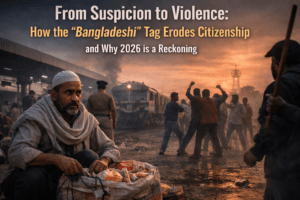
From Suspicion to Violence: How the “Bangladeshi” Tag Erodes Citizenship and Why 2026 is a Reckoning
In the dim, pre-dawn hours at a railway station in Jharkhand, a street vendor named Alai Sheikh packs his modest wares. His thoughts are not on profits, but on prudence. He mentally rehearses a truncated version of his identity, a story stripped of the details that might betray his origins: Murshidabad, West Bengal, Bengali Muslim. For Alai, and for hundreds of thousands like him, the simple act of moving across state lines for work has become a high-stakes performance of belonging. A single word, an accent, a reference to home, can trigger a chain reaction ending in detention, assault, or death. His fear is not of failure, but of being seen. This is the lived reality of the Bengali Muslim migrant worker in India today—a reality where the political label “Bangladeshi” has been weaponized into a potential death sentence.
The incidents are no longer isolated; they form a chilling pattern. From the lynching of Jewel Rana in Odisha to the fatal assault on a worker in Karnataka, and the suspicious death in Howrah, a common thread links these tragedies: identity-based suspicion. These are not crimes of robbery or personal vendetta. They are mob verdicts delivered on the basis of accent, appearance, and rumor. This represents a fundamental shift from criminal violence to social and political violence, where the perpetrator is often not an individual but a collective impulse, empowered by a pervasive narrative.
The Anatomy of a Label: How “Bangladeshi” Became a Weapon
To understand this crisis, one must dissect the power of the label itself. “Bangladeshi” has undergone a deliberate semantic shift in large parts of India’s political and social discourse. It has shed its neutral geographical meaning to become a potent political slur, synonymous with “infiltrator,” “illegal,” and “other.” This transformation is not accidental; it is a calculated political project.
The narrative conveniently ignores documented history. As evidenced by processes like the SIR 2026 draft voter list, a significant portion of West Bengal’s Muslim population are descendants of families who made a conscious, and often difficult, choice against migrating to East Pakistan (now Bangladesh) during Partition. Their citizenship is rooted in the soil of pre-independent India. Yet, the “infiltrator” myth persists because it serves multiple functions: it provides a simplistic scapegoat for complex issues like economic competition and resource strain, it fuels majoritarian anxiety, and it creates a permanent “suspect community” for political mobilization.
Triple Marginality: The Perfect Storm of Vulnerability
Bengali Muslim migrant workers exist at a dangerous intersection of identities, a state of triple marginality that makes them uniquely vulnerable:
- Economic Precarity: As informal sector workers in construction, brick kilns, and street vending, they lack the safety nets of formal employment. Their need to be mobile and invisible to labor regulations makes them easy to exploit and hard to protect.
- Religious Minority Status: In a climate of rising majoritarianism, their Muslim identity adds a layer of religious prejudice to any encounter, making them targets for factions pushing polarized politics.
- Linguistic Marking: Their Bengali accent acts as an immediate, unchangeable marker of “otherness” in Hindi or Dravidian-speaking states. Language becomes not a mode of communication, but a beacon for suspicion.
This confluence pushes them to the farthest edges of state protection. When violence occurs, they are often framed not as victims, but as suspects whose very presence justified the inquiry. Local law enforcement, influenced by the same social prejudices and political pressures, frequently engages in “profiling” rather than protection, conducting arbitrary detentions for “identity verification” that are themselves acts of humiliation and dehumanization.
Conditional Citizenship and the Hollowing of Article 21
This situation forces a grave constitutional confrontation. Article 21 of the Indian Constitution guarantees the protection of life and personal liberty. The Supreme Court has consistently interpreted this to include a life of dignity, livelihood, and security. Yet, for these workers, citizenship has become terrifyingly conditional. It is contingent upon passing an unwritten, ever-shifting test of acceptable appearance, speech, and behavior in public spaces.
When the street becomes a courtroom and the mob the judge, the Right to Life is rendered meaningless. It is reduced to a mere right to biological existence, stripped of the dignity and freedom from fear that gives life its value. This conditional citizenship undermines the very foundation of a democratic republic, where rights are inherent, not granted by social consensus.
The Failure of Frameworks: Laws, Lies, and Lack of Will
The legal and institutional response has been woefully inadequate. While the Supreme Court’s directives in the Tehseen Poonawalla case (2018) called for stringent anti-lynching laws, many states have dragged their feet. More critically, there is a glaring absence of legislation that specifically addresses the root cause of this violence: identity-based dehumanization and the deliberate propagation of suspicion.
Furthermore, India lacks a robust interstate mechanism to protect internal migrant workers. Their safety is left to the ad hoc discretion of local administrations, which often view them as a demographic problem rather than citizens with enforceable rights. The official data that could counter the disinformation—like the SIR 2026 records proving deep-rooted domicile—is rarely deployed proactively by the state in public discourse, allowing the “infiltrator” lie to flourish unchallenged.
2026: Beyond the Vote Bank, Towards a Question of Survival
This is where the 2026 West Bengal Assembly elections transcend typical political theater. The election presents a fundamental test: will Bengali Muslims—both within Bengal and those who migrate from it—continue to be treated as a monolithic vote bank, courted every five years and abandoned in between? Or will their existential security become a non-negotiable plank of governance and political commitment?
Genuine political accountability would demand concrete, actionable agendas:
- Legislative Action: Enacting state laws that criminalize hate-based profiling and public incitement of suspicion against linguistic or religious communities.
- Legal Recognition: Amending penal codes to explicitly define and punish lynching and mob violence as distinct, heinous crimes with stringent penalties.
- Interstate Protocols: Creating binding agreements between source and destination states to ensure migrant worker registration, access to grievance redressal, and prompt intervention by home-state authorities when their citizens are targeted.
- Institutional Reform: Mandatory constitutional sensitivity training for police forces, especially in industrial and migrant-heavy regions, emphasizing their duty to protect, not profile.
- Truth as Defense: The proactive, widespread dissemination of official data (like SIR findings) through government channels to fact-check and disarm the “infiltrator” narrative.
The Cost of Silence
To remain silent, or to offer only superficial condemnation, is to grant consent to this machinery of dehumanization. The cost of this consent is measured in human lives—Jewel Rana, Alai Sheikh, and countless unnamed others. It is paid by families who lose their breadwinners to baseless suspicion, and by a nation that loses a piece of its soul each time the mob is allowed to define belonging.
The question looming over 2026, and indeed over India, is stark: Can the republic guarantee an unconditional right to life and livelihood to all its citizens, or will we allow suspicion to become the final arbiter of Indianness? The answer will not be found in manifestos alone, but in the willingness to confront uncomfortable truths, to protect the most vulnerable from the mobilized prejudice of the crowd, and to reaffirm, through relentless action, that in a democracy, citizenship is not a claim to be proved, but a right to be respected. The democratic conscience of the nation awaits its verdict.
You must be logged in to post a comment.