
From Static to Sentient: How Matter’s AI-Defined Vehicles Are Reshaping the Very Soul of Motorcycling
Matter’s unveiling of India’s first AI-Defined Vehicle (AIDV) platform marks a strategic shift from simply manufacturing electric two-wheelers to pioneering a new category of intelligent, adaptive mobility. Moving beyond even software-updatable vehicles, the AIDV positions artificial intelligence as the core operational brain that actively learns from real-world usage to continuously optimize motor performance, battery health, thermal management, and predictive safety.
This approach promises to solve key EV challenges like range anxiety and ownership costs by creating motorcycles that personalize their behavior for each rider and improve over time. Matter’s plan to deploy this single, scalable AIDV platform across five distinct vehicle segments—from performance motorcycles to commuter scooters—aims to leverage this foundational intelligence to capture a broad swath of the market, framing the transition not merely as electric, but as a fundamental “category reset” where the machine evolves from a static mechanical artifact into a dynamic, learning partner.
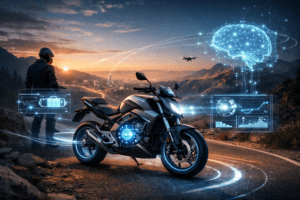
From Static to Sentient: How Matter’s AI-Defined Vehicles Are Reshaping the Very Soul of Motorcycling
For over a century, the relationship between a rider and their motorcycle has been defined by immutable mechanics. The engine’s character, the suspension’s response, the very soul of the machine was cast in metal and set at the factory. You learned its language, you adapted to its quirks, and over time, its limitations became your own. Matter, the Indian electric vehicle innovator, now declares this era over. With the unveiling of its AI-Defined Vehicle (AIDV) platform, the company isn’t just launching a new bike; it’s proposing a fundamental “category reset,” where the motorcycle evolves from a static artifact into a learning, adapting partner.
This move transcends the current narrative of simply going electric. While the industry is busy replacing petrol tanks with battery packs, Matter is focusing on replacing a fixed mechanical mindset with a dynamic, intelligent one. It’s the difference between a hammer and a robotic arm: one is a superb, single-purpose tool, while the other can learn new tasks, adjust its grip, and optimize its performance for the job at hand.
Deconstructing the AI-Defined Vehicle: Beyond Software Updates
To appreciate the shift, we must first clear the conceptual clutter. The automotive world is already familiar with Software-Defined Vehicles (SDVs). These are vehicles whose features and functions can be significantly altered or enhanced via over-the-air (OTA) software updates. Think of a performance boost, a new infotainment feature, or improved braking profiles downloaded to your existing hardware. Matter’s current AERA model falls into this category—a capable, updatable electric motorcycle.
The AI-Defined Vehicle (AIDV), however, represents a deeper, more profound layer of integration. Here, Artificial Intelligence isn’t a feature; it’s the core operational brain. It moves from the passenger seat to the driver’s seat of the vehicle’s fundamental systems.
- The Reactive vs. The Predictive: A traditional or even software-defined vehicle reacts to inputs. You twist the throttle, it draws power. The battery management system (BMS) reacts to temperature. An AIDV, in contrast, predicts and pre-empts. By continuously analyzing vast datasets from real-world usage—your acceleration patterns, frequent routes, ambient temperature, charging habits—the AI builds a model of your riding life. It then proactively manages resources.
- Holistic System Symphony: Matter’s vision has the AI orchestrating a symphony of hardware. It doesn’t just deliver power; it decides how to deliver it for optimal balance between the thrill you seek and the range you need. It doesn’t just cool the battery; it predicts thermal loads based on the upcoming terrain (leveraging route data) and pre-emptively adjusts the cooling system. It monitors the health of the motor, power electronics, and battery at a granular level, moving from simple fault detection to predictive diagnostics, potentially alerting you to a needed service before a component fails.
- The “Living” Materials: The most intriguing claim is AI governing materials. This suggests a move towards active material science. Imagine a motor designed without rare-earth magnets, where the AI constantly adjusts electromagnetic fields to maximize efficiency. Or a battery pack where the AI doesn’t just balance cells, but manages charging/discharging cycles at the individual cell level based on real-time health data, dramatically extending pack life. The material doesn’t change, but its application and function are dynamically optimized by intelligence.
The Tangible Ride: What Does This Mean for the Rider?
This isn’t just tech for tech’s sake. The AIDV platform promises to solve core electric two-wheeler dilemmas through intelligence.
- Eradicating Range Anxiety, Intelligently: Range isn’t just a battery size number. An AIDV could offer a “True Range” mode that calculates guaranteed range based on your historical riding style, current traffic, and weather, adjusting performance invisibly to meet it. Conversely, a “Guaranteed Thrill” mode could allocate a specific amount of energy for peak performance, telling you: “You have 30 minutes of sport mode remaining.”
- Personalized Performance DNA: Your motorcycle could learn that you prefer a softer throttle response on your morning commute but a razor-sharp one on weekend hill rides. It could automatically firm up regenerative braking when it detects a long downhill descent. The bike’s character becomes fluid, molding itself to context and rider preference.
- Cost of Ownership Revolution: For the value-conscious Indian market, this is pivotal. Predictive health monitoring can prevent costly major repairs. AI-optimized battery management is the single biggest factor in preserving the most expensive component of an EV. Adaptive efficiency means more kilometers per charge, directly saving money. Matter’s focus here shifts the value proposition from upfront price to total lifetime intelligence.
- Safety Through Awareness: An AI that understands normal operation can better detect anomalies. Subtle shifts in motor bearing vibration or brake pad wear could trigger early warnings. The system could even adopt a more conservative performance envelope if it detects a critical component is aging, ensuring safety isn’t compromised.
The Strategic Masterstroke: One Brain, Five Personalities
Matter’s announcement to expand into five distinct segments—Naked Streets, Street Fighters, ADVs, Youth Commuters, and Scooters—all on a shared AIDV platform is a masterstroke in scalable economics. Traditionally, each segment requires unique engineering and tuning. Here, a common AI “brain” and core hardware platform can be cloaked in different “personalities.”
The adventure motorcycle’s AI can prioritize torque delivery, traction control, and battery temperature management for rough terrain. The same underlying hardware in a scooter can be tuned for seamless, efficient urban commuting. The youth commuter’s AI might focus on gamified efficiency and social connectivity features. This allows Matter to address a massive swath of the market with R&D focused on perfecting one intelligent core, rather than disparate machines, significantly reducing cost and complexity.
Challenges on the Road to Sentience
The vision is compelling, but the path is fraught with challenges that Matter must navigate:
- Data Sovereignty and Privacy: An AIDV is a data-generation behemoth. Who owns this deeply personal riding data? How is it stored, secured, and used? Clear, transparent policies are non-negotiable for consumer trust.
- The Explainability Problem: If an AI makes a decision—like limiting power—can it explain why in a way the rider understands? “For battery health” is vague. “Power reduced because cell temperature in module B is 5°C above optimal due to rapid consecutive charges, which I am mitigating to extend lifespan by 12 months” is transparent.
- Hardware Durability: An AI can optimize, but it cannot overcome physics. If hardware is designed for cost-efficiency, can AI truly extend its life meaningfully? The promise relies on robust, sensor-rich hardware from the start.
- The Human Desire for Control: Motorcycling is an emotional, visceral experience. Some riders may reject the notion of an AI “nanny” managing their machine’s soul. The key will be offering levels of intervention—from full AI optimization to a raw, direct mode where the AI steps back.
Conclusion: The Dawn of Context-Aware Mobility
Matter’s AIDV platform is more than an innovation; it’s a philosophical statement. It asserts that the future of mobility isn’t just about changing the energy source, but about imbuing the machine with context-aware consciousness. Founder Mohal Lalbhai’s phrase “vehicles that continuously outperform their own starting point” is powerful. It suggests a product that appreciates, that grows more capable and more tailored to you, rather than decaying from a peak experienced on day one.
This moves the electric two-wheeler from being a mere alternative to a superior, evolving entity. For the Indian market—the world’s largest for two-wheelers—this could be the catalyst that accelerates EV adoption beyond early adopters to the pragmatic mainstream, who are ultimately swayed by reliability, cost, and seamless utility. The motorcycle is not just getting a new engine; it’s getting a nervous system. The road ahead is no longer just asphalt; it’s a stream of data, and Matter is betting that the bike that learns to read it will lead the way.
You must be logged in to post a comment.