
From Soil to Silicon: How DeHaat’s AI is Rewriting the Rules for India’s Small-Scale Farmers
From Soil to Silicon: How DeHaat’s AI is Rewriting the Rules for India’s Small-Scale Farmers
In the vast, sun-baked fields of rural India, a quiet revolution is taking root. It’s not heralded by massive tractors or corporate land acquisitions, but by the gentle ping of a mobile notification and the trusted advice of a local micro-entrepreneur. At the heart of this shift is DeHaat, an agritech platform that has grown from a humble village pilot into a digital lifeline for 1.8 million smallholder farmers. This is the story of how artificial intelligence is moving from Silicon Valley labs to the soil of Bihar and Odisha, transforming age-old agrarian challenges into data-driven solutions.
The Foundational Crack in the System
India’s agricultural backbone has long been its millions of small and marginal farmers, each working a plot of land often smaller than two football fields. Despite their crucial role in food security, these farmers have traditionally been trapped in a cycle of fragmentation: isolated from quality seeds and fertilizers, dependent on opaque middlemen for both inputs and sales, and starved of timely, personalized agronomic advice. Climate volatility only deepened this vulnerability.
Spotting this systemic gap wasn’t the work of a distant think tank, but of two individuals deeply familiar with the landscape: IIT and IIM alumni Shashank Kumar and Manish Kumar. In 2012, they began not with a grand tech solution, but with on-ground research. They saw that the problem wasn’t a lack of resources, but a catastrophic failure in last-mile connectivity and trust. Their vision for DeHaat was born not as a mere app, but as a full-stack ecosystem—a digital and physical bridge between the isolated farmer and a more efficient, transparent agricultural value chain.
The Hybrid Model: Digital Intelligence with a Human Face
DeHaat’s genius lies in its refusal to be a purely digital platform in a landscape where smartphone literacy varies and trust is paramount. Instead, it built a hybrid, asset-light network that has become its scaling engine.
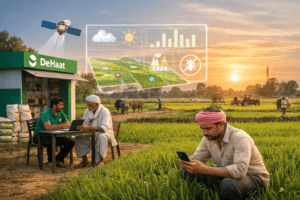
- The Grassroots Nerve-Endings: DeHaat Centres & Micro-EntrepreneursAcross 12 states, over 11,000 DeHaat Centres, often run by local micro-entrepreneurs, serve as the physical touchpoints. These centers are more than just input shops; they are advisory hubs, data collection nodes, and aggregation points. The local entrepreneur, often a respected community figure, becomes the human interpreter of DeHaat’s AI, building the essential trust that no algorithm could generate alone. This network has also catalysedrural entrepreneurship, creating thousands of sustainable livelihoods.
- The AI Brain: From Reactive to Predictive AdvisoryThe platform’s core is its AI-powered advisory engine, which crunches a symphony of data points:
- Satellite Imagery: Monitors crop health, vegetation indices, and even moisture levels at the plot level.
- Hyperlocal Weather Data: Provides forecasts tailored to a cluster of villages, not just a district.
- Soil Health Profiles: Offers insights into nutrient deficiencies.
- Pest and Disease Incidence Records: Crowdsourced from farmers across regions.
By synthesizing this data, DeHaat’s models move beyond generic advice. They deliver crop-stage-specific, personalized recommendations directly to a farmer’s phone in their local language: “Spray neem oil mixture on the eastern section of your paddy field in the next 48 hours to prevent early signs of blast fungus.” This shifts farming from a tradition-guided gamble to a science-informed practice.
The Tangible Impact: A Ripple Effect Across the Value Chain
The proof of any agricultural intervention is in the yield and the income. DeHaat’s integrated model creates value at every step:
- For the Farmer (The Core Beneficiary):
- Input Access & Cost Savings: Sourcing directly from manufacturers via DeHaat’s aggregated demand cuts out middlemen, reducing input costs by an estimated 15-20%.
- Yield Optimization: AI-driven advisories on optimal sowing times, nutrient management, and pest control have helped increase yields for key crops by 20-30%, as reported in case studies.
- Market Access & Price Realization: Direct linkages with institutional buyers (food processors, exporters, retail chains) through the platform’s procurement service ensure better prices, often 5-10% higher than local mandi rates, while reducing post-harvest waste.
- For the Broader Ecosystem:
- Farmer Producer Organizations (FPOs): DeHaat digitally empowers over 500 FPOs with tools for accounting, markerting, and quality control, turning them into professionally managed entities.
- Buyers & Brands: Agri-businesses gain unprecedented supply chain visibility and traceability. They can source specific quality produce directly, knowing its provenance and cultivation practices.
- Input Manufacturers: Receive granular, predictive data on regional demand, enabling better production planning and inventory management.
The Deeper Human Insight: Technology as an Enabler, Not a Displacer
What DeHaat truly understands is that in Indian agriculture, technology succeeds only when it augments, not replaces, human relationships. The platform doesn’t seek to make the local input dealer obsolete; it transforms him into a “DeHaat Guru.” It doesn’t dismiss traditional knowledge; it enriches it with satellite data. This respectful, integrated approach has been key to its adoption.
The model addresses a profound psychological need for security among farmers. By reducing uncertainty—through predictive alerts, guaranteed quality inputs, and assured market linkages—DeHaat doesn’t just boost income; it reduces anxiety and builds resilience. A farmer sleeping through a storm, confident her crop has been advised for such weather, represents a victory as significant as any percentage point in yield increase.
The Road Ahead: Scaling in the Face of Complexity
The journey is far from complete. Scaling to millions more farmers requires continuous model refinement to account for India’s dizzying crop and climate diversity. Future challenges and opportunities include:
- Deepening Climate Resilience: Integrating more advanced climate-risk models to help farmers navigate increasing volatility.
- Financial Inclusion: Using its rich trove of farm-level data to facilitate tailored credit and insurance products.
- Nutrition & Specialty Crops: Encouraging sustainable shifts to high-value, regenerative crops through predictive market signals.
A New Blueprint for Equitable Growth
DeHaat’s story offers a powerful blueprint for the future of inclusive growth. It demonstrates that the Fourth Industrial Revolution can reach the most foundational sectors of the economy, not by disruption, but by orchestration. It shows that AI’s greatest potential may not be in creating virtual worlds, but in stewarding our natural one more intelligently.
For India, and for the global agricultural community watching, DeHaat proves a vital thesis: the smallholder farmer is not a relic of the past, but a key participant in a efficient, digital future. By building a platform that connects the silicon chip to the soil, DeHaat is sowing the seeds for a system where farming is not just a struggle for survival, but a viable, prosperous, and dignified profession. The transformation of agriculture is no longer just about water and seeds; it’s about data, connectivity, and, most humanely, about choice and empowerment delivered one personalized advisory at a time.
You must be logged in to post a comment.