
From Sizzling to Soaked: Bengaluru’s Weather Whiplash and What It Means for You
From Sizzling to Soaked: Bengaluru’s Weather Whiplash and What It Means for You
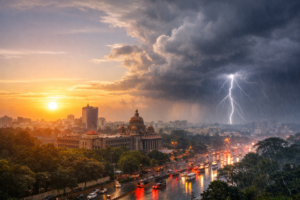
If you stepped out in Bengaluru this afternoon, you were likely greeted by the familiar, unrelenting glare of a March sun. The city is basking in a picture-perfect, yet intensely warm, day. The forecast, as curated by News18, is clear: “Sunny Today.” But for anyone who has lived in India’s Silicon Valley for more than a few monsoon seasons, they know that a “clear sky” in the forecast is often just the calm before the chaos. And according to the India Meteorological Department (IMD), that chaos—in the form of heavy rain and thunderstorms—is precisely what’s on the horizon.
The next 48 hours promise a classic Bengaluru weather plot twist. The city, and much of Karnataka, is poised on the edge of a meteorological shift, transitioning from a dry, warm spell to the dramatic onset of pre-monsoon activity. This isn’t just a news bulletin to be scrolled past; it’s a heads-up for residents, commuters, and visitors to prepare for the city’s most unpredictable season.
The Pre-Monsoon Tango: A Dance of Atmospheric Elements
To understand why Bengaluru’s weather is about to do a complete 180, we need to look beyond the city limits. The IMD’s latest bulletin points to a fascinating interplay of atmospheric forces that is setting the stage for this dramatic change.
At the heart of it all is a “high temperature circulation in the mid-levels of the atmosphere.” Think of this as a powerful, slow-spinning top of warm air high above the ground. For the past few days, this circulation has been a dominant feature, acting like a lid and trapping heat, leading to the above-normal daytime temperatures we’ve been experiencing. As this system is expected to expand and intensify around March 14, it will begin to interact with a new, equally important player: moisture-laden winds from the Bay of Bengal.
These winds are the quintessential harbingers of pre-monsoon showers for peninsular India. As they sweep in from the east, they carry with them the humidity and instability needed to birth a thunderstorm. When this moist, low-level air clashes with the persistent warm circulation in the upper atmosphere, it creates an inherently unstable environment. Warm, moist air is less dense and rises rapidly, cooling and condensing into towering cumulonimbus clouds—the very clouds that produce thunder, lightning, and sudden, heavy downpours.
This isn’t just about Bengaluru. The IMD’s forecast paints a broad canvas of change across Karnataka. The coastal districts, which have been “continuing to face the heat,” might find some respite with “scattered clouds” in the evenings. The hilly Malnad region—Kodagu, Hassan, Chikkamagaluru—known for its lush landscapes, is bracing for similar pre-shower conditions. Meanwhile, North Interior Karnataka is on alert for thunderstorms starting March 14. The entire state is essentially holding its breath, waiting for the sky to open up.
Bengaluru’s Tryst with the Thunderstorm: A City Unprepared
For Bengaluru, this forecast is more than just a weather update; it’s a recurring theme in the city’s modern narrative. The prediction of “isolated showers and thunderstorms” later in the week is a phrase that can send a ripple of anxiety through its millions of residents.
Bengaluru’s relationship with rain is a complicated one. On one hand, the first showers after a spell of scorching heat are a cause for celebration. The parched earth smells of life (petrichor), the city’s famed gardens get a much-needed drink, and the oppressive heat momentarily vanishes, replaced by a cool, soothing breeze. It’s a moment of collective relief, a shared secret between the city and the sky.
On the other hand, these same rains often expose the city’s most glaring vulnerabilities. Bengaluru’s infamous traffic, a challenge on the best of days, can grind to a complete halt under a heavy downpour. Roads that are usually just congested turn into small lakes. The city’s drainage system, strained by rapid and often unplanned urbanization, frequently struggles to cope with a sudden deluge, leading to waterlogging in low-lying areas and underpasses.
The mention of “lightning and gusty winds” in the IMD bulletin adds another layer of concern. For the IT professional on a two-wheeler, a sudden gust can be a safety hazard. For the families in areas with older power infrastructure, it raises the specter of outages. The city’s famed canopy of trees, while beautiful, can also become a liability in high winds, with branches—and sometimes entire trees—coming down on roads and parked vehicles.
This is where the human insight lies. The forecast isn’t just a collection of data points; it’s a prompt for action. It’s a reminder for the father working in Whitefield to check if his child’s school has sent out a rain advisory. It’s a cue for the young professional in Indiranagar to ensure their balcony plants are secured. It’s a nudge for everyone to keep a raincoat or umbrella within arm’s reach, a permanent resident of the Bengaluru bag.
A Practical Guide to Navigating the Bengaluru Shower
So, as the city stands on the cusp of this weather event, how does one navigate the next few days? Here is some genuine, actionable advice drawn from the collective experience of Bengaluru’s residents:
- The Commuter’s Creed: Assume the Worst, Hope for the Best: If you have a meeting in the central business district but live on the outskirts, plan your journey as if it will take twice as long. Work from home if your organization permits. If you must commute, check live traffic apps before you leave. The “isolated” nature of the showers means one part of the city could be dry while another is underwater.
- Two-Wheeler Ready-Kit: For the vast two-wheeler army, preparation is key. A fully zipped-up raincoat is non-negotiable. But also consider a waterproof cover for your backpack to protect your laptop and other valuables. A small plastic bag to slip your phone into can be a lifesaver. And remember, wet roads are slippery roads—especially after the first shower when oil and dust rise to the surface. Gentle acceleration and braking are your best friends.
- The Digital Lifelines: Bookmark the Bangalore Traffic Police Twitter/X handle and your local weather radar app. Often, community-driven updates on social media about a blocked road or a waterlogged underpass are faster than any official alert.
- Home and Hearth: For those in areas with exposed wiring or older homes, a surge protector for sensitive electronics is a wise investment. Check your terrace or balcony for any blockages in the drainage to prevent water from seeping indoors. If you live in an area with large trees, park your car away from them if possible.
- Embracing the Gloom: Beyond the chaos, there’s a unique charm to a Bengaluru rainy day. It’s the perfect excuse to indulge in a cup of hot filter coffee at a local “tiffin room” (if you can get there dry), curl up with a book as the wind rattles the windows, or simply enjoy the rare spectacle of a city pausing to acknowledge the raw power of nature.
The Bigger Picture: The Rhythm of the Seasons
This impending weather change is also a reminder of the timeless rhythm of the Indian seasons. Long before weather apps and Doppler radar, the people of this region understood these shifts. The increasing heat of March was a signal, a herald of the life-giving rains to come. While the pre-monsoon showers can be fierce, they are also a vital part of the ecological cycle. They cool the land, replenish water sources, and prepare the soil for the main event: the southwest monsoon.
The farmers in the surrounding regions of Ramanagara and Tumakuru watch these forecasts with a different kind of interest. For them, these pre-monsoon rains are crucial for summer ploughing and for providing relief to their livestock. It’s a connection to the land that many in the city have lost, but one that the weather forecast subtly reinstates.
Conclusion: More Than Just a Forecast
As Bengaluru prepares for its scheduled drenching, the story is bigger than “heavy rain likely.” It’s a story of a modern metropolis re-learning to dance with an ancient climate. It’s a tale of two cities: one of gleaming office parks and tech campuses that hums with digital energy, and another of low-lying neighborhoods and vulnerable infrastructure that is at the mercy of a sudden downpour.
The sunny skies of today are a fleeting illusion. By March 14 or 15, the atmosphere will have done its tango, and Bengaluru will once again be transformed. The thunder will roll over Nandi Hills, the rain will lash against the windows of Koramangala’s cafes, and the city will, for a brief moment, surrender to the sky. So, enjoy the last of the sunshine, Bengaluru. And don’t forget your umbrella tomorrow. It’s going to be a wet, wild, and wonderfully chaotic ride.
You must be logged in to post a comment.