
From Silent Streets to Shattered Trust: The Rising Tide of Violence Against Palestinians in Israel
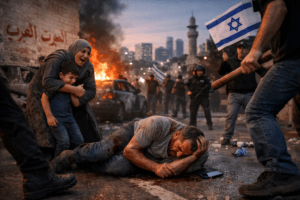
A disturbing wave of racist violence is shattering the long-held, albeit fragile, sense of relative safety for Palestinian citizens within Israel, as attacks by Jewish Israelis escalate from Jerusalem to liberal strongholds like Tel Aviv and Jaffa. This systematic targeting of bus drivers, sanitation workers, and passersby is directly fueled by incendiary rhetoric from far-right government officials and a climate of impunity, where perpetrators are often lightly punished or released.
The ideology and perpetrators are increasingly the same as those operating in the West Bank, signifying a dangerous erosion of the boundary between violence in the occupied territories and within Israel itself. Institutional complicity—from police who sometimes participate in assaults to courts that fail to deliver justice—effectively sanctions this violence, revealing a profound societal shift where the supremacist logic of the occupation is being turned inward, undermining the very foundations of shared citizenship and safety for all Israelis.
From Silent Streets to Shattered Trust: The Rising Tide of Violence Against Palestinians in Israel
For decades, a pervasive narrative inside Israel has drawn a stark line: the “conflict” was over there, beyond the separation barrier, in the occupied territories. Within Israel’s 1967 borders, Palestinian citizens—who make up over 20% of the population—lived a complex reality of institutional discrimination, yet often with an expectation of relative physical safety in their daily interactions, especially in mixed cities like Tel Aviv or Jaffa. That fragile expectation is now shattering. As a wave of racist attacks spreads from Jerusalem to liberal Tel Aviv, Palestinian citizens of Israel are confronting a terrifying new normal, one that mirrors the violence long endemic in the West Bank and signals a profound and dangerous shift in the fabric of Israeli society.
The story of Mahmoud Agbaria is a stark microcosm. A construction worker from Umm al-Fahm, he traveled to Tel Aviv, a city often heralded as a cosmopolitan bubble. His crime? Speaking Arabic on his phone. The perpetrators, two men claiming to be police officers, beat him until they thought he was dead. His father’s anguish is layered with a chilling realization about geography and safety: “He came to work, not to die.” This attack, and the subsequent release of the suspects to house arrest, sends a corrosive message: that certain bodies in certain spaces are inherently threatening, and that the justice system may look the other way.
A Pattern, Not an Anomaly: The Geography of Hatred
The violence is not random. Since late November, a documented pattern has emerged across Israel’s map:
- Jerusalem: The epicenter, with attacks on bus drivers and municipal workers like Khalil al-Rashak, who was left with broken teeth and ribs.
- Tel Aviv & Jaffa: The assault on Mahmoud Agbaria and the pepper-spray attack on a heavily pregnant Hanan Khamil and her family in Jaffa puncture the myth of the “left-wing haven.”
- Netanya, Afula, Kiryat Ata: Incidents in these cities show the phenomenon is nationwide, not confined to historical flashpoints.
The targets are symbolic: bus drivers, sanitation workers, security guards, construction workers—Palestinians engaged in public service and essential labor, the very people facilitating daily life. The attack on bus drivers has become so severe that their union has moved toward strike action, a desperate measure highlighting the state’s failure to protect them.
The Enablers: From Political Incitement to Institutional Complicity
To view these attacks as mere street brawls is to miss the point entirely. They are the symptom of a disease fostered at the highest levels.
- The Political Climate: Far-right ministers like National Security Minister Itamar Ben Gvir, a convicted supporter of a terrorist organization and a figure long accused of anti-Arab racism, have moved from the fringe to the heart of government. Their rhetoric, which routinely dehumanizes Palestinian citizens as a “fifth column” or potential terrorists, provides ideological fuel. Ben Gvir’s policies of massively arming Jewish civilian militias further create an atmosphere where vigilante violence is tacitly encouraged.
- Police and Judicial Failure: As documented by Adalah, The Legal Center for Arab Minority Rights in Israel, there is a consistent pattern of impunity. From the killing of Mousa Hassouna in Lod in 2021 to the recent assault on MK Ayman Odeh, investigations are slow-walked, indictments are rare, and sentences are lenient. When attackers of Mahmoud Agbaria are released because they “felt threatened,” it institutionalizes a “shoot first” rationale against Palestinian presence. In some cases, like that of security guard Qais Haddad, the police are the alleged perpetrators, violently asserting that “an Arab won’t check me.”
- The West Bank Connection: This is a critical insight. The attackers are often ideologically and, in cases like the “hilltop youth” arrested for the Jaffa attack, literally the same people. The violent supremacist ideology cultivated in illegal West Bank outposts, where Palestinians live under military rule with few rights, is now being imported into Israel proper. The boundary between the occupied territories and sovereign Israel is blurring, not geographically, but in the tactics and mindset of Jewish extremists.
The Human Cost: Beyond Broken Bones
The physical injuries are grave—broken ribs, head trauma, the terror of a pregnant woman fearing for her unborn child. But the deeper damage is to the very idea of shared citizenship.
- Erosion of Trust: When the state’s institutions—meant to protect all citizens—are seen as complicit, the social contract frays. Palestinian citizens are left in a state of vulnerable isolation, unsure who to turn to for protection.
- Economic and Social Withdrawal: Fathers like Zidan Agbaria now fear letting their sons work in Jewish cities. This threatens livelihoods and severs the already limited threads of daily co-existence that occur in workplaces and public spaces.
- The Psychological Toll: The constant calculation of risk—should I speak Arabic here? Is this street safe?—creates a relentless, low-grade trauma. The message is clear: your identity is a threat, and your safety is not guaranteed.
A Mirror to Society
This wave of violence holds up a mirror to Israel, reflecting a society at a dangerous crossroads. The ideology that has governed the occupation for over 56 years—one of inherent Jewish supremacy and Palestinian disposability—is now metastasizing inward. Palestinian citizens of Israel, who have long fought for equality within a Jewish-majority state, now face the raw violence of that state’s most radical elements, often with only passive defense from its institutions.
The conclusion is inescapable: when a government mainstreams racism, when courts fail to punish hate crimes, and when police alternately ignore or participate in violence, you create a permission structure for pogroms. The attacks on the streets of Tel Aviv and Jerusalem are not isolated lapses in law enforcement; they are the direct and predictable outcome of a political project that has systematically devalued Palestinian life, whether in Gaza, the West Bank, or Umm al-Fahm.
The real insight is that the “conflict” can no longer be neatly partitioned. The violence has breached the wall. The struggle for Palestinian rights and safety was always one struggle, from the Jordan River to the Mediterranean Sea. The only thing changing now is that more of the world, and more citizens of Israel itself, can no longer look away from what that reality entails when it violently manifests on the streets of its so-called liberal heartlands. The silence of the streets, now broken by the sounds of beatings and racist slurs, tells a story of a nation unraveling from within.
You must be logged in to post a comment.