
From Seafloor to Symposium: How the Western Indian Ocean is Leading the Global Charge on Seagrass Conservation
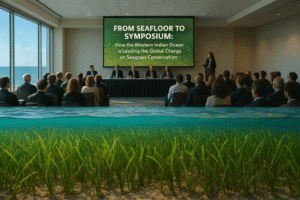
From Seafloor to Symposium: How the Western Indian Ocean is Leading the Global Charge on Seagrass Conservation
Beneath the sun-dappled, turquoise waters of the Western Indian Ocean lies a hidden world of profound importance. It is not the vibrant coral reefs that often steal the spotlight, but vast, swaying meadows of seagrass—unassuming flowering plants that form the bedrock of coastal life. These underwater prairies are emerging as a critical frontier in the fight against climate change and biodiversity loss. And in a remarkable display of regional cooperation, scientists, policymakers, and community leaders from across the Western Indian Ocean are uniting to ensure these vital ecosystems are finally given the protection they deserve.
The upcoming 13th Western Indian Ocean Marine Science Association (WIOMSA) Scientific Symposium in Mombasa, Kenya, serves as a powerful testament to this momentum. Under the theme “One Ocean, One Future,” the event is more than a conference; it is the operational hub for a regional conservation strategy that is setting a global example. At the heart of this strategy is a simple yet revolutionary idea: you cannot protect what you do not understand, and you cannot manage what you have not mapped.
The Unsung Hero of the Ocean: Why Seagrass Matters
To the casual observer, a seagrass meadow might look like a simple patch of underwater grass. But this perception belies a ecosystem of staggering complexity and value. Seagrasses are the triple-threat warriors of the marine world:
- Biodiversity Hotspots: They provide essential nursery grounds, shelter, and feeding areas for a myriad of species, including commercially valuable fish, endangered sea turtles, and the enigmatic dugong. The health of these meadows is directly linked to the health of fisheries that sustain millions of people along the coastlines of Kenya, Tanzania, Mozambique, Madagascar, and the Seychelles.
- Coastal Guardians: The dense root systems of seagrasses bind the seabed, significantly reducing coastal erosion. They act as a natural buffer, dissipating the energy of storm surges and waves, thereby protecting vulnerable shorelines and the communities that live there from the increasing ferocity of storms fueled by climate change.
- Climate Change Powerhouses: Perhaps their most critical, and until recently, most overlooked role, is in climate mitigation. Seagrass meadows are phenomenal carbon sinks, sequestering carbon dioxide from the atmosphere at a rate up to 35 times faster than tropical rainforests. They store this “blue carbon” in their leaves, roots, and, most importantly, in the sediments trapped by their dense matted roots, where it can remain for millennia.
Despite these immense benefits, seagrass ecosystems have historically been neglected in conservation planning, often falling victim to dredging, pollution from coastal development, and sedimentation. The first step to reversing this trend is to illuminate these hidden landscapes with precise, actionable data.
The Mapping Revolution: Turning Data into Protection
A major hurdle to seagrass conservation has been the lack of accurate, field-validated maps. Knowing that seagrass exists is not enough; conservationists need to know its exact extent, density, and species composition to assess its health and carbon storage potential.
This gap is being filled by ambitious collaborative projects like the Large-Scale Seagrass Mapping and Management Initiative (LaSMMI), a partnership between The Pew Charitable Trusts, WIOMSA, the University of Southampton, and regional research institutions. LaSMMI represents a quantum leap from anecdotal knowledge to data-driven management.
The process is both high-tech and hands-on. Researchers use advanced cloud computing platforms to analyze high-resolution satellite imagery, identifying potential seagrass areas across vast stretches of coastline. But the true innovation lies in the ground-truthing—or rather, “sea-truthing.” Teams of local scientists and divers are deployed to these sites, collecting sediment cores, identifying species, and verifying the satellite data. This fusion of satellite technology and on-the-ground expertise creates a map that is not just a picture, but a reliable baseline for policy action.
The success story of the Seychelles is a beacon for the region. Through a precursor to LaSMMI, the Seychelles government became the first in the region to develop a comprehensive, field-validated map of its seagrass resources. This scientific effort had an immediate policy impact: the data directly informed the country’s landmark commitment to protect 100% of its seagrass meadows by 2030. This move integrates seagrass conservation squarely into the nation’s climate strategy under the Paris Agreement.
“One Ocean, One Future”: The Power of a Regional Approach
The WIOMSA symposium’s theme is not just a slogan; it’s a scientific and practical necessity. Ocean currents pay no heed to national borders. Fish stocks migrate across exclusive economic zones, and coral larvae from Mozambique can replenish reefs in Tanzania. Similarly, the benefits of a protected seagrass meadow in Kenya—through carbon sequestration or fish production—are felt across the wider marine region.
The Mombasa gathering is crucial because it accelerates the “science-to-policy” pipeline. It’s where a researcher from Madagascar can share a breakthrough in carbon sediment analysis with a policymaker from Zanzibar. It’s where the lessons learned from the Seychelles’ mapping success can be directly transferred to teams working in Mozambique and Tanzania.
This regional collaboration, exemplified by LaSMMI’s expansion beyond Seychelles, allows for efficiencies and consistencies that individual country projects might lack. By developing shared methodologies and standards, the data generated across different nations becomes comparable, paving the way for the first-ever comprehensive regional seagrass map. This would be a game-changer, enabling transnational conservation planning and providing a powerful tool for advocating for international climate finance.
Beyond the Map: The Human Dimension
The ultimate goal of this scientific endeavor is to strengthen the resilience of the people who depend on the ocean. For the coastal communities of the Western Indian Ocean, a healthy seagrass meadow means more fish in their nets, a safer coastline for their homes, and a more stable climate for their future.
The real genius of this regional approach is its focus on seagrass as a nature-based solution. Instead of relying solely on expensive, grey infrastructure like sea walls, countries are recognizing the power of their natural assets. Protecting and restoring seagrass is a cost-effective strategy that simultaneously addresses climate change (mitigation and adaptation), biodiversity loss, and food security.
The path forward is not without challenges. Continuous monitoring is needed to track seagrass loss and growth. Effective management plans must be enforced to curb damaging activities. And perhaps most importantly, local communities must be engaged as partners and stewards, ensuring that conservation efforts are equitable and sustainable.
The work being showcased in Mombasa is a powerful antidote to the often-gloomy narrative of environmental decline. It is a story of proactive, collaborative, and intelligent conservation. By shining a light on the hidden seagrass meadows of the Western Indian Ocean, scientists and policymakers are not just charting underwater flora; they are mapping a brighter, more resilient future for an entire region. Their success offers a replicable blueprint for the world, proving that when we connect people, policy, and science, we can indeed secure a thriving future for our one ocean.
You must be logged in to post a comment.